
Description
Key Technical Specifications
| Parameter | Specification |
|---|---|
| Product Type | Redundant ModuleBus Termination Unit |
| Model | GRBTU |
| Material Code | 3BSE013175R1 |
| Manufacturer | ABB |
| System Platform | S800 I/O / AC 800M |
| Design | Passive (no power feed, no configuration) |
| Bus Channels Terminated | Redundant A/B channels |
| Mounting | DIN rail |
| Approx. Dimensions | 40 mm × 160 mm × 100 mm (W×H×D) |
| Operating Temperature | 0°C to +60°C |
| Installation | End-of-line on ModuleBus segment |
| Application Industries | Petrochemical, power, water/wastewater, process automation |
Product Introduction
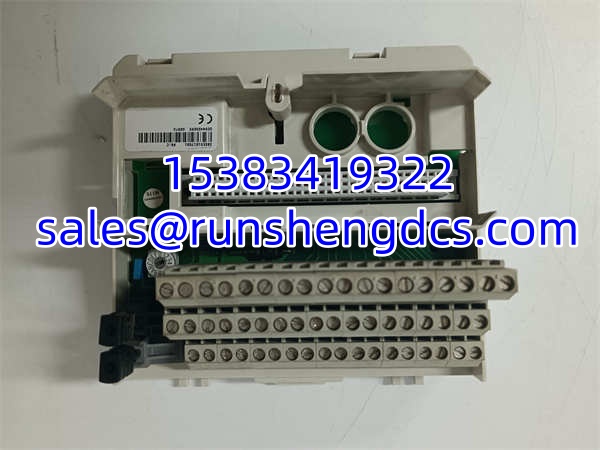
Bus reflections kill communication. On a redundant ModuleBus running S800 I/O, an unterminated or improperly terminated segment end creates signal reflections that show up as intermittent bus errors — the kind of fault that makes maintenance teams chase ghosts for days. The GRBTU (3BSE013175R1) exists to prevent exactly that. It’s a passive termination unit that sits at the physical end of a redundant ModuleBus segment, matching the bus impedance and absorbing signal energy that would otherwise bounce back and corrupt data.
Because it’s passive — no power supply, no firmware, no DIP switches — the GRBTU has virtually zero failure modes of its own. You install it, verify the bus error count drops to zero, and forget about it. That simplicity is the point. In high-availability systems where hot-standby controllers and redundant I/O are standard practice, bus integrity is non-negotiable. The GRBTU is a small, inexpensive component that quietly protects uptime on systems where a bus fault could cascade into a process upset.
QA/QC Transparency SOP
- Intake & Origin Verification: Confirm the module label reads GRBTU with material code 3BSE013175R1. Inspect the DIN-rail clip for damage. Check the bus connector contacts for bent pins, corrosion, or oxidation. Since this is a passive device, there are no ICs to inspect for burn marks — focus on connector integrity and PCB trace condition.
- Visual & Mechanical Inspection: Verify the PCB shows no signs of thermal damage, cracked solder joints, or delamination. Confirm the DIN-rail mounting mechanism engages properly and holds the unit securely.
- Impedance/Continuity Verification: Using a multimeter, verify continuity across the termination resistors (or resistor network) on both the A-channel and B-channel bus lines. Measure resistance values and compare against the expected termination impedance specified in the S800 I/O hardware manual. An open circuit on either channel means the unit is defective.
- Live Bus Integration Test: Install the GRBTU at the end of a redundant ModuleBus segment in a test rack with an AC 800M controller and S800 I/O modules. Power up the system and monitor bus diagnostics. Confirm zero bus errors over a sustained test window (minimum 30 minutes). Verify that removing the GRBTU causes the expected bus fault — this confirms the termination is actually doing its job.
- Final QC & Packaging: No configuration data to clear (passive device). Pack with foam cushioning to protect the bus connector pins. Ship in a rigid carton. Anti-static bag recommended as a precaution, though the passive design is less ESD-sensitive than active modules.
Field Engineer Gotchas
- Missing Terminator = Intermittent Bus Errors: The most common mistake is forgetting to install the GRBTU at the physical end of a ModuleBus segment, or installing it in the middle instead of the end. The bus may work fine most of the time, then throw sporadic communication errors under load or temperature changes. Bottom line — if you’ve got unexplained bus errors, check your termination first.
- Redundant Means Both Channels: The GRBTU terminates both the A and B channels of a redundant ModuleBus. If you only terminate one channel and leave the other floating, you’ll get asymmetric bus behavior — one channel runs clean, the other throws errors. Verify both channels are terminated.
- Don’t Confuse with Active Modules: The GRBTU is passive. It has no address, no LEDs, no configuration. If a technician is looking for status indicators on this unit, they’re looking at the wrong component. The bus status lives on the AC 800M controller diagnostics, not on the terminator.
- Wrong Part Number Trap: ABB’s S800 I/O family has multiple termination and adapter modules with similar naming conventions. The GRBTU is specifically for redundant ModuleBus segments. A non-redundant bus may require a different termination unit. Match the part number to your exact bus topology.
- Mechanical Vibration in Harsh Environments: In high-vibration areas (compressor rooms, turbine halls), a DIN-rail mounted terminator can work loose over time. Use a retaining clip or screw-down DIN rail adapter if the installation environment is subject to mechanical shock. A loose terminator is functionally the same as a missing one.
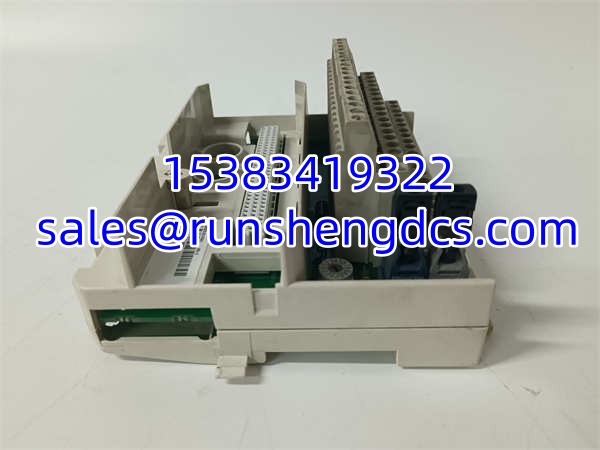
ABB GRBTU 3BSE013175R1
Application Scenarios
- Redundant I/O in a Petrochemical Reactor: A reactor control loop uses redundant I/O modules for critical temperature and pressure measurements. The GRBTU terminates the redundant ModuleBus at the last I/O node, ensuring clean signal integrity across both A and B channels.
- Power Plant Turbine Protection System: A turbine protection system requires high-availability I/O with hot-standby controllers. The GRBTU is installed at the end of each redundant ModuleBus segment to prevent bus reflections that could delay or corrupt protection signals.
- Municipal Water Treatment Expansion: A water treatment plant adds a new remote I/O cabinet to its existing AC 800M system. The GRBTU is installed at the end of the new ModuleBus segment to properly terminate the bus and prevent communication errors during the expansion.
Field Case (anonymized): A pulp mill’s AC 800M system started logging intermittent ModuleBus errors on a redundant I/O segment. The errors appeared randomly — sometimes once an hour, sometimes not for a full shift. The maintenance team replaced two I/O modules and reseated all connectors. Nothing helped. A third investigation found that during a recent cabinet reorganization, someone had moved the GRBTU from the physical end of the bus to a middle position, leaving the actual end unterminated. Moving the terminator back to the correct position eliminated the errors immediately. Lesson: bus topology matters, and “close enough” isn’t close enough.
FAQ
Q: Does the GRBTU require a power supply?
A: No. It’s a passive termination unit. No power connection, no configuration, no firmware. It terminates the bus using onboard resistors matched to the ModuleBus impedance.
Q: How do I know if I need the GRBTU or a different termination unit?
A: The GRBTU is designed for redundant ModuleBus segments in I/O / AC 800M systems. If your bus is non-redundant, you may need a different terminator. Check the I/O hardware manual for the correct termination unit for your specific bus configuration.
Q: Can I install the GRBTU anywhere on the bus, or does it have to be at the end?
A: It must be at the physical end of the ModuleBus segment. Installing it anywhere else leaves the actual end unterminated, which causes signal reflections and intermittent bus errors. The terminator goes where the bus stops.
Q: Is the GRBTU the same as a Profibus DP slave adapter?
A: No. Some distributor listings incorrectly describe the GRBTU as a Profibus DP slave adapter. The GRBTU is a passive bus terminator — it does not have a Profibus address, does not process data, and does not communicate with a Profibus master. Verify the product description against the ABB hardware manual.
Q: What happens if the GRBTU fails?
A: Since it’s a passive resistor network, failure modes are limited to an open circuit (broken resistor or cracked solder joint). If the terminator fails open, the bus will see reflections and start logging communication errors. A multimeter continuity check on the termination resistors will confirm the failure.
Q: Can I hot-swap the GRBTU on a live bus?
A: Technically, removing a terminator from a live redundant bus will cause immediate bus errors on that segment. If your system is running in hot-standby with redundant controllers, the standby controller may maintain process control during the swap. However, plan the replacement during a maintenance window if possible. Verify hot-swap behavior with your system integrator before attempting a live swap.
Q: What’s the operating temperature range?
A: 0°C to +60°C. If your cabinet runs hotter than 60°C, you need to address the thermal environment before relying on this component for bus integrity.