
Description
Key Technical Specifications
| Parameter | Specification |
|---|---|
| Model Number | DSBB110A |
| Order Code | 57330001-Y |
| Brand | ABB |
| Product Type | Shield Board (EMC Shielding / Grounding Plate) |
| Function | Electromagnetic shielding and grounding within control rack |
| Configuration | Passive — no firmware, no software setup required |
| Mounting | Rack plug-in form factor (fits ABB control/I/O frames) |
| Product Net Weight | Approx. 0.28 kg |
| Origin | Sweden / Switzerland (varies by production batch) |
| Reference Price | ~CNY 1,123 – 6,990 (surplus channel; varies significantly by supplier) |
Product Introduction
A control rack full of mixed-signal I/O cards sits next to VFD cables carrying high-frequency switching noise. The analog input channels start drifting. The operator blames the sensors. The instrumentation tech blames the PLC. Nobody suspects the missing shield plate.
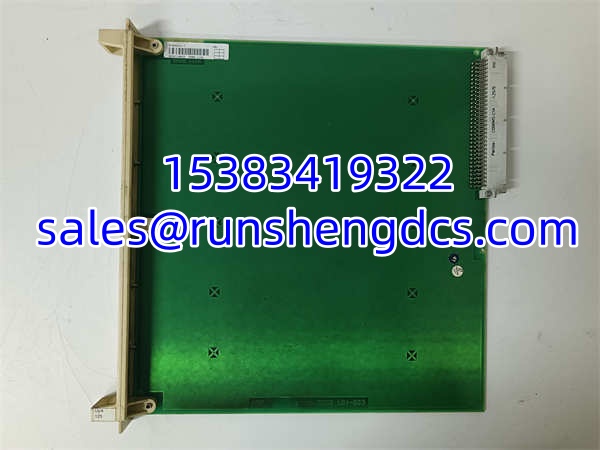
The DSBB110A is exactly that — a shield plate. It mounts inside ABB control racks to establish a stable ground reference and block electromagnetic interference from coupling between adjacent modules through the backplane. It is a passive component: no firmware to flash, no parameters to configure, no communication protocol to negotiate. You install it, verify the bonding connection, and it does its job silently.
In practice, this board shows up in I/O frames and controller racks where sensitive analog or mixed-signal modules share a backplane with digital or power-handling cards. When a plant experiences intermittent analog drift, crosstalk between channels, or unexplained noise spikes on measurement signals, a missing or degraded shield board is often part of the root cause chain.
QA/QC Transparency SOP
- Intake & Origin Verification
Photograph the board markings. Capture the DSBB110A designation, the 57330001-Y order code, and any ABB manufacturing labels or date codes. Cross-reference against the target rack frame’s bill of materials to confirm this shield board is the correct part for the slot position. - Visual & Mechanical Inspection
Inspect the PCB for bent edges, cracked traces, corrosion, or signs of physical impact. Check all mounting holes and guide rails for damage. Verify the board slides into the target rack slot without forcing or binding. Look for any signs of overheating or discoloration on the board surface. - Grounding Continuity Test
Using a multimeter, measure resistance between the board’s grounding contact points and the rack’s ground bus. The reading should show a low-resistance path (typically <1Ω). A high or open reading indicates a broken ground bond — the board is functionally useless without it. - Mechanical Fit Verification
Install the board in the target rack slot. Confirm it seats fully and makes proper contact with adjacent modules and the backplane ground plane. A shield board that does not make full contact provides incomplete shielding. - Final QC & Packaging
Label with QC pass status and test date. Pack in anti-static shielding bag with edge protection. Include a note that the board must be verified for ground continuity after installation in the live rack.
Field Engineer Gotchas
- It Is Not a Controller or Communication Module
Some surplus listings describe the DSBB110A as a “bus interface module,” “processor module,” or “control module.” These descriptions are incorrect. The DSBB110A is a passive shield board. It has no processing capability, no communication ports, and no configurable parameters. If your application requires a communication interface or control processor, this is not the part you need. - Ground Bond Is the Entire Point
The shield board’s only job is to provide a low-impedance ground path across the rack. If the grounding contact is corroded, bent, or not fully seated, the board provides zero shielding benefit. During installation, always verify ground continuity with a meter — do not assume the board is working just because it is physically installed. - Rack Frame Compatibility
The DSBB110A is designed for specific ABB control rack frames. It will not fit arbitrary third-party enclosures or non-ABB racks. Confirm the target rack model before ordering. A board that does not seat properly cannot provide shielding. - Missing Shield Boards Cause Subtle Symptoms
A missing or failed shield board rarely causes a hard fault or alarm. Instead, it produces intermittent, hard-to-diagnose symptoms: analog drift that comes and goes, noise spikes that appear only under certain load conditions, crosstalk between I/O channels. If you are chasing a ghost noise problem in a mixed-signal rack, check whether the shield boards are present and properly grounded. - Do Not Substitute with Generic Metal Plates
The shield board’s grounding contact geometry is designed to mate with the specific backplane and module arrangement of the ABB rack. A generic metal plate cut to size will not provide the correct ground path and may actually create ground loops or short circuits.
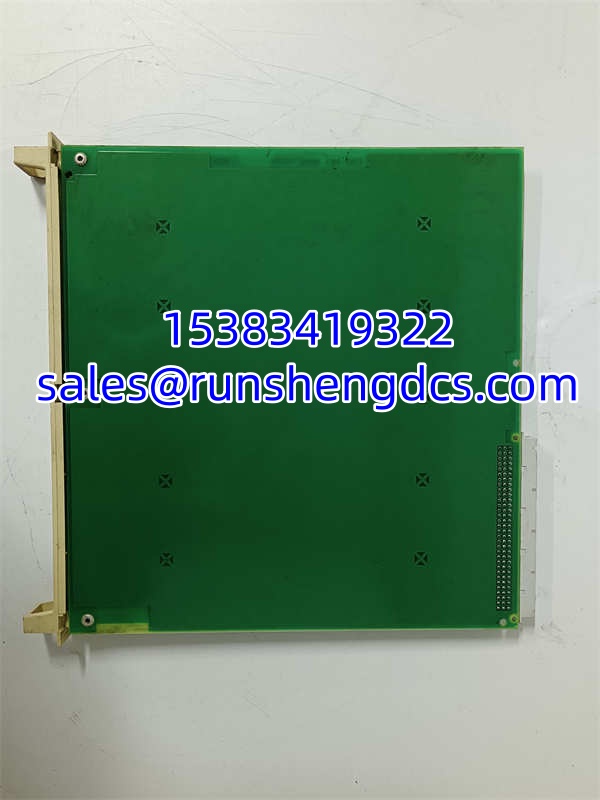
ABB DSBB110A 57330001-Y
Application Scenarios
- Analog I/O racks in process control — Shield boards protect low-level analog input modules (4–20 mA, thermocouple, RTD) from EMI generated by adjacent digital output modules or nearby VFD power cables.
- Mixed-signal controller frames — In racks where high-speed digital communication modules share a backplane with sensitive analog measurement cards, the shield board reduces crosstalk and maintains signal integrity.
- Brownfield rack expansions — When adding new modules to an existing ABB rack, the original shield board configuration may need to be updated. A missing shield board in a newly populated slot can introduce noise into previously stable channels.
- EMC compliance troubleshooting — During EMC/EMI audits, inspectors check that all shield plates are installed and grounded. A missing can cause a rack to fail conducted or radiated emissions testing.
FAQ
No. It is a completely passive shield board. There is no firmware, no software, no DIP switches, and no configuration of any kind. Install it, verify ground continuity, and it works.
What happens if I run a rack without the shield board?
The rack will still power up and operate. However, without proper shielding, the rack becomes more susceptible to electromagnetic interference. In environments with VFDs, large contactors, or radio-frequency sources nearby, this can manifest as analog drift, communication errors, or intermittent I/O faults.
Can I use a generic metal plate as a replacement?
No. The has specific grounding contact geometry designed to interface with the ABB rack backplane. A generic plate will not provide the correct ground path and may create ground loops or short circuits.
How do I know if the shield board is faulty?
A shield board rarely “fails” in a dramatic way. The most common failure mode is a broken or corroded ground contact. Measure resistance between the board’s grounding points and the rack ground bus. If the reading is high or open, the board is not functioning. Visually inspect the contact edges for corrosion or damage.
Is this part still available from ABB?
Verify directly with ABB. The has been deployed across a large installed base. Some rack components may have been superseded by newer variants. Confirm current availability and any recommended replacement before specifying it for a new installation.
What is the typical lead time for surplus units?
Surplus availability varies. Some suppliers list stock with delivery in approximately 4 days. Confirm stock status with the supplier before committing to a project timeline.