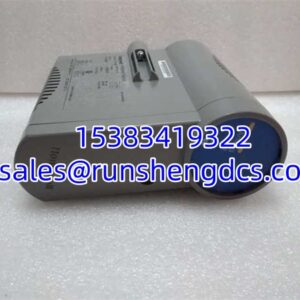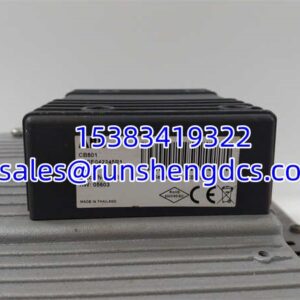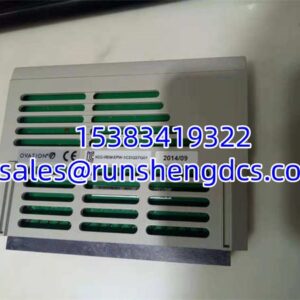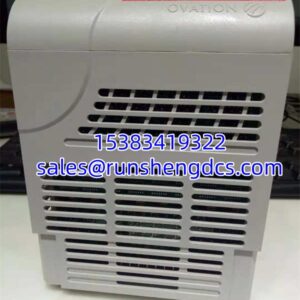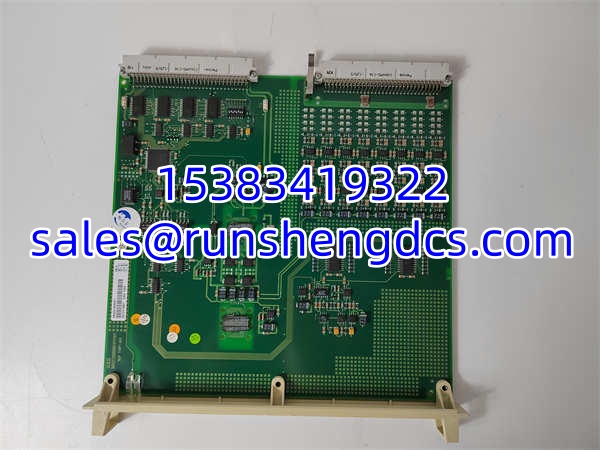

Description
Key Technical Specifications
| Parameter Name | Parameter Value |
|---|---|
| Product Model | DSAI133A 3BSE018290R1 |
| Manufacturer | ABB |
| Product Series | Advant OCS / S800 I/O |
| Channel Count | 32 Independent Analog Inputs |
| Resolution | 16-Bit ADC |
| Signal Types | Voltage, Current, RTD, Thermocouple |
| Channel Isolation | Group/Channel Isolated (Verify Rev) |
| Update Time | < 100ms (all 32 channels) |
| Operating Temp | 0°C to +60°C |
| Dimensions | 225mm x 324mm x 22.5mm |
| Weight | 0.29 kg |
| Calibration | Internal Self-Calibration |
Product Introduction
Drifting analog inputs are the silent killers of process quality. You won’t see them in the alarm log, but your yield drops 2% over a month. The ABB DSAI133A 3BSE018290R1 fights this with 16-bit resolution and internal self-calibration that runs on startup and periodically during operation. It’s not just reading signals; it’s actively compensating for thermal drift in the backplane.
Engineers trust this module because it holds ±0.05% accuracy over a 6-month calibration interval in chemical reactors where a 0.1% shift means a ruined batch. Just know this: 32 channels on one board means you lose 32 points if it fails. Always pair it with a hot-standby adapter or critical redundancy if the process can’t tolerate a blind spot. Bottom line: it’s a workhorse, but treat it like one.
QA/QC Transparency SOP
We don’t trust “tested” stickers from surplus brokers. Every DSAI133A 3BSE018290R1 undergoes a rigorous five-step validation to ensure your control loop doesn’t drift:
- Intake & Origin Verification: We trace the serial number against ABB production batches to filter out high-quality counterfeits. Visual inspection checks for cracked terminal blocks or corrosion on the backplane connector.
- Live Functional Testing: Module is mounted on a live S800 test rack. We inject calibrated 4-20mA and 1-5V signals across all 32 channels, logging deviation against a Fluke 754 calibrator.
- Electrical Parameter Tests: Fluke 115 verifies the 24V DC rail stability and checks for continuity on all backplane pins. No open circuits or voltage drops under load.
- Firmware/Config Verification: We verify the self-cal routine completes without error codes and log the internal EEPROM status to ensure no hidden fault flags exist.
- Final QC & Anti-Static Packaging: Module is sealed in ESD-safe shielding with a printed test report. No bare PCBs in bubble wrap.
Field Engineer Gotchas
- Suffix Mismatch: The
3BSE018290R1suffix is your lifeline. Risk: Swapping a Rev A for a Rev C without checking can cause a 0.2% ADC reference shift. Your control loop will hunt, and you’ll waste a weekend chasing sensor faults. Fix: Always match the full3BSE...number. I’ve seen a tech swap a “R1” for a “R2” and spend 8 hours re-calibrating because the factory default scaling was different. - Dirty 24V Power: The internal ADC reference is sensitive to ripple. Risk: If your 24V supply has >5% ripple, the ADC will jitter, and self-cal will fail. Fix: Measure with an oscilloscope, not just a multimeter. A cheap multimeter won’t catch the spikes. Add a local 470µF capacitor if the run is long.
- Backplane Pin Damage: These modules rely on gold-plated edge connectors. Risk: Forcing the module into a misaligned slot bends the pins, causing intermittent faults that look like software bugs. Fix: Always use the alignment guides. If it requires more than 5 lbs of force, stop. Inspect the backplane for debris.
- ESD Sensitivity: The input protection diodes are fragile. Risk: Touching the terminal screws while ungrounded will kill the input channel instantly. Fix: Wrist strap mandatory. Treat it like a bare CPU, not a light switch.
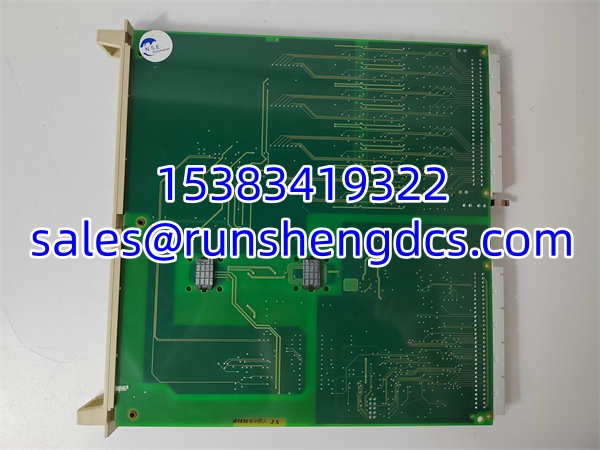
ABB DSAI133A 3BSE018290R1
Application Scenarios
- Chemical Reactor Control: Monitoring temperature and pressure in exothermic reactions where a 0.1% drift can cause a runaway condition or product spoilage.
- Pharmaceutical Batch Processing: Ensuring precise ingredient ratios in high-value batches where regulatory compliance demands documented calibration traceability.
- Power Plant Boiler Feed: Tracking steam temperature gradients across multiple points to prevent thermal shock in turbine casings.
FAQ
Can I mix RTD and 4-20mA on the same board?
Yes, but only if the DIP switches are configured for mixed mode. Most DSAI133A boards are set for all voltage or all current. Check the hardware manual for your specific revision. Mixing without proper jumper settings will give you garbage readings.
Why is my self-calibration failing?
90% of the time, it’s dirty 24VDC. Measure the ripple with an oscilloscope. If it’s >100mV peak-to-peak, add a filter. The other 10% is a failed ADC reference IC—time to replace the board.
Is this module hot-swappable?
The S800 bus supports it, but I don’t recommend it for 32-channel AI boards. The inrush current can dip the backplane voltage, causing neighboring modules to reboot. Shut down the bus. It’s safer and takes 60 seconds.
What’s the max cable length for 4-20mA?
1000 meters at 24 AWG, but only if your loop resistance is under 600Ω. Calculate your total loop resistance (cable + barrier + transmitter). If you’re over 500Ω, drop to 18 AWG or add a repeater.
Can I use this for high-speed sampling?
No. This is a process AI, not a vibration monitor. Update time is ~100ms for all 32 channels. If you need <10ms response, look at the DSAI134A or a dedicated vibration module.
Do I need to recalibrate after 2 years?
The internal self-cal handles drift, but OEM recommends a full external calibration every 24 months for safety-critical loops. In non-critical apps, I’ve stretched it to 36 months with zero issues. Document your decision.
Is the 3BSE018290R1 the same as 3BSE018290R2?
Mechanically, yes. Electrically, usually. But firmware compatibility can vary. Always verify the exact suffix on your failed unit. We test for cross-revision compatibility, but your specific application might have unique constraints.