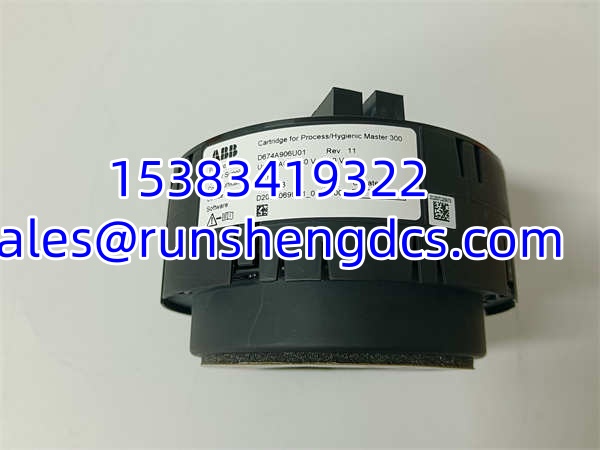

Description
Key Technical Specifications
| Parameter | Value / Notes |
|---|---|
| Product Type | Insert Electronics Module (Flow Transmitter) |
| Part Number | D674A906U01 |
| Supply Voltage | 230VAC |
| Communication | HART |
| Output Signal | 4–20 mA (analog, proportional to flow) |
| Replaces | D674A881U01, D674A900U01 |
| Installation | Insert / plug-in module for ABB EMF flowmeter housings |
| SIL Capability | Evaluated per IEC 61508-2 (Route 2S / 2H) — achievable SIL depends on full safety loop |
| Revision Levels Seen | Rev.10, Rev.11 (verify against your existing unit) |
| Application Fluids | Water, wastewater, chemical process liquids, food/beverage, oil & gas liquids |
Product Introduction
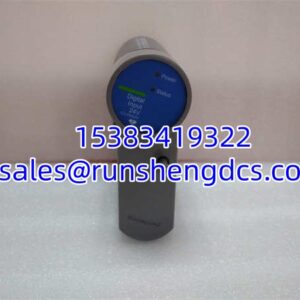
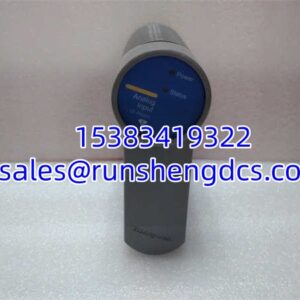
You pull a flow transmitter off the shelf and the first thing you check is the supply voltage. Get that wrong and you fry the module before it ever sees a sensor signal. The D674A906U01 is the 230VAC variant in ABB’s EMF insert module lineup — it plugs directly into the electronics housing of an ABB electromagnetic flowmeter, takes the raw electrode signal from the flow tube, and pushes out a 4–20 mA HART signal that your DCS or PLC can read.
This module replaces the older D674A881U01 and D674A900U01 units, so if your plant has legacy ABB EMF flowmeters running those part numbers, the D674A906U01 is the current-generation swap. It carries HART communication for remote configuration and diagnostics, and it participates in SIL-rated safety loops when paired with the correct logic solver and final elements per IEC 61508. The insert-module form factor means you can swap the electronics without pulling the flow tube from the pipe — assuming the housing and sensor are still serviceable.
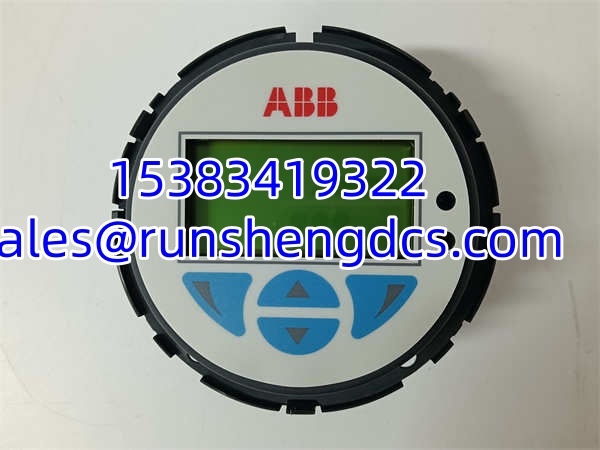
ABB D674A906U01
A/QC Transparency SOP
For surplus D674A906U01 modules, a credible test sequence looks like this:
- Intake & Origin Verification — Confirm the label reads D674A906U01 with the correct revision stamp (Rev.10 or Rev.11). Check for ABB markings, date codes, and any prior configuration labels. Inspect the PCB for corrosion, burnt traces, or damaged connector pins.
- Visual & Mechanical Inspection — Verify the module slides cleanly into a compatible ABB EMF electronics housing without binding. Check that the HART communication terminals and 4–20 mA output terminals are intact with no bent or corroded contacts.
- Live Functional Testing — Apply 230VAC supply. Confirm the module powers up without fault indication. Using a HART communicator (e.g., Emerson 475 or AMS Trex), verify the module responds to HART polls and returns valid device status, tag, and range information.
- Electrical Parameter Tests — Measure the 4–20 mA output at multiple simulated flow points (0%, 50%, 100%) using a calibrated process meter (Fluke 789 or equivalent). Confirm linearity within the module’s specified accuracy. Perform insulation resistance testing (megger) on supply terminals per IEC 61010 practices.
- Final QC & Anti-Static Packaging — Reset any site-specific HART configuration (tag, range, damping) to factory defaults. Package in ESD-safe bag with foam protection. Include a test report documenting power-up status, HART communication pass/fail, and output linearity readings.
Field Engineer Gotchas
Gotcha #1: 230VAC vs. 24VDC — the wrong voltage kills modules instantly.
The D674A906U01 is the 230VAC version. The 24VDC variant is D674A905U01. If someone grabs the wrong part number off the shelf and feeds 230VAC into a 24VDC module, it’s done. Always verify the supply voltage printed on the module label before energizing. I’ve seen this mistake cost a plant a weekend of downtime.
Gotcha #2: Revision mismatch causing HART communication failures.
Rev.10 and Rev.11 units may have different HART command sets or firmware behaviors. A newer HART communicator might not fully recognize an older revision, or vice versa. Before deploying a surplus unit, connect with your HART tool and confirm it reads the device ID, software version, and configuration parameters without errors.
Gotcha #3: Assuming the module swap fixes a bad flow reading.
If your flow measurement is drifting or reading zero, the insert module is only one possible culprit. The flow tube electrodes could be coated, the liner could be degraded, or the grounding rings could be corroded. Swapping the electronics module on a fouled flow tube will give you a perfectly calibrated transmitter reading garbage. Check the sensor side first.
Gotcha #4: SIL loop assumptions.
The module is rated for use in SIL safety loops, but the achievable SIL level depends on the entire loop — logic solver, final element, proof test intervals, and diagnostic coverage. Dropping a into a SIL 2 loop without recalculating the PFDavg for the full system is a compliance gap. Run the numbers before signing off.
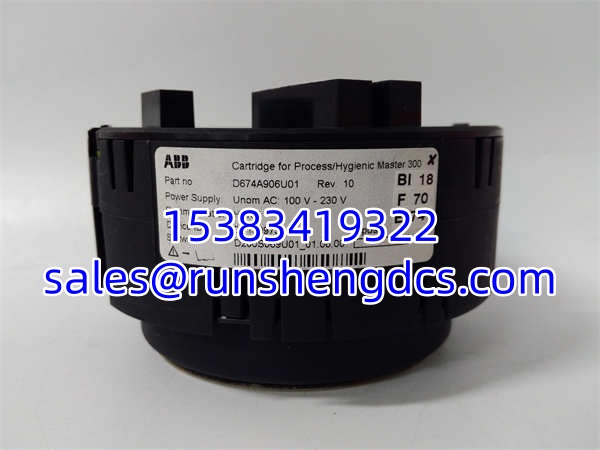
ABB D674A906U01
Application Scenarios
- Water treatment plant intake monitoring — Measuring raw water flow into clarifiers where 4–20 mA HART output feeds the plant SCADA system for dosing control and mass balance calculations.
- Chemical process transfer lines — Monitoring corrosive liquid transfer between storage tanks and reactor vessels, where HART diagnostics alert operators to electrode fouling or liner degradation before measurement drift becomes a process issue.
- Cooling water circulation loops — Tracking flow through heat exchangers in power generation or manufacturing facilities, feeding data to energy management systems for efficiency calculations.
Case Study (Anonymized): A chemical processing facility had an ABB EMF flowmeter on a caustic transfer line that started reading intermittently high. The operations team swapped the insert module with a surplus (Rev.10). The new module powered up and communicated via HART, but the flow reading was still erratic. Root cause turned out to be electrode coating from caustic buildup — the flow tube needed cleaning and the grounding connections needed replacement. The module itself was fine. Lesson: always isolate whether the fault lives in the electronics or the sensor before ordering replacement parts.
FAQ
Supply voltage. The runs on 230VAC. The D674A905U01 runs on 24VDC. They are not interchangeable — wrong voltage will destroy the module.
What older part numbers does this module replace?
D674A881U01 and D674A900U01. If your existing installation uses either of those, the is the designated replacement.
Does this module work with any electromagnetic flow tube?
No. It is designed for ABB EMF flowmeter housings. The physical form factor, connector layout, and signal conditioning are specific to ABB’s flow tube platform. Verify mechanical and electrical compatibility with your specific flow tube model before ordering.
Can I configure this module without removing it from the housing?
Yes, if you have HART access. A HART communicator or HART-enabled DCS/SCADA interface can read and write configuration parameters (tag, range, damping, alarm settings) through the 4–20 mA loop without pulling the module.
Is this module still in active production?
The circulates primarily through surplus and aftermarket channels as of the available data. Contact ABB directly with the full part number to confirm current production status and any recommended successor part numbers.
What HART communicator is compatible?
Standard HART communicators (Emerson 475, AMS Trex, or equivalent) should work. Verify that your communicator’s HART revision supports the module’s firmware revision — older communicators may not fully parse newer device profiles.
Does the revision number matter for replacement?
It can. Different revisions may carry different firmware, HART command support, or calibration behaviors. Match the revision to your existing system configuration when possible, or verify compatibility with your HART tool and DCS before deploying a different revision.