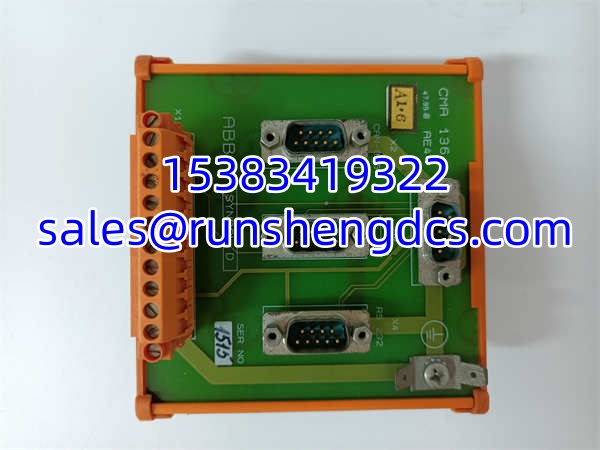

Description
Key Technical Specifications
- Product Model: CMA136
- Order Code: 3DDE300416
- Manufacturer: ABB
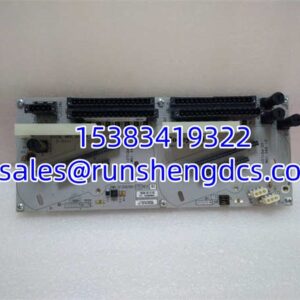
- Product Type: Generator Relay Terminal Board
- Channel Count: 32 Inputs
- Design: Passive (No internal power/firmware)
- Connection: Robust Screw-Terminals
- Application: Generator Trip/Close, Interlocks
- Compatibility: Symphony, Advant, 800xA
- Footprint: Standard Control Panel Layout
Product Introduction
Generator protection panels are unforgiving environments where a single wiring error can cause a nuisance trip or, worse, a missed fault. The ABB CMA136 (3DDE300416) solves this by providing a dedicated, clearly labeled termination point for generator control circuits. Unlike active I/O cards, this is a passive interface board designed specifically for trip/close commands, interlocks, and status contacts. It acts as the physical bridge between the field wiring and the protection IEDs.
Sourcing the CMA136 is typically a retrofit or repair necessity for thermal, gas, and hydro plants running legacy ABB DCS architectures. Because it is a passive board with no firmware or active components, failure rates are extremely low, but physical terminal damage or corrosion can still occur. The CMA136 fits standard control panel layouts, leaving adequate space for adjacent protection relays. Bottom line — it’s the unglamorous, bulletproof wiring interface that keeps the generator protection scheme intact.
QA/QC Transparency SOP
- Intake & Origin Verification: We inspect the CMA136 for physical damage to the screw terminals and verify the 3DDE300416 label, rejecting units with stripped threads or cracked PCB substrates.
- Live Functional Testing: Since it is passive, we perform a full continuity sweep from every front terminal to the corresponding backplane pin to ensure no open circuits or solder joint fractures.
- Electrical Parameter Tests: Technicians verify isolation resistance between adjacent channels and to ground, ensuring no carbon tracking or moisture damage exists on the CMA136.
- Firmware/Config Verification: N/A (Passive Hardware). We verify the physical pinout matches the 3DDE300416 specification sheet exactly.
- Final QC & Anti-Static Packaging: After passing continuity and isolation tests, the is sealed in an ESD-safe bag with terminal covers to prevent dust ingress during shipping.
Field Engineer Gotchas
- Passive vs. Active Confusion: Do not expect LEDs or status indicators on the . It is purely a wiring interface. If you need signal conditioning or diagnostics, you are looking at the wrong board.
- Torque Specifications: The screw terminals on the are robust but can be stripped if over-torqued. Use a calibrated torque screwdriver (typically 0.5-0.7 Nm, verify with OEM manual). Loose screws cause intermittent faults that are a nightmare to troubleshoot.
- Pinout Verification: The has 32 channels. Do not assume the pinout matches other CMA boards. Always cross-reference the 3DDE300416 wiring diagram before energizing. A swapped wire here can energize a trip coil unintentionally.
- Retrofit Compatibility: If replacing an older board, check the backplane connector keying. The is designed for specific Symphony/Advant slots. Forcing it into a different slot can damage the backplane pins.
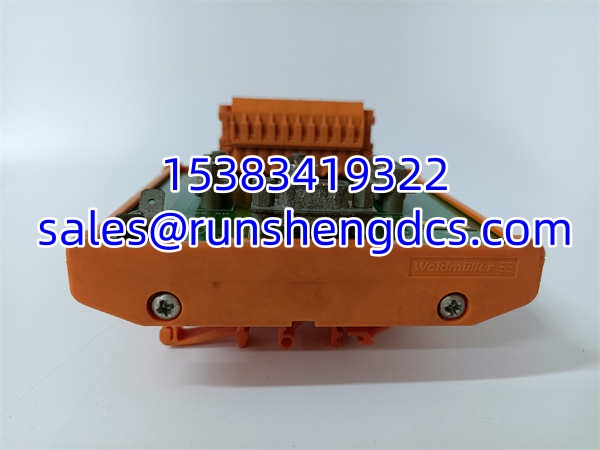
ABB CMA136 3DDE300416
Application Scenarios
- Thermal & Gas Turbine Plants: Interfaces breaker control circuits and protection signals in legacy ABB-based generator protection panels.
- Hydropower Units: Provides clean termination for gate control, excitation system interlocks, and status contacts in hydro generator schemes.
- Industrial Cogeneration: Compact termination in MCC/relay rooms for captive power generators, replacing messy field wiring.
- Case Study: A gas turbine plant experienced intermittent “Generator Trip” alarms during high-vibration startup. Diagnostics revealed a cracked solder joint on channel 14 of the , causing an open circuit that the protection relay interpreted as a fault. Swapping in a verified surplus restored reliable operation, avoiding a costly protection relay replacement.
FAQ
- No. The is a passive board. It does not need a separate power feed, which simplifies design and eliminates a failure point.
- Can I use this for analog signals?
Technically yes, but it is optimized for digital control signals (trip/close, status). For high-precision analog, use dedicated analog I/O modules. The is built for reliability in critical binary circuits. - Is this compatible with 800xA systems?
Yes. The integrates cleanly into ABB-based generator control and protection panels within Symphony, Advant, and 800xA environments. - How do I troubleshoot a suspected bad channel?
Since it is passive, use a multimeter to check continuity from the front terminal to the backplane pin. If continuity is good, the issue is likely in the wiring or the connected IED, not the . - Are replacement terminals available?
Individual terminals are not typically sold separately for the . If terminals are damaged, replace the entire board to ensure mechanical integrity and safety.