
Description
Key Technical Specifications
| Parameter | Value |
|---|---|
| Protocol | Modbus TCP |
| Operating mode | Master and Slave |
| Ethernet ports | 2 × RJ-45 (8-pin) |
| Channel 1 speed | 100 Mbps, full-duplex |
| Channel 2 speed | 10 Mbps, half-duplex |
| Max slaves per master | Up to 70 (CI867 family reference) |
| Max masters | Up to 8 (CI867 family reference) |
| Mounting | CEX-Bus in AC 800M I/O rack |
| Hot swap | Supported |
| Redundancy | Supported |
| Power supply | 24 V DC via CEX-Bus |
| Operating temperature | 0 °C to +55 °C (verify with OEM datasheet) |
| Storage temperature | -40 °C to +70 °C |
| Protection class | IP20 |
| EMC compliance | EN 61000-6-4 / EN 61000-6-2 |
| Safety standards | UL 508, IEC/EN 61131-2 |
| Hazardous area | UL/CSA 60079-15, Class I Zone 2 |
Product Introduction
Modbus TCP looks simple on paper — just Ethernet and a register map. In practice, mismatched timeouts, swapped cable pairs, and unmanaged switches turn it into the most common third-party integration headache on an 800xA site. The CI867 sits between the AC 800M controller and that mess, handling the Modbus TCP framing, timeout management, and register mapping so the controller does not have to.
This module is the standard choice when an AC 800M needs to talk to third-party PLCs, packaged equipment, motor control centers, or analyzers that only speak Modbus TCP. With dual Ethernet ports, it supports redundant network paths, and the hot-swap capability means a failed module can be replaced without pulling the entire rack. Channel 1 runs at 100 Mbps full-duplex while Channel 2 is limited to 10 Mbps half-duplex — a detail that matters when you are designing the network topology.
QA/QC Transparency SOP
- Intake & Origin Verification: Confirm model CI867, order number 3BSE043661R1, revision, and serial number. Inspect both RJ-45 ports for bent pins, corrosion, or physical damage. Check the CEX-Bus edge connector for wear.
- Live Functional Testing: Install the module in an AC 800M test rack with a compatible PM86x CPU. Power up and verify RUN/ERROR LED behavior. Confirm the module is detected on the CEX-Bus and that both Ethernet ports establish link when connected to a test switch.
- Electrical Parameter Tests: Measure 24 V DC supply current via the CEX-Bus and compare against expected values for the CI867 family. Verify continuity on both RJ-45 ports pin-by-pin. Check for shorts between signal and ground planes.
- Firmware/Config Verification: Read module identity and firmware revision through Control Builder M. Confirm compatibility with the installed 800xA system version. Back up the Modbus TCP configuration, including slave device tables and register mappings.
- Final QC & Anti-Static Packaging: Record all test results, photograph the nameplate and ports, and pack in ESD-safe materials with RJ-45 port protectors.
Field Engineer Gotchas
- Channel speed mismatch: Channel 1 is 100 Mbps full-duplex; Channel 2 is 10 Mbps half-duplex. Plugging Channel 2 into a 100 Mbps-only switch port will cause link failures. Label the ports before cabling.
- Modbus timeout tuning: Default timeouts are rarely correct for third-party devices. If a slave responds slowly, the CI867 will flag a communication fault before the device has finished processing. Adjust the per-device timeout and retry parameters in Control Builder M.
- Redundancy wiring errors: Redundant Modbus TCP requires two independent network paths. Running both ports into the same unmanaged switch defeats the redundancy. Use separate switches or a properly configured managed switch with VLAN separation.
- Register map drift: The does not auto-discover Modbus registers. If the third-party vendor changes the register map in a firmware update, communication breaks silently. Lock the register map in your documentation and verify after any device firmware change.
- CEX-Bus slot compatibility: The mounts on the CEX-Bus in an AC 800M I/O rack. It is not a standalone Ethernet switch and cannot be used outside the 800xA hardware architecture.
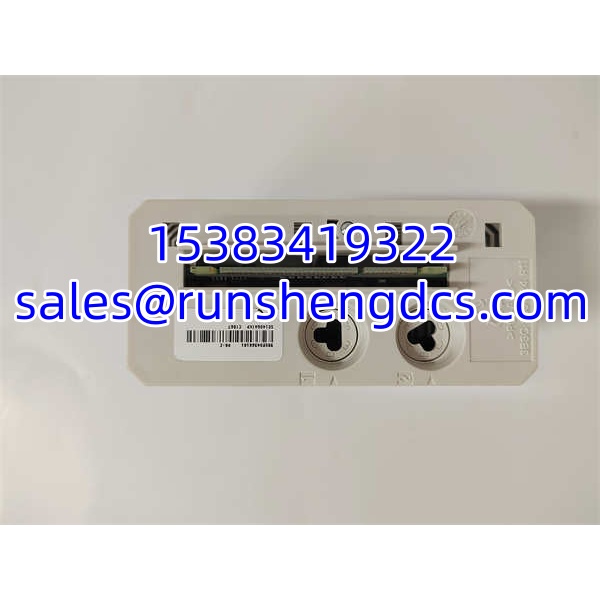
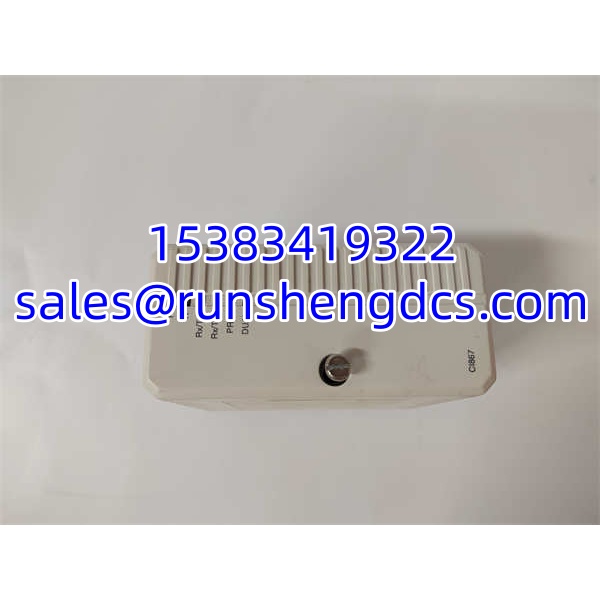
ABB CI867 3BSE043661R1
Application Scenarios
- Packaged boiler integration: Connects a third-party boiler PLC to the AC 800M via Modbus TCP for start/stop commands, fuel flow feedback, and alarm status.
- MCC status monitoring: Reads motor run/stop/trip signals from a Modbus TCP-enabled motor control center without hardwiring each point.
- Analyzer data acquisition: Pulls pH, conductivity, and turbidity values from water treatment analyzers that only support Modbus TCP.
- OEM skid integration: Interfaces with vendor-supplied process skids (filtration, dosing, compression) that expose a Modbus TCP register map.
FAQ
Yes. It supports both master and slave modes, which is useful when the AC 800M needs to poll external devices or expose data to a SCADA system.
What is the difference between 3BSE043660R1 and 3BSE043661R1?
Both are variants. The exact difference — typically a revision or configuration variant — should be confirmed against the ABB hardware manual or your supplier before procurement.
Does it support Modbus RTU over serial?
No. The is Modbus TCP over Ethernet only. For Modbus RTU, you would need a serial communication module such as the CI853 or a gateway device.
Can I use it for redundant Modbus TCP?
Yes. The supports redundancy, and the dual Ethernet ports allow separate network paths. Verify the network design with separate switches for true path redundancy.
What is the maximum number of slave devices?
Up to 70 slave devices per in master mode, based on the family specification. The practical limit depends on poll cycle time, network latency, and slave response times.
Is it hot-swappable?
Yes. The supports hot swap on the CEX-Bus without interrupting controller communication.
What is its lifecycle status?
Many variants are now in ABB’s Classic phase. Confirm the exact lifecycle status for 3BSE043661R1 against the current ABB lifecycle bulletin before planning long-term spares.