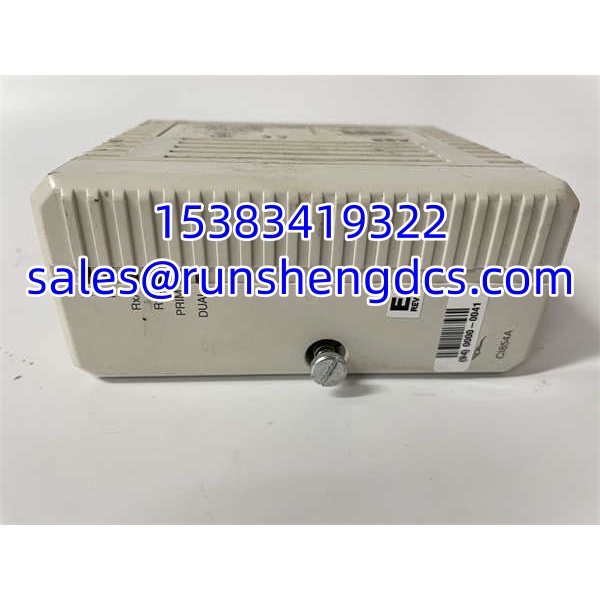

Description
Key Technical Specifications
| Parameter | Specification |
|---|---|
| Protocol | PROFIBUS DP-V1 (cyclic + acyclic) |
| Ports | 2 × DB9 female on TP854 baseplate (PROFIBUS A/B) |
| Baud Rate | 9.6 kbit/s – 12 Mbit/s (auto-negotiated) |
| Max Nodes | Up to 124 with repeaters; 32 per segment |
| Line Redundancy | Yes — internal RLM (Redundant Link Module) |
| Master Redundancy | Yes — requires two CI854A modules |
| CEX-Bus Max Units | 12 |
| Power Supply | 24 V DC via CEX-bus, 190 mA typical (max 240 mA) |
| Power Dissipation | ~4.6 W typical |
| Operating Temperature | +5 °C to +55 °C |
| Storage Temperature | −40 °C to +70 °C |
| Humidity | 5–95%, non-condensing |
| Protection Class | IP20 (EN 60529 / IEC 529) |
| Mounting | DIN-rail via TP854 baseplate |
| Dimensions (W × H × D) | 59 × 185 × 127.5 mm |
| Weight | ~700 g (CI854 + TP854 kit) |
Product Introduction
Pulling a PROFIBUS segment offline because one remote I/O cluster lost comms is a familiar headache. The CI854A sits right at that boundary between the AC 800M controller and the field — it is the module that makes or breaks your DP network health.
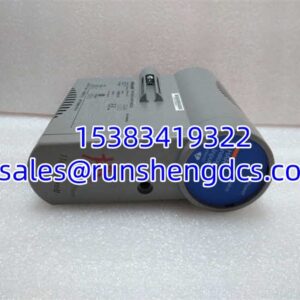
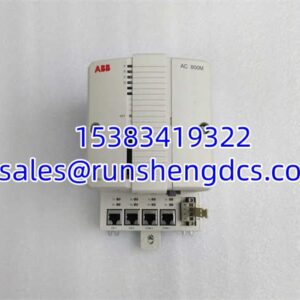
It is a CEX-bus mounted PROFIBUS DP-V1 master interface for the AC 800M platform. The TP854 baseplate provides two physical DB9 ports (A and B), and the internal RLM handles line redundancy at the hardware level without any extra configuration overhead. It supports both cyclic process data and acyclic DP-V1 parameter access, which matters when you are commissioning intelligent drives or reading device diagnostics. Bottom line — if your plant runs S800 I/O clusters over PROFIBUS, this module is the gateway.
QA/QC Transparency SOP
- Intake & Origin Verification: Confirm the label reads CI854A / 3BSE030221R1. Inspect the DB9 connectors for bent pins and the CEX-bus edge for corrosion or physical damage.
- Live Functional Testing: Mount on a TP854 baseplate in a test rack with an AC 800M CPU. Load a minimal Control Builder M project and verify cyclic data exchange with at least one DP slave (e.g., an S800 I/O cluster or ACS880 drive). Confirm both Port A and Port B pass data independently.
- Electrical Parameter Tests: Measure 24 V DC draw with a Fluke multimeter — expect ~190 mA typical, no more than 240 mA. Check continuity on the DB9 pins (pins 3/8 for RS-485 differential pair). No megger testing on the communication ports — that is a good way to kill the transceiver.
- Firmware/Config Verification: Read the hardware and firmware revision via Control Builder M or the module’s web diagnostic page (if supported). Record the revision for compatibility matching against the existing plant configuration.
- Final QC & Anti-Static Packaging: Place the module in an ESD bag with desiccant. Protect the DB9 connectors with dust caps. Include a test report with measured current draw, port test results, and firmware revision.
Field Engineer Gotchas
- Firmware revision mismatch. A CI854A with an older firmware rev can cause communication timeouts or fail to recognize newer DP-V1 slaves. Always check the firmware revision before swapping into a live rack. If the plant runs Control Builder M 6.x, verify compatibility against the ABB release notes.
- Terminal resistor errors on the DP segment. PROFIBUS DP must be terminated at the two outermost nodes. Using a connector without built-in termination — or leaving it unplugged — causes reflections and intermittent faults. This is the number-one cause of “ghost” DP errors in the field.
- Mixing up CI854A and CI854AK01. 3BSE030221R1 is the CI854A module alone. 3BSE030220R1 is the CI854AK01 kit, which includes the TP854 baseplate. Ordering the wrong one means you either have no baseplate or an extra one you did not budget for.
- CEX-bus unit limit. You can mount a maximum of 12 units on one CEX-bus segment. Adding a counts toward that limit. Plan your I/O architecture before you run out of slots.
- Redundancy wiring confusion. Line redundancy uses the A and B ports on the . Master redundancy requires two modules plus a redundancy cable between them. These are two different features — do not assume plugging into both ports gives you master redundancy.
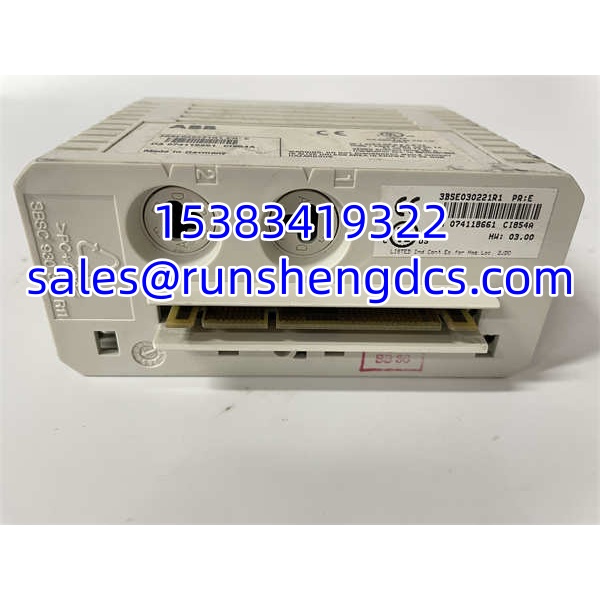
ABB CI854A 3BSE030221R1
Application Scenarios
- Remote S800 I/O clusters in a refinery. A distillation unit has I/O racks located 200 m from the control room. The runs the PROFIBUS DP segment at 1.5 Mbit/s over shielded twisted pair, with line redundancy protecting against cable cuts.
- Drive integration in a pulp & paper mill. Multiple ACS880 drives are connected over PROFIBUS DP for speed reference and diagnostics. The handles cyclic process data for speed/torque and acyclic reads for fault logs.
- Legacy system migration. A plant upgrading from an older AC 800M generation keeps its existing PROFIBUS infrastructure intact by retaining modules while migrating the CPU to a newer PM866.
FAQ
It is classified as “Classic” by ABB, meaning it is still supported but no longer the preferred choice for new designs. CI854B is the recommended successor.
Yes. ABB allows and CI854B to be configured together in a redundant master setup.
Does it support PROFIBUS PA devices?
Not directly. You need an LD 800P gateway to bridge PROFIBUS PA segments onto the DP network.
What is the maximum baud rate?
12 Mbit/s. At that speed, the segment length is limited to about 100 m. Drop to 9.6 kbit/s and you can reach roughly 1,200 m.
Can I hot-swap this module?
The supports replacement while the CEX-bus is powered, but you should follow ABB’s hot-swap procedure in Control Builder M to avoid a CPU fault. Do not just yank it during a critical process run.
The module itself has no external ports — the DB9 connectors are on the . If you are ordering a standalone 3BSE030221R1, verify whether your rack already has a installed. If not, order the CI854AK01 kit (3BSE030220R1) instead.
What is the typical current draw?
Approximately 190 mA at 24 V DC, with a maximum of 240 mA. Power dissipation is about 4.6 W.