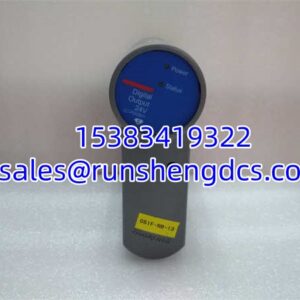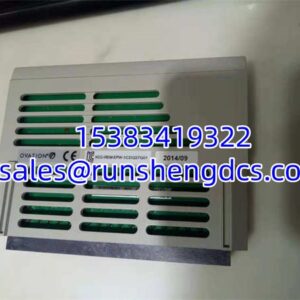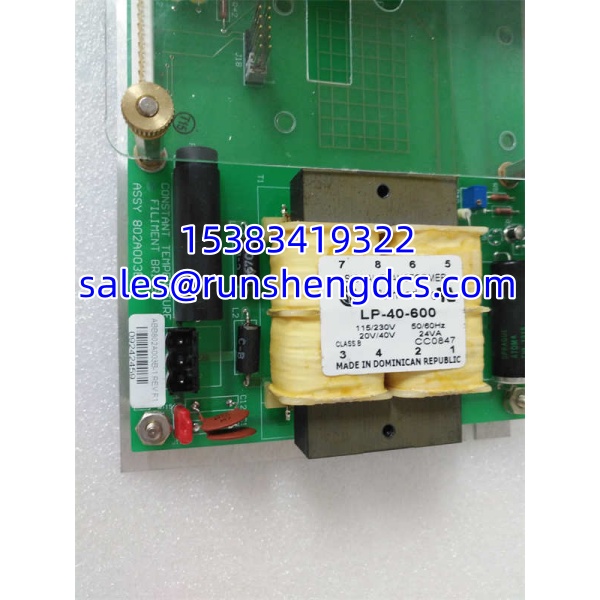

Description
Key Technical Specifications
| Parameter | Value |
|---|---|
| Product Model | 81943A041-1 |
| Manufacturer | ABB |
| Component Type | Precision Amplifier / TC Signal Conditioning Component |
| Typical Input Range | 0–5 V or 4–20 mA |
| Input Resolution | 16-bit (per published listings) |
| Typical Output Range | 0–5 V or 4–20 mA |
| Output Resolution | 12-bit |
| Sampling Rate | Up to 100 kSPS (listed; verify with OEM) |
| Auxiliary Feature | RTC with backup battery (listed) |
| Typical Application | Control systems, monitoring, data acquisition, instrument signal conditioning |
Product Introduction
Signal conditioning failures rarely announce themselves with a hard fault. More often, they show up as drifting readings, unstable 4–20 mA loops, or thermocouple inputs that look fine at one temperature and wrong at another. The ABB 81943A041-1 sits in that quiet but critical layer — amplifying and conditioning instrument signals so the control system sees clean, usable data.
Listed as a precision amplifier or TC amplifier component, it is typically used where sensor signals must be scaled, buffered, or converted before reaching a controller or data acquisition stage. With listed support for 0–5 V and 4–20 mA ranges and multi-channel capability, it fits legacy ABB control or instrumentation racks where signal integrity matters more than raw throughput. Because public documentation is limited, treat it as a legacy component and validate against the installed system.
QA/QC Transparency SOP
- Intake & Origin Verification: Record full part number 81943A041-1, serial/lot code, and any rack or assembly markings. Inspect for burnt components, cracked PCB traces, corroded terminals, or swollen capacitors.
- Visual & Mechanical Inspection: Check connector pins, terminal blocks, mounting hardware, and battery holder if an RTC is present. Reject units with heat damage, broken connectors, or missing fasteners.
- Electrical Parameter Tests: Verify input/output channel continuity, insulation resistance, and power supply rails. Apply a known 4–20 mA or 0–5 V test signal and confirm proportional output within expected tolerance.
- Functional Verification: If the unit includes RTC or multi-channel conditioning, verify channel-to-channel consistency and battery-backed clock retention. Compare output against a calibrated source.
- Final QC & Packaging: Document measured input/output values, channel status, and visual condition. Pack in anti-static packaging with a test report and clear part identification.
Field Engineer Gotchas
- Limited OEM documentation. The 81943A041-1 appears mostly in surplus listings and third-party references. Do not assume full datasheet availability. Verify wiring, ranges, and channel count against the physical unit.
- TC vs. generic amplifier confusion. Some listings call it a “TC component,” which may mean thermocouple conditioning or a generic signal amplifier role. Confirm whether it expects mV thermocouple inputs or standard 4–20 mA / 0–5 V signals.
- Range mismatch. Feeding a 0–5 V input into a channel configured for 4–20 mA, or vice versa, will produce incorrect readings. Check jumpers, DIP switches, or software configuration before blaming the module.
- RTC battery leakage. If the module includes a backup battery, old cells can leak and damage the board. Inspect the battery holder and replace the cell if corrosion is present.
- Channel drift under load. A module may pass bench tests at no load but drift when connected to long cable runs or noisy instrument loops. Test with representative loop impedance.
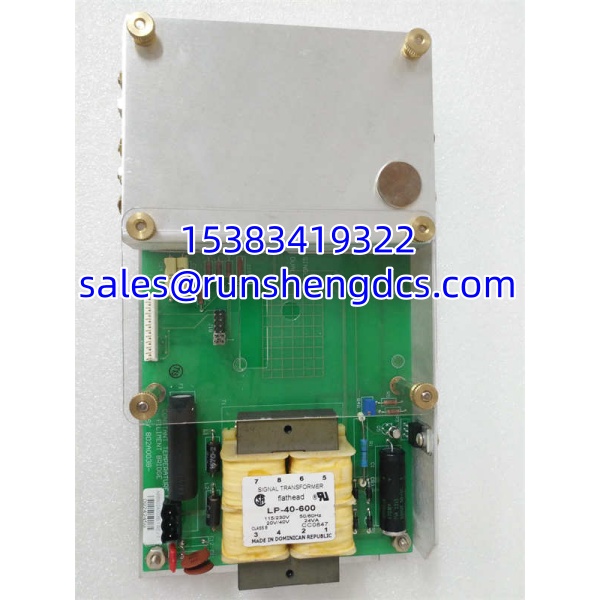
ABB 81943A041-1
Application Scenarios
- Legacy ABB control systems where analog sensor signals must be amplified before reaching a controller or recorder.
- Thermocouple or low-level sensor conditioning where signal integrity affects temperature or process measurement.
- 4–20 mA loop scaling for instrumentation panels that require buffered or isolated analog outputs.
- Data acquisition racks where multi-channel analog inputs must be conditioned for reliable logging.
- Spare-part replacement for discontinued ABB instrumentation or control modules.
FAQ
- Is 81943A041-1 a PLC module?
Not exactly. It is listed as a precision amplifier or TC signal conditioning component used within control or instrumentation systems, not a standalone PLC CPU. - What signals does it support?
Published listings indicate 0–5 V and 4–20 mA analog ranges. Confirm the exact configuration from the nameplate or installed system documentation. - Can I substitute it with another ABB amplifier module?
Only after verifying input/output ranges, channel count, mechanical footprint, and system compatibility. Do not substitute based on part number similarity alone. - Does it include an RTC?
Some listings mention an RTC with backup battery. Whether your unit has this feature depends on the exact revision and assembly. - Is new stock available?
Uncertain. Most availability comes from surplus or refurbished channels. Require nameplate photos and functional test reports before purchase. - How do I verify a surplus unit?
Check power-up behavior, measure input/output scaling with a calibrated source, inspect for battery leakage, and confirm channel consistency under load.