Description
Key Technical Specifications
- Product Model: AI810 (3BSE008516R1)
- Manufacturer: ABB
- Product Series: Advant S800 I/O
- Channel Count: 8 Single-Ended Channels
- Signal Range: 0(4)–20 mA, 0–10 V
- Resolution: 12-bit
- Isolation: 50 V (Input to Backplane)
- Required Termination: TU810, TU812, TU814, TU818, TU830, TU833, TU835, TU838
- Status Indicators: F (Fault/Red), R (Run/Green), W (Warning/Yellow)
- Mounting: DIN Rail / S800 Bus Terminal
Product Introduction
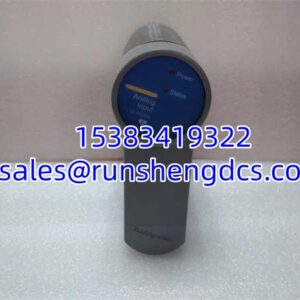
Analog signal acquisition is where process reality meets digital logic, and the ABB 3BSE008516R1 AI810 is the workhorse that makes that translation in S800 racks. It’s not a smart transmitter; it’s a dumb-but-reliable 12-bit sampler that takes 0–10 V or 4–20 mA signals and shoves them onto the backplane for the AC 800M controller to chew on. Eight channels, single-ended, no frills.
Why does this specific ABB 3BSE008516R1 AI810 matter? Because it’s been in production for decades and your plant is probably still running on it. The 12-bit resolution gives you about 0.024% step size—fine for level, pressure, and temp loops that don’t need lab-grade precision. Bottom line: It works, it’s cheap to replace, and it doesn’t try to be clever. Just remember it needs a matching TU810 or TU830 termination unit; the module itself has no screw terminals.
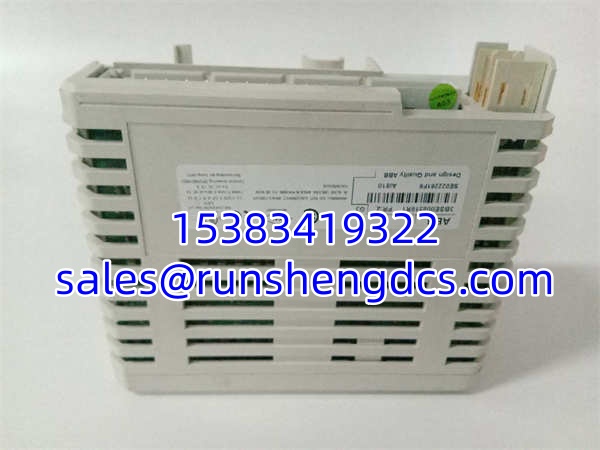
ABB 3BSE008516R1 AI810
QA/QC Transparency SOP
We don’t ship analog modules without proving they read correctly. Here is the bench protocol for every ABB 3BSE008516R1 AI810:
- Intake & Origin Verification: Visual check of the 3BSE008516R1 label, date codes, and PCB revision. We inspect for counterfeit markers like mismatched epoxy or reflowed solder on the ADC section.
- Live Functional Testing: Mounted on an S800 test rack with a TU810. We inject precision 4–20 mA and 0–10 V signals and verify the digital readout matches within ±0.2% of span.
- Electrical Parameter Tests: Megger test at 50V DC between input group and backplane to verify isolation integrity. Continuity check on all 8 signal paths to rule out cold solder joints.
- Firmware/Config Verification: Read the module ID and hardware revision via the S800 bus. Confirm it matches the expected ABB 3BSE008516R1 AI810 profile. No stuck configuration bits.
- Final QC & Anti-Static Packaging: Functional test report printed and packed with the unit. Sealed in ESD-safe bag with desiccant. Ready for the rack, not the scrap pile.
Field Engineer Gotchas
- Termination Unit Mismatch: The ABB 3BSE008516R1 AI810 has no terminals. It plugs into a TU810, TU830, etc. If you order the module without the matching TU, you have a very expensive paperweight. Solution: Check the existing termination unit part number before ordering. I’ve seen guys order 20 AI810s and realize they needed TU830s, not TU810s, because the field wiring was shielded differently.
- Single-Ended Ground Loops: All 8 channels share a common reference. If you mix grounded and floating signal sources on the same , you will create ground loops and see 60Hz hum or erratic readings. Solution: Use signal isolators or separate modules for grounded vs. floating sources. Don’t blame the module until you’ve checked your grounding scheme.
- Status LED Misinterpretation: The has F, R, and W LEDs. “W” (Warning/Yellow) often means an input is out of range or open, not that the module is dying. Solution: Check the channel diagnostics in Control Builder. I’ve seen techs swap a perfectly good because the “W” light was on, when the real problem was a broken wire at the field device.
- ESD During Handling: The ADC front-end is sensitive. Static discharge through the signal wires can fry individual channels while leaving the others working. Solution: Wrist strap on. Ground the S800 rack before touching the .
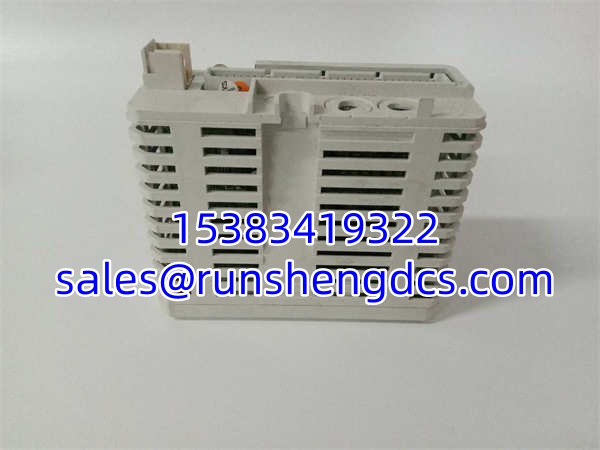
ABB 3BSE008516R1 AI810
Application Scenarios
- DCS Analog Input Expansion: The is the go-to for adding 8 channels of pressure, level, or temperature to an rack. Its 12-bit resolution is standard for process control loops that don’t require high-speed sampling.
- Retrofit & System Expansion: When expanding a legacy Advant system, the provides a drop-in replacement for older modules. Its compatibility with multiple TU units makes it flexible for different field wiring schemes.
- Batch Process Monitoring: In pharmaceutical or food processing, the monitors tank levels and temperatures. Its reliability and long-term availability make it ideal for systems that can’t tolerate frequent hardware changes.
Case Study: A water treatment plant had erratic pH readings on a dosing loop. The channel showed 50% one second, 80% the next. Maintenance swapped the module. Same issue. Finally, we found the pH transmitter was grounded to the pipe, while the ’s TU810 was grounded to a different panel. The ground loop was injecting noise. Added a signal isolator, problem gone. The was fine; the grounding wasn’t.
FAQ
Yes, the I/O system supports hot-swapping. You can pull and replace the without powering down the rack. The controller will detect the module removal and re-insertion, though you’ll get temporary “module missing” alarms.
What termination unit do I need?
Depends on your wiring. TU810 is standard screw terminal. TU830 is for shielded cables with separate shield connection. TU814/TU818 are for specific spring-terminal or high-density applications. Check the existing TU part number on the you’re replacing.
Not necessarily. “W” means Warning, usually an out-of-range or open channel. Check the channel diagnostics in Control Builder. If all channels are healthy but the light is on, verify the module configuration matches the actual wiring. Don’t swap the until you’ve ruled out field issues.
Is 12-bit resolution enough?
For 90% of process loops (pressure, level, temp), yes. 12-bit = 4096 steps. On a 0–100% scale, that’s 0.024% per step. If you need higher resolution for lab-grade measurement, look at the AI820 (14-bit). But for standard control, the is fine.
Does it support HART?
No. The is a standard analog input module. If you need HART communication, you need the AI820H or a dedicated HART interface module. Don’t try to force HART through this; it won’t work.
What’s the max cable length?
Depends on wire gauge and signal type. For 4–20 mA, you can go 1000m+ with 1.5mm² wire. For 0–10 V, keep it under 100m to avoid voltage drop and noise. Use shielded cable for the in noisy environments.