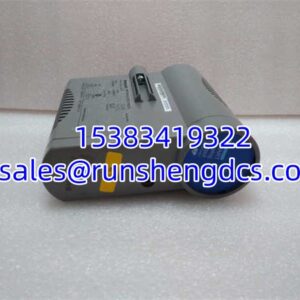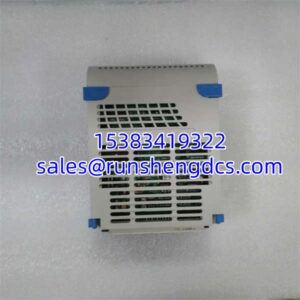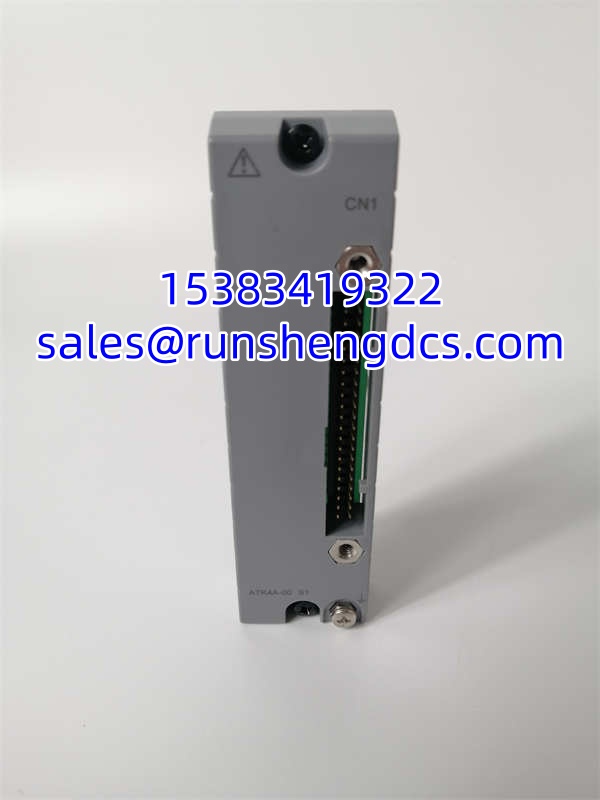

Description
Key Technical Specifications
- Form factor: Compact plug‑in adapter for Yokogawa I/O nest
- Channel capacity: 16 analog channels (4‑20mA / 1‑5V)
- Connector to nest: dedicated edge connector
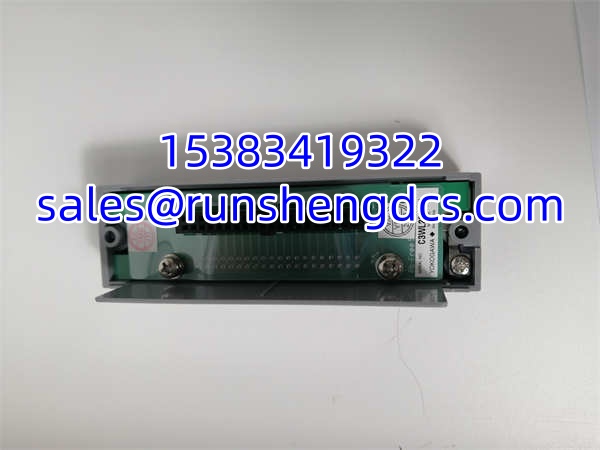
- Field‑side connector: 40‑pin MIL connector for KS cable
- Compatible I/O modules: AAI141‑S00/K4A00, AAO141‑S00/K4A00High Five …
- Compatible terminal boards: AEA4D series
- Compatible cables: KS1, KS2, KS8, KS9
- Voltage rating: 250VAC / 125VDC
- Per‑terminal current: 1A max
- Insulation: ≥10MΩ @500VDC; Hi‑pot 500VAC 1min between circuits
- Operating temperature: 0 °C to +55 °C (cabinet ambient)
- Storage temperature: −20 °C ~ +70 °C
- Humidity: 5–90% non‑condensing
- Variant note: ATK4A‑00 S1 = conformal coated (ISA G3) for corrosive environments
- Power: Passive, draws no supply power
- Weight: ~0.06 kg
Product Introduction
CENTUM DCS analog I/O nests rely on ATK4A‑00 as the transition piece between the I/O card cage and KS multi‑core ribbon cables. If this adapter suffers pin damage or oxidation, entire 16‑channel groups lose field signals, forcing loop bypass. Yokogawa no longer manufactures this adapter, so plant spares inventories are critical for avoiding lengthy shutdowns during I/O cabinet rework. This is strictly a passive wiring adapter; it performs no signal conditioning, A/D conversion or diagnostics. It simply routes each channel pin‑for‑pin from the I/O nest to the KS cable via the 40‑pin MIL plug.
Most field failures come from bent MIL pins, contamination, mechanical stress from pulled KS cables, or oxidation on the nest edge connector. No active components mean MTBF is very high when mechanically intact. Signal latency is zero, as there is no buffering. Bottom line — it works reliably if connectors are kept clean and strain‑relieved, but you must verify exact module option /K4A00 compatibility before ordering.
QA/QC Transparency SOP
- Intake & Origin Verification. Match model ATK4A‑00 and check for S1 coating marking. Inspect nest edge fingers for scratches/corrosion, inspect 40‑pin MIL pins for bending, cracks or debris. Photograph label, top PCB and both connectors. Reject units with broken pins or burned traces.
- Live Functional Testing (Continuity, Load). Mate adapter to a validated AAI141‑K4A00 or AAO141‑K4A00 module in a Yokogawa nest. Attach known‑good KS cable to AEA4D terminal board. Continuity test all 16 channel loops, confirm no short circuits between adjacent pins. Run signal injection for each channel to confirm no open connections. Test minimum 2 hours under cabinet‑level thermal cycling.
- Electrical Parameter Tests (Megger, Continuity). De‑energize nest. Run 500 V Megger between signal lines and adapter ground. Insulation resistance >100 MΩ required. Verify every pin path from nest edge connector through to MIL connector.
- Compatibility Verification. Confirm target I/O module has the /K4A00 factory option. Flag units modified or pins reworked by third parties.
- Final QC & Anti‑Static Packaging. Recheck MIL connector pin alignment, fit dust cap. Pack in ESD bag with foam protection. Attach unique test report ID listing continuity and insulation results.
Field Engineer Gotchas
- Missing /K4A00 Module Option. Risk: Installing ATK4A‑00 on standard AAI141 / AAO141 without / will not work; pinout differs. No error alarm, channels simply dead. Solution: Confirm module ordering suffix / before installation.
- MIL connector pin bending. Risk: Misaligned KS cable insertion bends fine MIL pins, creating intermittent open/short faults that appear under vibration. Hard to trace during live troubleshooting. Solution: Visually inspect every MIL pin before mating KS cable; use proper alignment guides.
- No hot‑swap isolation. Risk: While the adapter can be extracted live from the nest, removal drops all 16 analog loops immediately. Solution: Bypass all control loops before removal.
- KS cable strain relief missing. Risk: Cable tug transfers force directly onto ATK4A‑00 MIL connector. Over time pins fatigue and break. Solution: Secure KS cable to cabinet with cable ties near the adapter to eliminate pull stress.
YOKOGAWA ATK4A-00
Application Scenarios
Refinery CENTUM VP analog I/O cabinets: ATK4A‑00 adapters connect 16‑point AAI141 AI modules via KS cables to field terminal boards for 4‑20mA transmitters. Power plant CS3000 control nests: paired with AAO141 analog output modules to drive modulating control valves via KS multiway cabling. Chemical plant DCS retrofit projects: used when preserving existing KS cable looms while replacing aging I/O nests. Off‑shore and corrosive environment cabinets: ‑00 S1 coated variant deployed to resist salt mist and chemical vapors.
Case study: A chemical plant had intermittent loss of 8 out of 16 analog input channels. Technicians swapped the AAI141 module with no improvement. Bench inspection found three slightly bent pins on the ‑00 MIL connector. Replacing the adapter fully restored all channels without rewiring KS cables.
FAQ
Q: Does Yokogawa ‑00 support hot‑swap? A: Mechanically removable while nest powered, but removing it cuts all 16 field signals instantly. All affected control loops must be bypassed first.
Q: What is the difference between ‑00 and ‑00 S1? A: S1 has conformal coating (ISA G3) for corrosive / salt‑air environments. Electrical pinout is identical.
Q: Can I use ‑00 on any AAI141? A: No. The I/O module must be factory ordered with option . Standard pin assignment is incompatible.
Q: What lead time applies for tested surplus stock? A: Pre‑continuity‑tested units ship 2–5 business days. S1 coated units with full insulation test ship 5–9 days. No new original production.
Q: Is ‑00 an I/O module with signal processing? A: No, purely passive wiring adapter. It has no electronics, no measurement circuits and no built‑in diagnostics.
Q: Can I mix KS1 and KS2 cables with ‑00? A: Yes, ‑00 works with KS1, KS2, KS8, KS9; ensure cable pinout matches your terminal board.
Q: How many channels per ‑00? A: 16 channels maximum, matching the 16‑point analog I/O module it mates with.