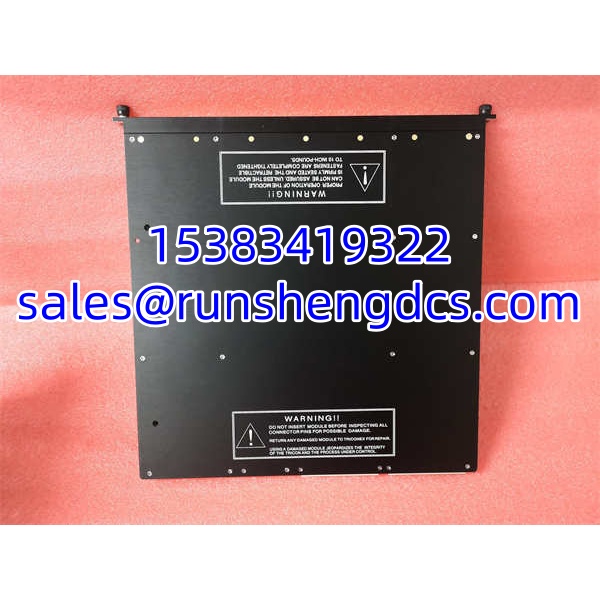

Description
Key Technical Specifications
| Parameter | Value / Notes |
|---|---|
| Manufacturer | Triconex / Schneider Electric |
| Product Family | Tricon TMR Safety Instrumented System |
| Module Type | 3721 / 3721C Analog Input Module |
| Channel Count | 32 channels, typical for 3721 family |
| Input Type | Differential, DC-coupled analog input |
| Update Rate | 10 ms, typical |
| Resolution | 12-bit / 14-bit programmable |
| Accuracy | < 0.15% FSR from 0°C to 60°C, typical |
| Isolation | Isolated points; verify exact isolation rating on nameplate |
| Overrange Protection | 150 VDC / 115 VAC continuous, typical for 3721 family |
| Diagnostics | PASS / FAULT / ACTIVE / FIELD indicators, typical |
| Installation | Tricon rack-mounted I/O module |
Product Introduction
Analog inputs in a Safety Instrumented System are not just measurement points. They are often the first link in a protection chain. If the AI module reads drift, loses isolation, fails channel diagnostics, or does not match the Tricon firmware environment, the SIS may still run — but the safety function becomes unreliable. The TRICONEX 3721C fits into that role as a TMR analog input module for Tricon-family safety systems.
The 3721 family is typically used where a Tricon SIS needs high-integrity analog process data. With 32 differential channels, a 10 ms update rate, and 12/14-bit programmable resolution, it is designed for continuous safety monitoring rather than general-purpose DCS trending. Bottom line — it is a safety-grade AI card, not a generic analog input module, and its value depends entirely on correct rack, firmware, channel configuration, and field wiring.
QA/QC Transparency SOP
- Intake & Origin Verification
Check the nameplate for 3721C, part number, revision, serial number, and Triconex labeling. Reject units with reprinted labels, mismatched model numbers, missing revisions, or evidence of unauthorized board-level repair. - Visual & Mechanical Inspection
Inspect the backplane connector, front-panel LEDs, mounting hardware, enclosure, and PCB edges. Look for bent pins, corrosion, burnt components, cracked housings, lifted traces, or liquid damage. The backplane connector is a common failure point on pulled Triconex modules. - Live Functional Testing
Install the module in a known-good Tricon rack with compatible power and controller firmware. Verify that the module powers up, the PASS/FAULT/ACTIVE/FIELD indicators behave normally, and the controller recognizes the module. If a calibrated signal source is available, confirm that analog channels read correctly across the configured range. - Electrical Parameter Tests
Perform continuity and insulation checks only where safe and permitted by OEM procedures. Do not apply high-voltage megger tests to analog input channels, backplane pins, or low-voltage logic areas unless Triconex documentation explicitly allows it. - Final QC & Anti-Static Packaging
Record the exact model, revision, physical condition, LED status, and test results. Package in ESD-safe materials, protect the backplane connector and front panel, and include a note to verify firmware, channel configuration, and field wiring before energizing the system.
Field Engineer Gotchas
Firmware / TriStation compatibility mismatch
Risk: Installing a 3721C into an existing Tricon rack, then finding the controller does not recognize it or will not accept configuration.
Fix: Verify the Tricon controller firmware, TriStation 1131 project compatibility, and module revision before installation.
Blunt warning: A “new” 3721C that the rack rejects is usually a firmware/revision problem, not always a dead module.
3721 vs 3721C confusion
Risk: Buying a 3721 when the system requires 3721C, or vice versa.
Fix: Match the full model exactly, including the C suffix, and confirm the revision against the removed module and Triconex documentation.
War story: A plant ordered a 3721 based on a surplus listing, but the existing SIS project expected a 3721C hardware/firmware profile. The module physically fit, but configuration and diagnostics did not line up cleanly.
Differential wiring mistakes
Risk: Wiring single-ended field signals into a differential AI module incorrectly, causing offset, noise, or false trips.
Fix: Confirm whether each channel expects differential pairs, common reference, shield grounding, and correct signal return paths.
Bottom line — the module can be perfect, but bad field wiring will make it look defective.
Hot-swap does not mean “no procedure”
Risk: Pulling or inserting the module without following SIS maintenance procedures.
Fix: Confirm that the Tricon rack, controller, and maintenance procedure support hot-swap for that module slot. For safety systems, always follow the plant’s SIS work permit and bypass/force procedures.
Surplus listing misclassification
Risk: Some listings incorrectly call 3721 a digital input card or mix it with 3720, 3723X, or other Triconex modules.
Fix: Require a clear photo of the full nameplate showing 3721C before purchase.
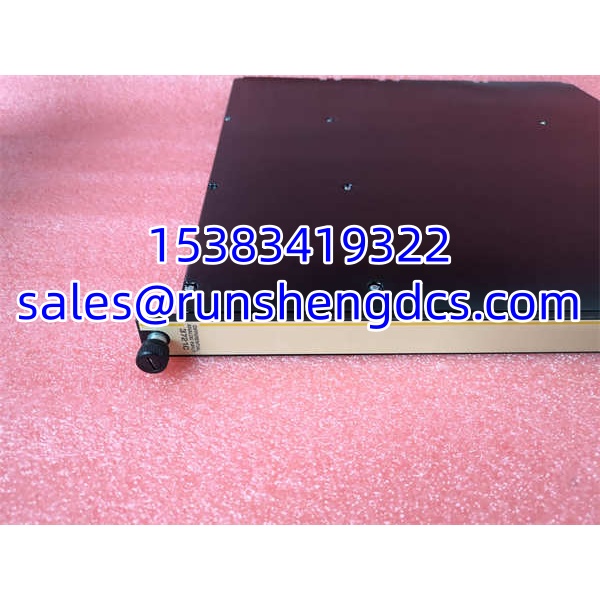
TRICONEX 3721C
Application Scenarios
- Emergency Shutdown Systems where reactor pressure, temperature, or flow must be monitored with high-integrity analog inputs.
- Fire and Gas Systems receiving analog signals from gas detectors or related safety transmitters.
- Burner Management Systems requiring reliable analog process feedback for safe combustion control.
- Compressor and turbine protection where analog vibration, pressure, or temperature signals feed safety logic.
- Petrochemical and power-generation SIS applications where Tricon TMR architecture is already installed.
Anonymized Field Case
A chemical plant had a Tricon SIS reporting intermittent channel faults on an analog input card. Maintenance suspected field wiring because the fault appeared only when a nearby VFD started. After checking the field loop, they found the shield grounding was inconsistent and one differential pair had a loose terminal. The 3721-family module itself was not faulty, but the poor wiring and grounding allowed common-mode noise to affect channel diagnostics. After correcting the shield ground, reseating the terminals, and verifying channel readings with a calibrated source, the FAULT indication cleared. The lesson: in TMR analog input modules, field wiring quality is part of the safety system.
FAQ
Is TRICONEX 3721C an analog input module or a digital input module?
It belongs to the 3721 analog input module family. Some third-party listings incorrectly describe 3721 as a digital input card. Verify the physical nameplate before purchase.
What is the difference between 3721 and 3721C?
The C typically indicates a revision or hardware variant. It can affect firmware compatibility, rack recognition, and replacement eligibility. Do not assume they are interchangeable.
How many channels does 3721C have?
The 3721 family is commonly referenced as a 32-channel differential analog input module. Confirm the exact channel configuration on the nameplate and in Triconex documentation.
Can I hot-swap this module?
Triconex 3721-family modules are generally designed for rack-based installation and online maintenance, but hot-swap depends on the Tricon rack, controller firmware, SIS procedure, and plant maintenance rules. Do not hot-swap without following the approved SIS procedure.
Is this module SIL 3 capable?
The Tricon TMR architecture is used in SIL 3 safety applications, but the module’s suitability depends on the full system: controller, firmware, power supply, I/O configuration, field wiring, and safety function design. The module alone does not define the SIF rating.
What should I check before using surplus 3721C stock?
Check the nameplate, revision, physical condition, backplane connector, LED behavior, firmware compatibility, channel configuration, and rack compatibility. For safety systems, visual inspection alone is not enough.
Where should exact specs be verified?
Use the Triconex nameplate, Tricon system documentation, TriStation project files, and official Schneider Electric / Triconex technical support. Third-party surplus listings are useful for identification, but they are not a substitute for OEM documentation.