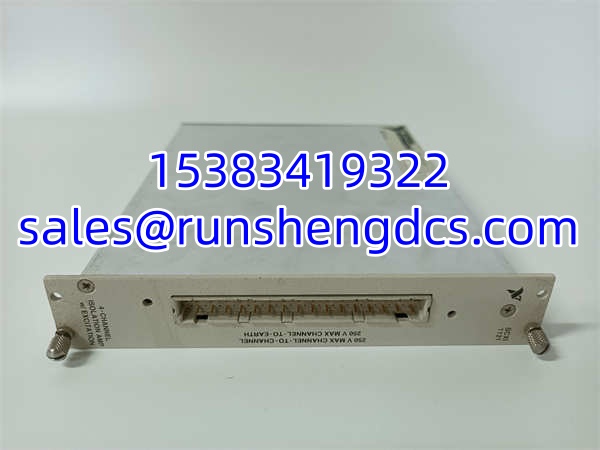

Description
Key Technical Specifications
- Product Type: 4-Channel Isolated Universal Input Module
- System Platform: NI SCXI Series (requires SCXI chassis such as SCXI-1000)
- Input Channels: 4 isolated analog input channels
- Excitation Channels: 4 isolated excitation channels (jumper-configurable for 3.33 V, 10 V, 0.15 mA, or 0.45 mA)
- Gain Settings: 1, 2, 5, 10, 20, 50, 100, 200, 500, 1000, 2000 (jumper-selectable per channel)
- Input Range: ±2.5 mV to ±5 V (depending on gain setting)
- Isolation Rating: Up to 250 Vrms channel-to-channel isolation
- Supported Signal Types: Strain gauge (quarter, half, full bridge), RTD, thermistor, thermocouple, voltage (V/mV), current (0–20 mA, 4–20 mA)
- Output Modes: Multiplexed (all 4 channels muxed to 1 DAQ channel) or Parallel (each channel to separate DAQ input)
- Cold-Junction Compensation: Supported via compatible terminal block temperature sensor (multiplexed or direct mode)
- Filtering: Per-channel low-pass filter included
- Shunt Calibration: Supported via SCAL control line
- Compatible DAQ Boards: PCI-MIO-16XE, Lab PC+, Lab NB, Lab PC, Lab LC, PC-LPM-16, and other NI DAQ hardware with SCXI interface
- Availability: Discontinued / Legacy — surplus and secondary market only
Product Introduction
Your strain gauge outputs a few millivolts. Your RTD needs excitation current. Your thermocouple needs cold-junction compensation. And all of it is sitting in an environment with nasty common-mode noise. The SCXI-1121 is the module that sits between those messy real-world sensors and your DAQ board — amplifying, isolating, filtering, and multiplexing the signals so the DAQ hardware sees clean, properly scaled voltage.
Built by National Instruments as part of the SCXI signal conditioning family, the SCXI-1121 gives you four independently configurable isolated input channels, each with its own excitation source, gain setting, and low-pass filter. It handles bridge-based transducers (120 Ω or 350 Ω), 100 Ω RTDs, 10k Ω thermistors, thermocouples, raw voltage, and 4–20 mA / 0–20 mA current loops. You can run it in multiplexed mode (all four channels share a single DAQ analog input) or parallel mode (each channel gets its own DAQ input). The 250 Vrms isolation keeps high common-mode voltages from corrupting your measurements or frying your DAQ hardware. This module is discontinued — supply runs through surplus channels, so verify your chassis, DAQ board, and terminal block compatibility before purchasing.
Troubleshooting Quick Reference
| Fault | Likely Cause | Quick Check | Fix |
|---|---|---|---|
| No signal output from module | Missing excitation or incorrect jumper configuration | Verify excitation jumpers are set correctly; measure excitation voltage at terminal block | Set jumpers for correct excitation (voltage or current); confirm DAQ board recognizes module |
| Noisy or drifting readings | Inadequate shielding or improper grounding | Check cable routing near noise sources; verify chassis ground (CGND) is connected | Route signal cables away from power lines; ensure proper chassis grounding; enable low-pass filter |
| Gain appears wrong | Incorrect gain jumper settings | Compare physical jumper positions against desired gain table | Reset jumpers to correct gain setting (1, 10, 100, etc.) |
| Thermocouple reading offset | Cold-junction compensation not configured | Confirm terminal block CJC sensor is connected; check mtemp/dtemp jumper setting | Set terminal block jumper to correct CJC mode; verify DAQ software reads CJC channel |
| Module not recognized by DAQ | SCXI chassis communication failure or wrong slot | Check SCXI chassis cable to DAQ board; verify module is fully seated in chassis slot | Reseat module; check SCXI chassis-to-DAQ cable; verify in NI MAX |
| Shunt calibration fails | SCAL control line not connected or misconfigured | Measure SCAL pin state during calibration command | Verify SCXI-1321 terminal block connection; check SCAL line continuity |

NI SCXI-1121
Application Scenarios & Pain Points
- Structural strain measurement: A test lab uses SCXI-1121 modules in an SCXI-1000 chassis to read quarter-bridge and half-bridge strain gauges on a fatigue test frame. The gauges output microvolt-level signals that need 1000× gain before the DAQ board can digitize them. The pain point: when a surplus replacement module arrives with slightly different offset characteristics, the engineer must re-run shunt calibration before trusting the data.
- Industrial process monitoring: A chemical processing facility uses the SCXI-1121 to read 4–20 mA current loops from pressure transmitters. The 250 Vrms isolation protects the DAQ system from ground loops caused by the plant’s electrical noise environment. When the module fails, the SCADA system loses visibility into critical process pressures — forcing operators to rely on local gauge readings until a replacement is sourced.
- Thermal testing with RTDs and thermocouples: A materials testing lab conditions RTD and thermocouple signals through the SCXI-1121’s excitation and CJC channels. The challenge is that CJC accuracy depends on the terminal block’s temperature sensor — if the terminal block is swapped or the mtemp/dtemp jumper is misconfigured, thermocouple readings drift by several degrees without any obvious fault indication.
- Multi-channel data acquisition expansion: Engineers chain multiple SCXI-1121 modules in multiplexed mode to scale up channel count without buying additional DAQ boards. Each module contributes 4 channels through a single DAQ analog input. The trade-off: effective sample rate per channel drops as you add modules, since the DAQ board must scan through each channel sequentially.