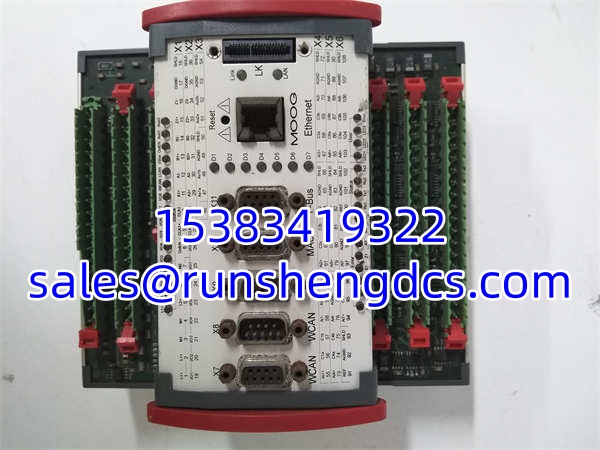

Description
Key Technical Specifications
| Parameter | Specification |
|---|---|
| Product model | D136-001-007 |
| Product series | MSC I motion controller |
| Processor | 32-bit PowerPC with RISC architecture and FPU |
| Flash memory | 4 MB Flash EEPROM |
| Control capability | Closed-loop control for up to 2 hydraulic servo-actuators |
| Supply voltage | 24 V DC (18 to 36 V), SELV per EN 60950-1 |
| Current consumption | 0.5 A no-load / 2 A full-load |
| Ethernet | 1× 10 MBit/s, RJ45 (10Base-T) |
| CAN interfaces | 2× independent CAN, 10 kBit/s to 1 MBit/s |
| PROFIBUS-DP | 1× slave, up to 12 MBit/s |
| Position sensor inputs | 2 |
| Serial ports | 2× EIA-232 (MACS + SIO) |
| Operating temperature | +5 °C to +55 °C |
| Dimensions (W × D × H) | 160 × 170 × 85.5 mm |
| Typical application | Hydraulic motion control for testing, metal forming, tire machinery, turbine control |
Product Introduction
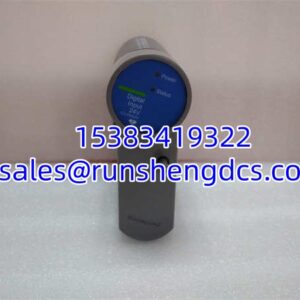
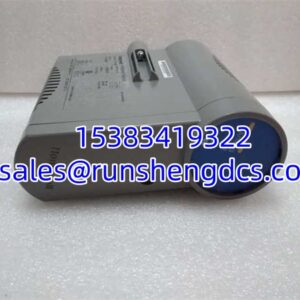
The D136-001-007 is not a servo valve, proportional valve or servo motor. It is a MOOG MSC I motion controller designed to drive and close the loop around hydraulic servo-actuators. In many legacy test rigs, rolling mill stands, turbine governor systems and tire-testing machines, this controller sits between the host PLC or HMI and the hydraulic valve/motor stage, handling position, speed or force control locally.
Its strongest point is deterministic hydraulic motion control with built-in PLC functionality. With two position sensor inputs, CAN, PROFIBUS-DP and Ethernet, it can run local control loops while exchanging setpoints and status with a higher-level system. Today it is primarily a lifecycle-support item: plants that still run MSC I-based hydraulic axes need verified replacements because the hardware is no longer part of Moog’s current mainstream controller portfolio.
QA/QC Transparency SOP
- Intake & Identity Verification — Confirm full model D136-001-007, serial number, hardware revision and MSC I series label. Reject units mislabeled as servo valves, servo motors or power supplies.
- Power-Up Test — Apply 24 V DC within the 18–36 V range. Verify boot sequence, LED status and absence of supply faults. Measure no-load and loaded current draw.
- Interface Verification — Test Ethernet link, CAN bus presence, PROFIBUS-DP identification and EIA-232 MACS port communication. Confirm the controller is recognized by Moog MACS or the configured engineering tool.
- I/O and Sensor Check — Verify analog/digital I/O behavior and position sensor inputs using a signal simulator or test fixture. Check for channel imbalance, noise or drift.
- Application Integrity Check — Read stored application, parameters and fault history. Note that existing programs are site-specific and may need re-validation before returning to service.
- Final QC & Packaging — Pack in anti-static material with connector protection. Label with model, serial number, firmware/application revision, test date and known limitations.
Field Engineer Gotchas
- It is not a valve or motor. Some surplus listings confuse D136-001-007 with MOOG servo valves or servo motors. It is a motion controller for hydraulic axes.
- Wrong electrical specs are common online. Listings showing 48 V DC, 10 A, 100 W or 3000 RPM are not consistent with the MSC I datasheet. The correct supply is 24 V DC, 0.5–2 A.
- Application backup is critical. If the original controller is still accessible, download the program and parameters before removal. A blank replacement will not restore hydraulic axis tuning.
- MSC I vs. MSC II/MSC-R matters. D136-001-007 belongs to the MSC I family. MSC II and MSC-R controllers have different interfaces and capabilities and are not automatic drop-in replacements.
- PROFIBUS-DP is slave-only. This controller supports PROFIBUS-DP slave, not master. System integration must be planned accordingly.
- Legacy software dependency. Commissioning typically requires Moog MACS or the correct engineering software version. Without it, parameter access and diagnostics may be limited.
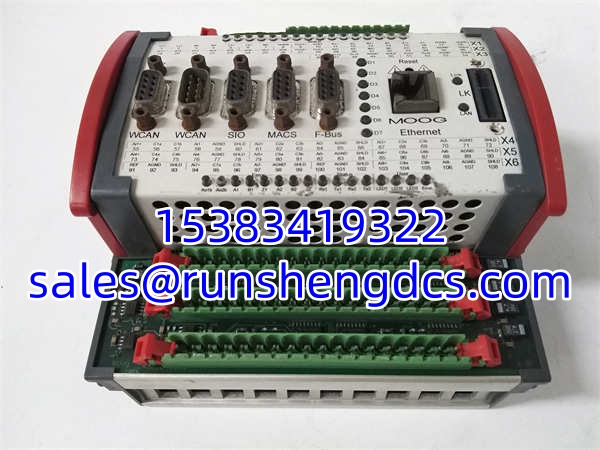
MOOG D136-001-007
Application Scenarios
- Hydraulic test rig maintenance. A legacy materials-testing or actuator test stand loses communication or axis control. The D136-001-007 restores local closed-loop control while the host system remains unchanged.
- Metal forming or rolling mill hydraulic axis. Older MOOG-controlled hydraulic axes depend on MSC I controllers for position and force regulation. A verified unit reduces unplanned downtime.
- Tire manufacturing equipment. has been used in tire machinery and similar process equipment where hydraulic actuators require fast local control.
- Turbine or industrial motion control retrofit bridge. During phased migration to a newer motion controller, a working MSC I unit can keep existing hydraulic axes operational.
FAQ
No. It is a MOOG MSC I motion controller used to control hydraulic servo-actuators, not a hydraulic valve itself.
Can it replace D136-001-008?
Not automatically. Both belong to the MSC I family, but application parameters, I/O mapping and firmware may differ. Replacement must be validated against the existing machine configuration.
What supply voltage does it need?
24 V DC, 18 to 36 V, SELV. Listings claiming 48 V DC or motor-style ratings are not reliable for this controller.
Does it support EtherCAT or PROFINET?
The MSC I supports Ethernet 10 MBit/s, CAN and PROFIBUS-DP slave. Newer MOOG controllers such as MSC III add EtherCAT and real-time Ethernet; do not assume those features exist on MSC I.
Can I load a new program without MACS software?
Commissioning and parameter access typically require the correct Moog engineering software. Without it, replacement and troubleshooting become significantly harder.
Is this still in production?
It is considered legacy hardware. Most available stock comes from surplus, refurbished or decommissioned systems. For new designs, current Moog motion controllers should be evaluated.
What should I send before buying?
Provide nameplate photos, serial number, existing application backup if available, interface requirements and fault logs. That reduces the risk of receiving a functionally mismatched controller.