
Description
Key Technical Specifications
- Product Model: PDP401
- Manufacturer: METSO
- Product Type: Distributed Processing Unit (DPU)
- Processor: 32-bit RISC
- Memory: 256 MB SDRAM
- Storage: 2 GB Flash
- Communication Interfaces: RS-232, RS-485, Ethernet
- Supported Protocols: Modbus, Profibus, HART
- Operating Temperature: -40°C to +70°C
- Protection Rating: IP65
- Standard Compliance: IEC 61131-3
- Redundancy: Hot Backup Support
Product Introduction
Legacy DCS systems often fail not because of bad logic, but because the processing hardware simply can’t keep up with modern data demands. The METSO PDP401 addresses this by serving as the computational core of the DL401 series, handling high-speed sensor acquisition and control execution locally. It’s not just a pass-through card; it’s a dedicated 32-bit RISC processor with 256 MB of SDRAM designed to run IEC 61131-3 compliant logic without dragging down the entire backplane.
Why keep this specific DPU in your spare parts strategy? Because it supports critical industrial protocols like Modbus, Profibus, and HART natively, eliminating the need for external protocol converters that add latency and failure points. With an operating range of -40°C to +70°C and IP65 protection, the METSO PDP401 is built for harsh environments where standard IT hardware would fail. Bottom line — if you’re running a METSO/Valmet system, this is the exact processing engine your control strategy depends on. (Always verify your firmware revision matches the rest of your redundant pair before installation.)
QA/QC Transparency SOP
- Intake & Origin Verification: We inspect the METSO PDP401 for authentic branding, correct component date codes, and physical damage. Boards with suspicious soldering or missing labels are immediately quarantined and scrapped.
- Live Functional Testing: The DPU is seated into a METSO DL401 test rack. We load a verified control program and verify the 32-bit RISC processor executes logic, communicates over Ethernet/RS-485, and handles I/O updates within spec.
- Electrical Parameter Tests: Using a Fluke multimeter and oscilloscope, we verify the internal 5V/3.3V power rails, check for shorted traces, and confirm the RS-485/Ethernet transceivers meet signal integrity standards.
- Firmware/Config Verification: We read the onboard Flash memory to log the firmware version and back up any existing configuration. The unit is then cleared to factory defaults to prevent hidden parameter conflicts.
- Final QC & Anti-Static Packaging: After a 4-hour continuous burn-in test under simulated load, the METSO PDP401 is cleaned, placed in an anti-static bag with desiccant, and shipped with a Certificate of Conformance and 1-year warranty.
Field Engineer Gotchas
- Redundancy Sync Failures: Swapping a single METSO PDP401 without matching the firmware revision of its redundant partner will cause sync timeouts. War Story: A tech replaced a failed DPU with a newer revision, and the system spent 20 minutes in “Sync Pending” state before finally tripping. Solution: Always match firmware revisions exactly, or plan for a full redundant pair replacement during a shutdown.
- Protocol Mismatch on RS-485: The METSO supports multiple protocols, but they’re not auto-detected. If you configure Modbus in software but the hardware jumpers are set for Profibus, you’ll get silent communication failures. Blunt truth: Check the physical jumpers AND the software config. Both must match.
- Flash Memory Wear: The 2 GB Flash storage has a finite write cycle limit. If your application logs data directly to the DPU’s internal memory, you may hit write failures after 5-7 years. Warning: Monitor Flash health via diagnostics. If you see write errors, migrate data logging to an external historian immediately.
- Backplane Connector Damage: The DL401 backplane connector is fragile. If you force the METSO into the slot without aligning the guide rails, you’ll bend pins and cause intermittent faults. Solution: Always use the extraction tool for removal, and apply even pressure during installation. Half-seated DPUs are the #1 cause of “new spare doesn’t work” tickets.
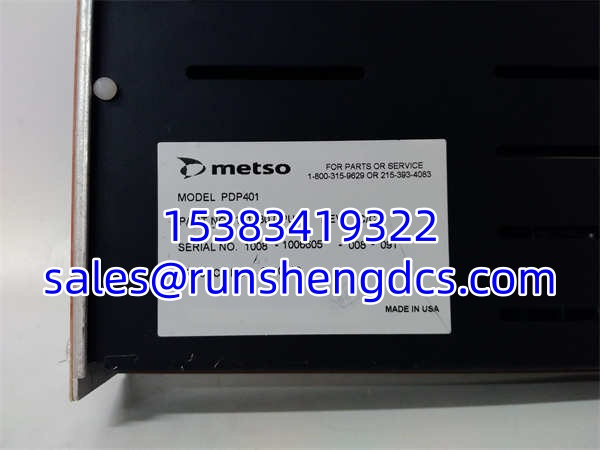
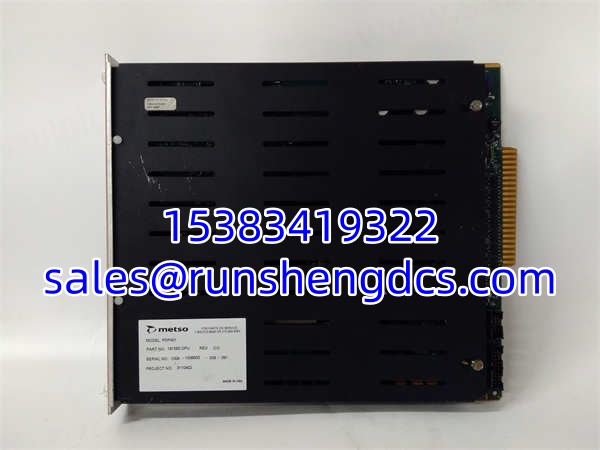
METSO PDP401
Application Scenarios
- Pulp & Paper Machine Control: High-speed paper machines require deterministic control loops for tension and speed. The METSO executes PID logic locally, ensuring microsecond-level response to web breaks or drive faults.
- Mineral Processing Flotation Cells: Harsh, dusty environments demand rugged hardware. With IP65 protection and -40°C to +70°C range, the METSO controls reagent dosing and air flow without failing in extreme conditions.
- Power Plant Boiler Feedwater Systems: Safety-critical level control requires redundant processing. The METSO ’s hot backup capability ensures seamless failover during primary DPU maintenance or failure.
- Real-World Case Study: A metal smelting facility experienced intermittent control losses on their METSO -based system. Diagnostics showed the DPU was functioning, but the RS-485 cable was routed parallel to a 480V motor drive, causing EMI-induced bit errors. Resolution: Rerouted the communication cable through grounded metallic conduit and added a repeater. The METSO worked perfectly once the physical layer was fixed. Lesson: The DPU is only as reliable as the network it lives on.
FAQ
It depends on your system configuration. Some DL401 setups support hot-swapping, but many require a brief maintenance window to safely remove and insert the DPU. Always check your system manual. If you’re unsure, schedule a shutdown. Guessing wrong can corrupt the redundant sync or damage the backplane.
No. Redundant DPUs must be identical in hardware revision and firmware. Mixing and PDP601 will cause sync failures and unpredictable behavior. Bottom line: Always replace with the exact same model and revision.
The LEDs only indicate power and basic link status. If the PLC isn’t sending valid cyclic data or the protocol config is wrong, the DPU will fault even if the hardware is healthy. Check your Modbus/Profibus configuration, verify the slave address, and use METSO’s diagnostic tools to read the communication error word.
Does this DPU support IEC 61131-3 programming?
Yes. The METSO is fully compliant with IEC 61131-3 and supports standard languages like Ladder Diagram, Function Block, and Structured Text. Configuration is done via METSO’s engineering software (e.g., Valmet DNA or equivalent).
What is the expected lifespan of the Flash memory?
The 2 GB Flash is rated for typical industrial write cycles, but heavy data logging can accelerate wear. In most control applications, you can expect 10+ years of reliable operation. Warning: If you’re logging high-frequency data directly to the DPU, plan for Flash replacement or external storage migration within 5-7 years.
Usually, yes. The “/3” suffix typically indicates a minor hardware revision or regional variant. However, always verify firmware compatibility. A newer suffix may require a CPU firmware update, while an older suffix may not support newer features. When in doubt, provide the full part number to your supplier for cross-reference.
No. The 2 GB Flash is non-volatile and retains program and configuration data without battery backup. However, some older revisions may have a battery for real-time clock retention. Check your specific hardware revision.