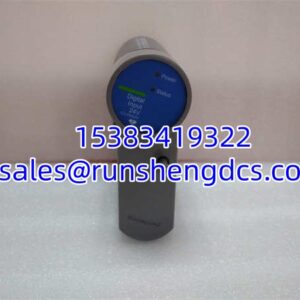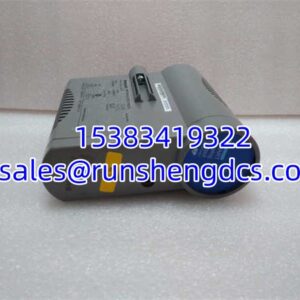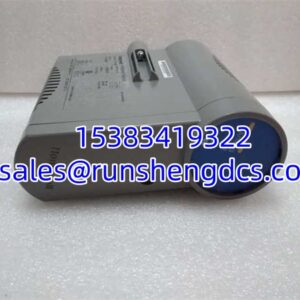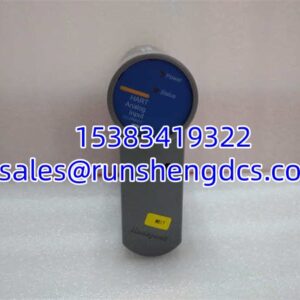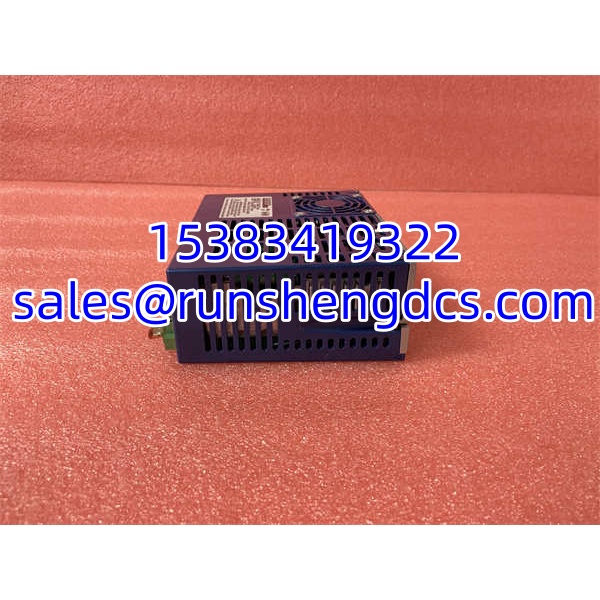
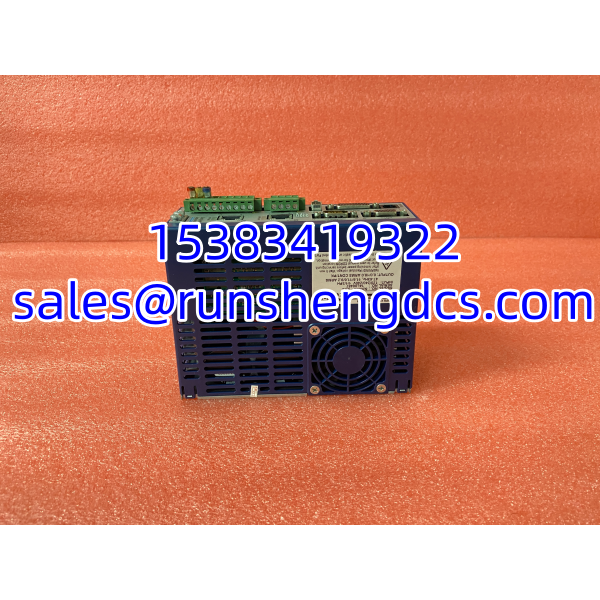

Description
Key Technical Specifications
| Parameter | Typical Value / Note |
|---|---|
| Manufacturer | Kollmorgen (Danaher Motion legacy) |
| Model | S20660-SRS |
| Product Type | Single-axis AC servo drive / amplifier |
| Series | S200 |
| Motor Compatibility | Kollmorgen AKM / brushless servo motors (with resolver) |
| Feedback Type | Resolver (SRS suffix indicates resolver-based feedback) |
| Input Voltage | 0–265 VAC (120/240 VAC nominal); 320 VDC nominal bus |
| Continuous Output Current | 9.0 ARMS @ 0–30°C; 6.0 ARMS @ 40°C; 4.0 ARMS @ 50°C |
| Peak Output | 6000 VA |
| Continuous Output Power | ~2000 W (240 VAC, 3-phase) |
| Current Loop Bandwidth | 3–5 kHz (S200 series typical) |
| Velocity Loop Bandwidth | Up to 800 Hz |
| Communication | SynqNet via RJ-45 |
| Control Modes | Torque, velocity; electronic gearing; analog ±10 V reference |
| Feedback Resolution | Up to 24-bit (series capability) |
| Safety/Compliance | UL 508C, CE, EN 50178, EN 61800-3, SEMI F47 |
| Keep-Alive Supply | Separate control power input for fast E-stop recovery |
| Mounting | Book-style panel mount; vertical orientation with clearance |
| Weight | ~0.82 kg |
| Status | Legacy/discontinued |
Product Introduction
A servo drive sitting on the shelf is useless if its feedback type and network firmware do not match the machine. The S20660-SRS is a Kollmorgen S200-series single-axis servo amplifier built around resolver feedback and SynqNet communication. It drives Kollmorgen brushless servo motors — typically AKM family — in applications where compact cabinet space, deterministic networked motion, and clean torque control matter more than having the latest fieldbus stack.
This unit sits in the mid-range of the S200 current family. With 9.0 ARMS continuous at 0–30°C and a 6000 VA peak capability, it handles short acceleration bursts without immediate faulting. The S200 platform brought an 800 Hz velocity loop bandwidth and up to 5 kHz current loop bandwidth to a book-size drive, which is still respectable for packaging, material handling, semiconductor sub-systems, and older OEM motion axes. The “-SRS” suffix is the important part: this is a resolver-feedback variant, not an EnDat or incremental encoder variant.
QA/QC Transparency SOP
- Intake & Origin Verification: Record model S20660-SRS, serial number, and any option-card markings. Inspect for burnt resistors, swollen capacitors, damaged RJ-45 ports, and prior rework.
- Live Functional Testing: Power from a verified 200–240 VAC source with proper fusing. Confirm boot, LED status, and absence of over-voltage/over-current faults. Connect a compatible resolver-equipped motor or simulator.
- Electrical Parameter Tests: Measure DC bus voltage, control supply voltage, and phase output balance. Check for ground leakage, shorted output stages, and abnormal idle current draw.
- Firmware/Config Verification: Confirm SynqNet firmware variant. S200 SynqNet drives often require a specific firmware image; generic firmware may not enable networked operation. Read and back up parameters via RS-232 or tuning software.
- Final QC & Anti-Static Packaging: Run a full power-cycle test with resolver feedback connected. Verify SynqNet link LED behavior. Bag in ESD packaging with desiccant. Label model, serial, firmware readout, and test date.
Field Engineer Gotchas
- SynqNet Firmware Trap: Not every drive speaks SynqNet out of the box. Some units carry different option firmware or no network firmware at all. If the drive powers up but the SynqNet link never establishes, the firmware is the first suspect. Kollmorgen has historically treated SynqNet firmware as a special variant.
- Resolver vs. Encoder Confusion: The “-SRS” suffix means resolver feedback. Swapping in a non-SRS drive (EnDat, incremental, or SinCos variant) will not work without reconfiguring the feedback interface and motor mapping. Verify the motor nameplate and existing feedback type before ordering.
- Derating at Temperature: The 9.0 ARMS continuous rating applies at 0–30°C. At 40°C it drops to 6.0 ARMS, and at 50°C to 4.0 ARMS. A drive that faults after 20 minutes in a warm cabinet is often a thermal derating issue, not a bad drive.
- Keep-Alive Supply Wiring: The has a separate keep-alive/control power input. If this is not wired correctly, the drive may not recover cleanly after an E-stop, or may behave unpredictably during control power cycling.
- DC Bus and Regeneration: In multi-axis or high-inertia applications, check whether the existing braking resistor and DC bus configuration can handle regeneration. The has internal braking capability, but sustained deceleration can exceed it.
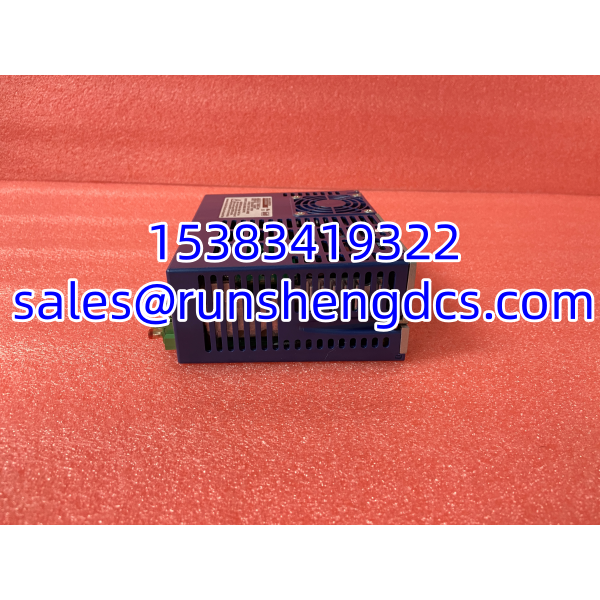
KOLLMORGEN S20660-SRS
Application Scenarios
- Packaging machine indexing axes: Cam-driven pick-and-place stations where tight velocity control and fast stop/start cycles are required.
- Semiconductor handling subsystems: Wafer transfer modules running legacy Kollmorgen motion architectures with SynqNet backbone.
- Web processing lines: Tension-controlled unwind/rewind stations where torque mode operation and analog reference input are used.
- OEM machine retrofits: Replacing a failed drive on an existing AKM motor without rewiring the resolver or changing the network topology.
FAQ
1. What does the “-SRS” suffix mean?
It indicates resolver feedback. The S20660-SRS is configured for motors with resolver-based position feedback, not EnDat or incremental encoders.
2. What current can this drive deliver continuously?
9.0 ARMS at 0–30°C ambient. It derates to 6.0 ARMS at 40°C and 4.0 ARMS at 50°C. If your cabinet runs hot, plan accordingly.
3. Does it support EtherNet/IP or EtherCAT?
No. The S20660-SRS uses SynqNet via RJ-45. If your machine runs EtherCAT or EtherNet/IP, this drive is not a direct drop-in replacement without network architecture changes.
4. Can I use it with a non-Kollmorgen motor?
Technically possible with careful configuration, but the platform is optimized for Kollmorgen motors with electronic motor nameplate support. Using a third-party motor requires manual parameter entry and carries higher commissioning risk.
5. Is this drive still available new?
The series is legacy. Most available stock is surplus, used, or refurbished. New sealed units are rare.
6. What software is used to configure it?
Kollmorgen tuning/configuration software via RS-232. Parameter sets can be saved to non-volatile memory or temporary RAM.
7. What should I check before installing a surplus unit?
Confirm SynqNet firmware variant, resolver compatibility, parameter backup availability, thermal derating conditions, and physical condition of the RJ-45 and power connectors.