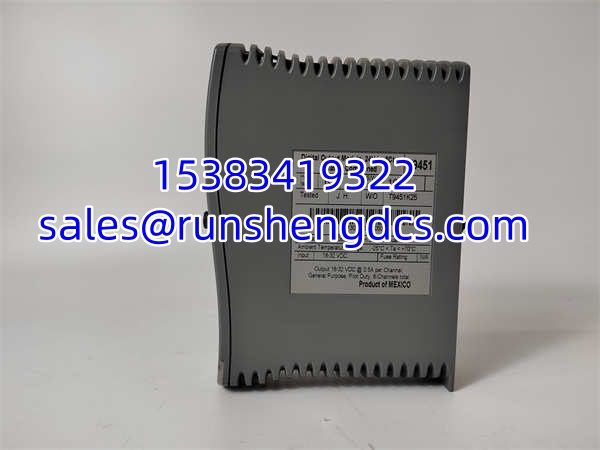

Description
Key Technical Specifications
| Specification | Details |
|---|---|
| Part Number | T9451 |
| Manufacturer | ICS TRIPLEX (Rockwell Automation Process & Safety) |
| Product Type | TMR (Triple Modular Redundant) Digital Output Module |
| Compatible Platforms | ICS TRIPLEX Trusted TMR system, AADvance safety system |
| Number of Channels | 8 independent digital output channels |
| Output Type | Sourcing digital output (NPN/PNP configurable depending on system variant) |
| Rated Output Voltage | 24/48V DC (supports both voltage levels) |
| Maximum Load Voltage | Up to 32V DC per device (some sources cite up to 60V DC depending on configuration) |
| Continuous Output Current | 1A per channel (some sources cite 0.75A–2A depending on revision and temperature derating) |
| Redundancy Architecture | TMR — each output channel internally tripled with hardware voting; single-point fault tolerant |
| Safety Integrity Level | SIL 3 (AADvance) / SIL 4 (Trusted TMR system-level certification); certification level depends on the host platform and application configuration |
| Fault Switching / Voting | Hardware-implemented majority voting; fault detection and masking within the module’s scan cycle (sub-millisecond range) |
| Diagnostics | Per-channel voltage and load current monitoring, reverse current protection, short-circuit and open-circuit line detection, LED status indicators |
| Hot-Swap Capability | Yes — supports replacement under power without system shutdown |
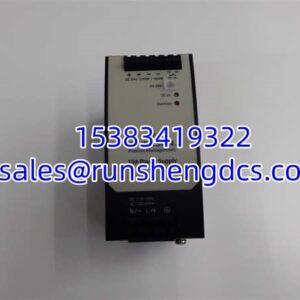
| Power Supply | 24V DC system power; supports dual redundant field power input (no external diodes required) |
| Power Consumption | <10W (module-level); varies with channel loading |
| Communication / Backplane | High-reliability backplane connection to Trusted/AADvance processor rack; no external communication ports on the module itself |
| Physical Connector | High-density industrial precision connector; mates with dedicated Field Terminal Assembly (FTA) |
| Operating Temperature | -40°C to +85°C (wide-temperature variant); some sources cite 0°C to 60°C for standard commercial-grade installations |
| Storage Temperature | -40°C to +85°C (typical industrial range) |
| Humidity | 5% to 95% non-condensing |
| Dimensions | Approximately 3.5″ × 19.8″ × 17.1 cm (varies by chassis configuration); module weight approximately 0.56 kg |
| Standards | IEC 61508 SIL 3/4, CE, UL (certifications vary by system generation and application) |
| Typical Applications | Emergency Shutdown (ESD), Fire & Gas (F&G), Turbine Control, Burner Management (BMS), High-Availability DCS output stages |
| Compatible Processor Families | Trusted TMR processors (T8111C, T8310, etc.), AADvance controllers |
| Compatible FTA | Trusted/AADvance digital output FTAs (model-specific; consult system documentation) |
Product Introduction
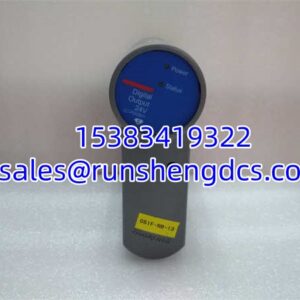
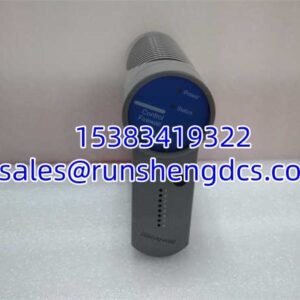
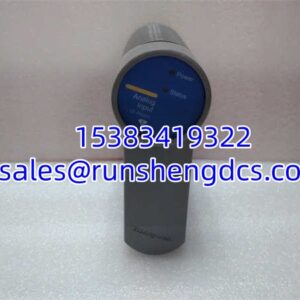
The ICS TRIPLEX T9451 is an 8-channel TMR digital output module — the kind of hardware you find driving shutdown valves, alarm horns, and turbine trip solenoids in a refinery’s safety instrumented system. It’s not a standard digital output card. Every one of its 8 channels is internally tripled: three independent output circuits per channel, with a hardware voter that compares all three on every scan. If one circuit fails open or shorted, the voter masks it and the channel continues to drive the field device correctly from the remaining two circuits. That’s the TMR promise — a single internal fault never causes a spurious trip and never prevents a required trip.
The T9451 sits in the ICS TRIPLEX Trusted or AADvance system rack, plugged into the backplane alongside the TMR processor module (such as the T8111C) and companion I/O modules. It receives output commands from the TMR processor over the backplane, converts them into field-level 24/48V DC signals, and drives the connected final elements — typically solenoid valves, relay coils, or indicator lamps. The module supports both 24V and 48V DC field power, which gives it flexibility across different installation standards. Each channel can source up to 1A continuously, which is enough to drive most industrial solenoids directly without an intermediate relay.
What sets the T9451 apart from a conventional DO module is the depth of its diagnostics. Each channel continuously monitors its own output voltage and load current. It detects short circuits (output shorted to ground or to another channel), open circuits (broken wire or failed solenoid coil), and reverse current (external voltage applied backward into the module). When a fault is detected, the module reports it to the processor via the backplane, and the processor logs it for the operator — all without interrupting the output state. This is critical in a safety system, where you need to know about a degraded channel during normal operation, not just when a trip is demanded.
The module is hot-swappable. If a T9451 develops a fault (indicated by its front-panel LED), a technician can pull it and insert a replacement without shutting down the rack or the process. The new module synchronizes with the TMR processor over the backplane, and the system resumes full triple-redundant operation. This is a major maintenance advantage over non-redundant systems, where replacing an output card requires a process shutdown.
One important clarification about the T9451’s product lineage: ICS TRIPLEX was acquired by Rockwell Automation, and the appears in both the Trusted TMR and AADvance product families. These are related but distinct platforms. The Trusted system is the older, established TMR platform with SIL 4 system-level certification. AADvance is a newer safety system platform, also TMR-based, typically certified to SIL 3. The module hardware is similar across both platforms, but the firmware, backplane protocol, and engineering software differ. A configured for Trusted will not work in an AADvance rack without reprogramming, and vice versa. When sourcing a replacement, always confirm which platform your rack is running.
The safety certification level (SIL 3 vs. SIL 4) is also worth understanding correctly. SIL 4 is the highest level under IEC 61508, but it’s rarely required in process industries — most ESD and F&G applications are designed to SIL 2 or SIL 3. The ‘s TMR architecture exceeds the hardware fault tolerance requirements for SIL 3, and when used in a properly designed Trusted system with appropriate proof testing, it can support SIL 4 applications. But the certification is a system-level attribute, not a module-level one. The by itself doesn’t “have” a SIL rating — it earns its rating as part of a certified system architecture.
Field wiring is handled through a dedicated Field Terminal Assembly (FTA). The doesn’t have screw terminals on its front panel. Instead, it plugs into the backplane, and the FTA — mounted on a DIN rail or in a termination cabinet — provides the screw-terminal blocks where the field wires land. The FTA also provides the field power distribution and may include fuse protection. This separation keeps the high-density module compact and moves the bulky terminal blocks to a more accessible location. When replacing a , you don’t touch the field wiring at all — you just unplug the module from the backplane and plug in the replacement.
The is still in active use but is increasingly considered a legacy component. New installations tend to favor newer ICS TRIPLEX / Rockwell I/O modules with Ethernet-based diagnostics and higher channel densities. However, there are thousands of modules still in service in oil & gas ESD systems, power plant turbine controls, chemical reactor safety systems, and pipeline compressor stations. Sourcing replacements is straightforward through independent industrial surplus dealers, but prices vary widely (from ~200 to over 1,000 USD depending on condition and platform). Always verify the firmware version and platform compatibility before purchasing.
Troubleshooting Quick Reference
| Fault | Likely Cause | Relevancy | Quick Check | Fix |
|---|---|---|---|---|
| Channel fault LED illuminated (single channel) | Short circuit, open circuit, or reverse voltage on the field wiring of that channel | ~30% | Check field wiring for shorts/opens; measure load current; verify field power voltage | Repair field wiring; replace faulty solenoid/relay; clear fault via engineering software after repair |
| Module fault LED illuminated (entire module) | Internal module failure, backplane communication loss, or firmware corruption | ~15% | Check backplane seating; verify rack power; review diagnostic logs in engineering software | Reseat module; check rack power supply; replace module if internal fault persists |
| Output not energizing when commanded | Field power missing, fuse blown on FTA, or channel inhibited in software | ~20% | Measure field power voltage at FTA terminals; check FTA fuses; verify channel is not inhibited in logic | Restore field power; replace blown fuse; remove software inhibition |
| Spurious output activation | External voltage back-fed into the module, or EMI-induced false trigger | ~10% | Check for external voltage sources connected to the output wiring; verify cable shielding | Install isolation relay; improve cable shielding and grounding; verify reverse current protection is functional |
| Intermittent channel faults | Loose FTA terminal connection, corroded wiring, or marginal solenoid coil resistance | ~15% | Check terminal screw torque at FTA; measure coil resistance of connected devices; inspect wiring for corrosion | Tighten terminals; replace corroded wiring; replace marginal solenoid |
| Module not recognized after hot-swap | Firmware version mismatch, or module not fully seated in backplane | ~5% | Verify replacement module firmware matches rack configuration; reseat module firmly | Update firmware on replacement module to match rack; reseat module; power-cycle rack if necessary |
| All channels on module show fault | Field power supply failure, or FTA backplane connector issue | ~5% | Measure field power voltage at FTA input; check FTA-to-module connector | Restore field power; reseat or replace FTA connector |
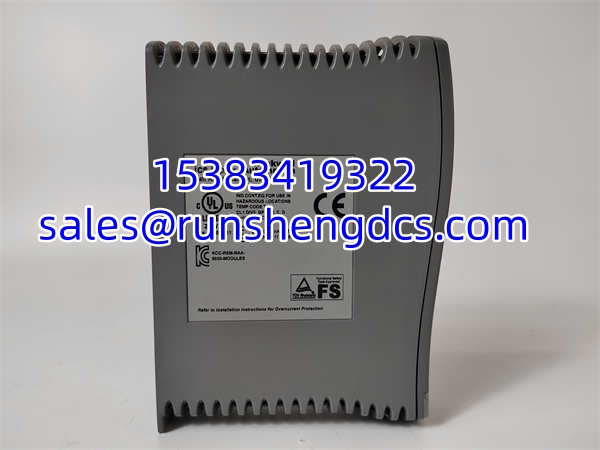
ICS TRIPLEX T9451
Application Scenarios & Pain Points
- Oil & gas (Emergency Shutdown Systems): Offshore platforms and onshore refineries use the to drive ESD valve solenoids — when the TMR processor detects a hazardous condition (overpressure, high temperature, gas detection), it commands the to de-energize the solenoid, causing the valve to fail-safe closed. The TMR architecture ensures that a single failed output circuit inside the won’t prevent the trip. The pain point: after 15–20 years, the electrolytic capacitors on the module’s internal power supply can degrade, causing intermittent module faults. Technicians often replace the module only to find the real issue was a marginal field power supply — always check field power voltage before swapping modules.
- Power generation (turbine trip systems): Combined-cycle and steam turbine installations use the to drive the turbine trip solenoid and auxiliary alarms. The fast hardware voting (<1ms) ensures that a trip command is executed immediately, without waiting for a software scan cycle. The pain point: solenoid coil inrush current. When a trip solenoid is de-energized, the collapsing magnetic field can generate a voltage spike that feeds back into the output channel. The ‘s reverse current protection handles this, but if a flyback diode is missing or failed on the solenoid, repeated spikes can eventually damage the output circuit. Always verify flyback diodes are present and functional on inductive loads.
- Chemical processing (reactor safety systems): Exothermic reactor installations use the to drive emergency cooling valve solenoids and agitator trip relays. The per-channel diagnostics are critical here — if a solenoid coil opens (due to corrosion or thermal cycling), the detects the open circuit and alerts the operator before a trip is actually needed. The pain point: field wiring in corrosive chemical environments. The ‘s open-circuit detection works, but by the time it triggers, the wiring may already be significantly corroded. Regular visual inspection of field wiring and FTA terminals is essential in these environments.
- Pipeline compressor stations: Natural gas compressor stations use the to drive shutdown valves and alarm horns on compressor units. The 48V DC capability is useful here, as some pipeline installations use 48V DC control power for longer cable runs (lower current = less voltage drop). The pain point: platform confusion. Some compressor stations were upgraded from Trusted to AADvance (or vice versa) without updating documentation, and maintenance teams order the wrong variant. Always confirm the rack’s platform (Trusted vs. AADvance) and firmware version before ordering a replacement.