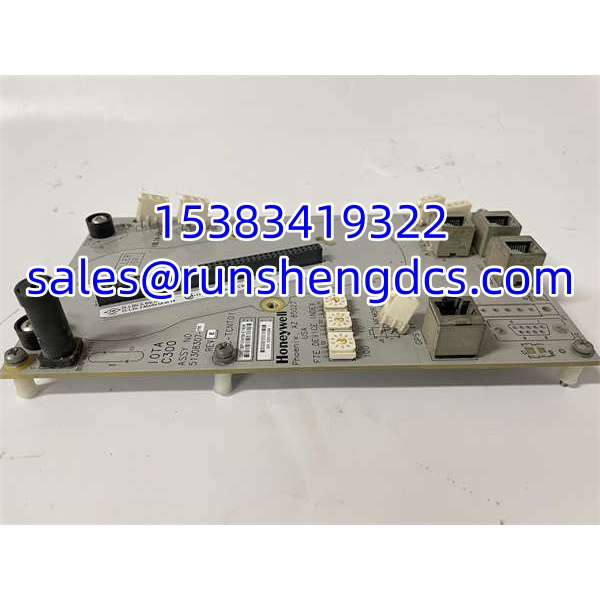

Description
Key Technical Specifications
| Parameter | Value |
|---|---|
| Product Type | C300 Control Processor IOTA board |
| Manufacturer | Honeywell |
| Order Code | CC-TCNT01 |
| Description | PWA, C300 Control Processor IOTA |
| Paired Controller | CC-PCNT01 C300 Control Processor |
| FTE Ports | FTE-A (yellow), FTE-B (green) RJ-45 |
| IOLINK Ports | IOL1A/IOL1B, IOL2A/IOL2B for C-Series I/O |
| Redundancy Interface | Redundancy port for primary/secondary controller link |
| Device Addressing | 3 rotary decimal switches (100/10/1) for FTE address |
| Battery Interface | MEMORY HOLD-UP connector for CC-SCMB02 backup battery |
| Power Connection | 24 VDC bus via IOTA carrier mounting screws |
| Documentation | Honeywell Experion PKS C300 hardware/installation manuals |
Product Introduction
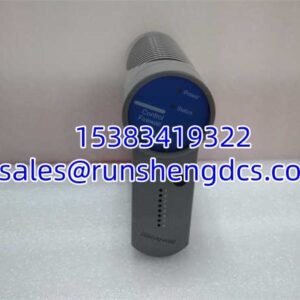
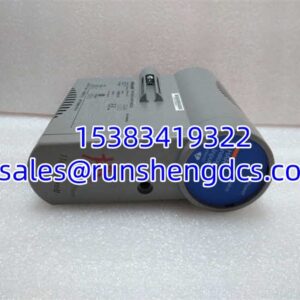
The CC-TCNT01 is the IOTA (Input/Output Terminal Assembly) baseplate that carries the Honeywell C300 control processor module — typically the CC-PCNT01 — in an Experion PKS C-Series control station. It is not the controller itself, not a servo motion controller, and not a generic PLC CPU board. Its job is to provide the physical and electrical interface between the C300 processor and the rest of the control system.
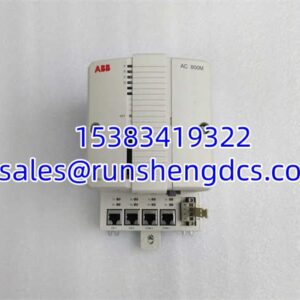
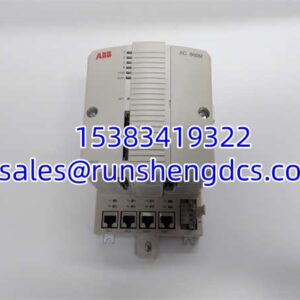
This IOTA board terminates the Fault Tolerant Ethernet (FTE) network connections, the IOLINK cables to local and remote C-Series I/O, the redundancy link between primary and secondary controllers, and the 24 VDC power feed from the cabinet bus. It also hosts the three rotary FTE device index switches that set the controller’s network address, and the memory hold-up battery connector for the CC-SCMB02 backup battery module.
Because the CC-TCNT01 sits at the center of controller communication, a damaged IOTA can produce symptoms that look like controller failure — FTE link loss, IOLINK timeouts, redundancy sync failures, or address conflicts. Always inspect the RJ-45 ports, IOLINK connectors, rotary switches, and battery connector before blaming the processor module.
QA/QC Transparency SOP
- Intake & Origin Verification — Record full code CC-TCNT01, serial number, and physical condition. Reject units with damaged RJ-45 ports, bent IOLINK pins, cracked rotary switches, or corroded 24 VDC bus contacts.
- Connector Integrity Testing — Verify continuity on FTE-A/FTE-B RJ-45 ports, IOL1A/IOL1B and IOL2A/IOL2B connectors, redundancy port, and memory hold-up battery connector. Check for open circuits or intermittent contacts.
- Rotary Switch Verification — Test all three FTE device index switches (100/10/1) for correct decimal addressing. Stuck or dirty switches can cause address conflicts on the FTE network.
- Live Functional Testing — Install on a C-Series test rack with a known-good CC-PCNT01 controller and CC-SCMB02 battery. Apply 24 VDC. Verify Power LED, Status LED behavior, FTE link establishment, and IOLINK communication.
- Final QC & Anti-Static Packaging — Seal in ESD bags with desiccant. Include test report, nameplate photos, rotary switch setting record, and a “verify with Honeywell manual before installation” warning.
Field Engineer Gotchas
- IOTA is not the controller. CC-TCNT01 is the baseplate; CC-PCNT01 is the processor module. Replacing the IOTA without checking the controller module, battery, or FTE cabling will not fix a processor fault.
- FTE address switches are critical. The three rotary switches set the controller’s FTE network address. Primary controllers use odd addresses; the address must match the Control Builder configuration exactly. A wrong switch setting produces communication failures that look like hardware faults.
- Redundancy cabling must be correct. In redundant configurations, the primary and secondary IOLINK cables must connect to the same IOLINK port pair on their respective IOTAs. Swapping IOLINK1 and IOLINK2 between primary and secondary causes sync failures.
- Battery connector matters. A missing or degraded CC-SCMB02 battery connection can cause database loss during power interruptions. Always verify the memory hold-up connector and battery health during IOTA replacement.
- Third-party descriptions are unreliable. Some vendors describe CC- as a servo motion controller, a high-precision positioning module, or a generic I/O card. Those are incorrect — it is a processor IOTA board.
- FTE cable color coding is standardized. FTE-A uses yellow cables; FTE-B uses green cables. Reversing them can cause network segmentation or redundancy failures.
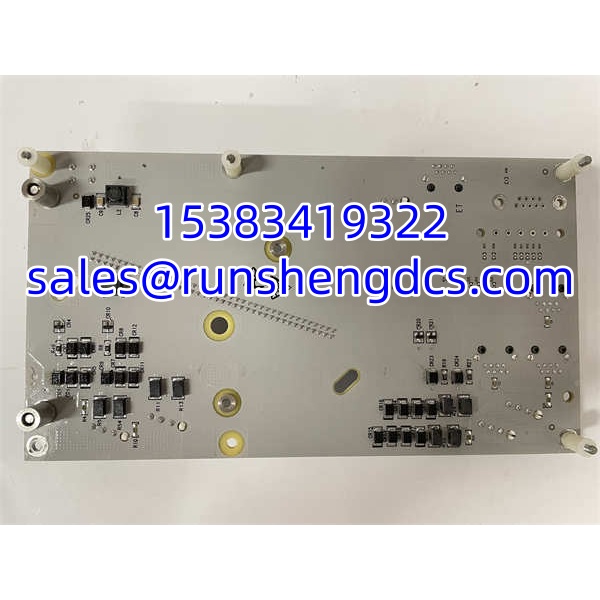
Honeywell CC-TCNT01
Application Scenarios
- The CC- IOTA is retained or replaced when swapping a failed CC-PCNT01 processor. FTE address switches and IOLINK cabling must be verified before power-up.
- Redundant controller migration. During a brownfield upgrade from non-redundant to redundant configuration, the IOTA provides the redundancy port and dual IOLINK paths needed for primary/secondary synchronization.
- FTE network troubleshooting. When a controller loses FTE communication, the IOTA’s RJ-45 ports, rotary switches, and 24 VDC bus connections are inspected before replacing the processor module.
- Spare pool build for C-Series control stations. Procured as a matched spare for sites running CC-PCNT01/CC- controller assemblies, with rotary switches pre-set to the site’s address standard.
FAQ
No. CC- is the IOTA baseplate. The controller module is CC-. The two assemble together to form the complete controller unit.
No. It is specifically designed for the control processor in the Experion PKS C-Series architecture. It is not compatible with HPM, PM, or C200 controllers.
What does the IOTA board do?
It provides FTE network ports, IOLINK ports to C-Series I/O, the redundancy interface, 24 VDC power connection, rotary FTE address switches, and the memory hold-up battery connector.
How do I set the FTE address?
Use the three rotary decimal switches on the IOTA (100/10/1). The address must match the Control Builder configuration. Primary controllers use odd addresses.
What battery does it need?
The CC-SCMB02 memory backup battery module connects to the MEMORY HOLD-UP port on the IOTA.
Is it hot-swappable?
Controller replacement procedures require careful coordination. Do not remove the IOTA or controller while the system is running without following Honeywell’s documented hot-swap and redundancy transfer procedures.
Where can I get the official manual?
Request the hardware and installation manual from Honeywell or an authorized distributor. Do not rely on third-party product descriptions, which frequently misidentify this part.