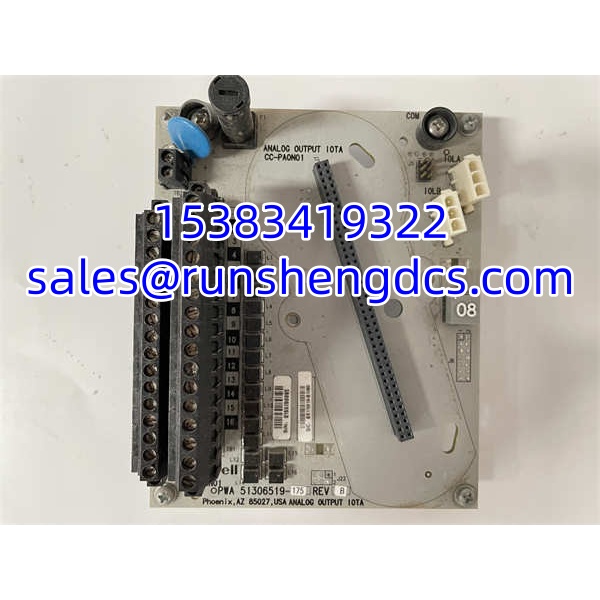

Description
Key Technical Specifications
| Parameter | Value |
|---|---|
| Product Model | CC-PAON01 |
| Assembly Reference | 51410070-175 (third-party listing) |
| Manufacturer | Honeywell |
| Product Family | Experion PKS / C300 PMIO, IOTA C Series I/O |
| Module Type | Analog Output (AO) module |
| Output Signal | 4-20 mA (typical AO range; verify per tag) |
| Channel Count | Typically 16 channels per C300 AO family; confirm on label |
| HART Support | Non-HART variant per catalog references (CC-PAOX01 / CC-PAON01 family) |
| Terminal Board | CC-TAOX01 (non-redundant) or CC-TAOX11 (redundant) |
| Controller Compatibility | Honeywell C300 Process Manager / Experion PKS |
| Configuration Tool | Honeywell Control Builder / Experion PKS configuration |
| Mounting | IOTA C Series PMIO rack |
| Typical Supply | 24 V DC system power (rack-dependent) |
| Operating Temperature | Verify on nameplate; public listings vary |
| Protection | IP20 typical for indoor rack-mounted I/O |
| Condition | Surplus/used unless factory-sealed with OEM documentation |
Product Introduction
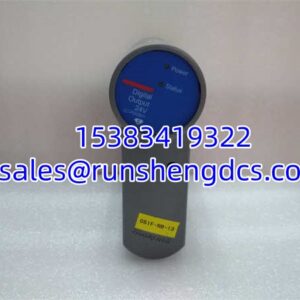
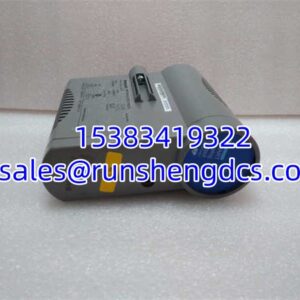
The Honeywell CC-PAON01 is an analog output module for the Experion PKS C300 PMIO architecture. It converts controller output values into analog current signals, typically 4-20 mA, to drive control valves, positioners, variable-speed drives, and other analog field devices.
Within the C300 I/O structure, the module plugs into an IOTA C Series PMIO rack and connects to the field through a dedicated AO terminal board. Configuration is handled in Control Builder, where each channel is mapped to a control tag, scaled to engineering units, and assigned failure-mode behavior. This module is typically used where HART communication is not required; HART-capable AO modules in the same family are designated differently, such as CC-PAOH01.
It is not a controller, communication gateway, analog input module, or digital I/O card. Several third-party listings misclassify CC-PAON01, so the nameplate and terminal board pairing should always be confirmed before procurement or replacement.
QA/QC Transparency SOP
- Identity Verification — Confirm model CC-PAON01 and assembly number 51410070-175 if present. Record serial number, hardware revision, and firmware.
- Mechanical Inspection — Check the IOTA connector, module latch, LEDs, and label. Reject units with bent pins, cracked housings, or missing labels.
- Rack Compatibility Check — Verify installation in a compatible PMIO rack with the correct CC-TAOX01 or CC-TAOX11 terminal board.
- Channel Output Test — Configure one or more channels to known 4-20 mA setpoints. Measure output current with a calibrated loop meter and verify linearity at 4 mA, 12 mA, and 20 mA.
- Failure Mode Verification — Test configured failure modes such as hold last value, drive to 0 %, or drive to 100 %. Confirm that the module responds correctly when the controller places the tag in manual failure state.
- Final Documentation — Record channel test results, terminal board type, rack slot, firmware revision, and condition. Package with ESD protection and include test summary.
Field Engineer Gotchas
- Confirm it is AO, not AI or communication. Public listings sometimes mislabel CC-PAON01. Cross-check against the terminal board: CC-TAOX01/CC-TAOX11 indicates AO.
- HART support is uncertain for this suffix. CC-PAOH01 is the HART-capable AO variant in many catalogs. CC- is typically non-HART.
- Terminal board must match. Using the wrong AO terminal board can cause wiring, redundancy, or channel-mapping errors.
- Channel count must be verified. Many AO modules are 16-channel, but the exact count should be confirmed from the nameplate or OEM documentation.
- Failure-mode configuration is critical. AO modules must be configured for safe output behavior on controller fault, communication loss, or tag failure.
- Legacy or surplus units may lack documentation. For safety-related loops, verify firmware, calibration status, and OEM support before deployment.
Application Scenarios
- Control valve output. The controller sends a 4-20 mA signal through CC- to a pneumatic positioner for flow, pressure, or level control.
- Redundant AO loop. Installed with a CC-TAOX11 terminal board, the module supports redundant analog output wiring for critical control valves.
- A failed AO card is replaced during a turnaround. The module is configured to match existing tag scaling and failure modes to avoid process disturbance.
- Actuator drive interface. Analog speed references for pumps or fans are generated by the and delivered through the AO module to variable-frequency drives.
FAQ
Yes, it is most consistently listed as a analog output module. Some third-party sources misclassify it, so the nameplate and terminal board should be verified.
Does it support HART?
CC- is typically a non-HART AO module. HART-capable analog output modules in the same family are usually designated CC-PAOH01.
What terminal board does it use?
It typically mounts on CC-TAOX01 for non-redundant AO or CC-TAOX11 for redundant AO.
Yes, when installed with the correct redundant terminal board and configured in Control Builder. Redundancy applies to the I/O subsystem, not just the module itself.
Is it still supported by Honeywell?
CC- is a legacy I/O module. Current availability, firmware support, and replacement guidance should be confirmed with Honeywell or an authorized distributor.