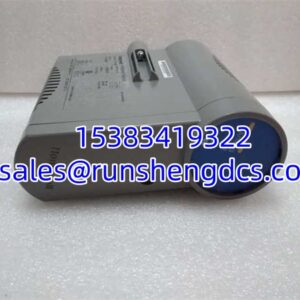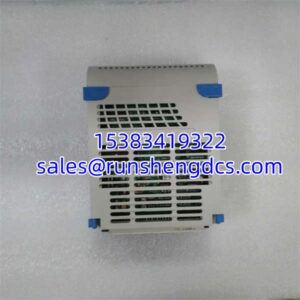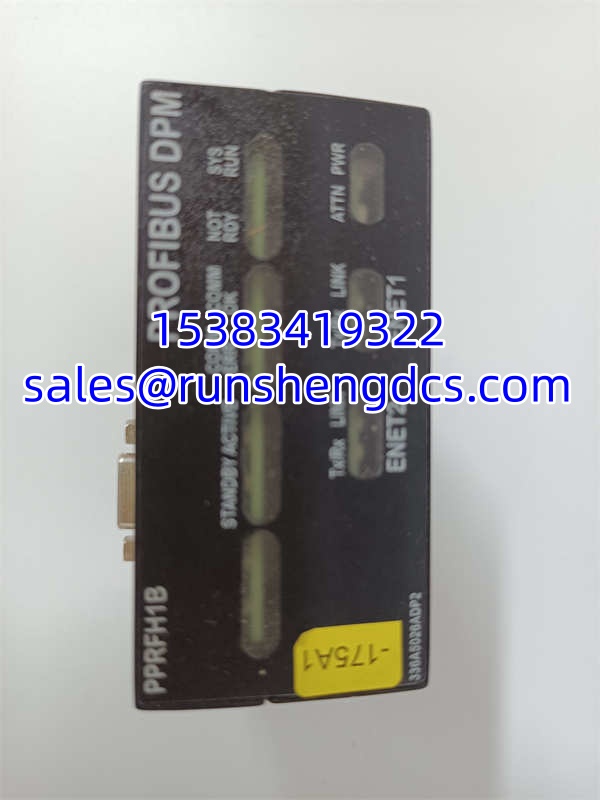

Description
Key Technical Specifications
| Parameter | Value |
|---|---|
| Product Model | IS220PPRFH1B |
| Alternate Part Number | 336A5026ADP2 |
| Manufacturer | GE (General Electric) |
| Product Type | PROFIBUS Master Gateway I/O Module (PPRF) |
| Compatible System | GE Mark VIe Speedtronic Turbine Control System |
| PROFIBUS Protocol | DPV0, DPV1 Class 1 Master |
| Maximum Slaves Supported | 125 PROFIBUS slave devices |
| I/O Data per Slave | 244 bytes input + 244 bytes output |
| Baud Rate Range | 9.6 KBaud to 12 MBaud (auto-negotiated) |
| Physical Interface | DE-9 D-sub female connector (RS-485) |
| Communication Module | Hilscher COM-C PROFIBUS communication module |
| Mounting Terminal Board | SPIDG1A (PROFIBUS Master Gateway Terminal Board) |
| Redundancy Options | Simplex (single I/O pack), Hot-backup (dual PPRF modules) |
| I/O Ethernet Connection | 1 or 2 Ethernet ports per I/O pack |
| Power Supply | 24VDC via I/O Ethernet backplane (shared with Mark VIe distributed I/O) |
| Diagnostic Indicators | Front-panel LEDs for visual status and fault diagnosis |
| Operating Temperature | -30°C to 65°C (conformal-coated for harsh environments) |
| Country of Origin | USA |
Product Introduction
A failed PROFIBUS gateway in a turbine control system doesn’t just lose a communication link — it severs the connection between the Mark VIe controller and every PROFIBUS field device on that segment: variable frequency drives controlling auxiliary motors, actuator positioners on fuel valves, flow meters on lube oil lines, and remote I/O drops distributing sensor signals across the turbine island. The GE IS220PPRFH1B sits at the protocol boundary of the Mark VIe Speedtronic architecture, translating between the I/O Ethernet network that the Mark VIe controller speaks and the PROFIBUS DP fieldbus that your field devices speak — making it the critical bridge that keeps the controller informed about, and in command of, the entire PROFIBUS device ecosystem.
This is GE’s PROFIBUS Master Gateway I/O module for the Mark VIe Speedtronic turbine control system, designed for gas turbine, steam turbine, and wind turbine applications in both power generation and mechanical drive service. The PPRF module functions as a PROFIBUS DPV0/1 Class 1 master, meaning it initiates all communication on the PROFIBUS segment, cyclically exchanging I/O data with up to 125 slave devices at baud rates from 9.6 KBaud up to 12 MBaud. Each slave can transfer up to 244 bytes of input data and 244 bytes of output data per cycle — more than sufficient for drive control words, actuator position feedback, analog process values, and discrete status signals. The module is built around a shared Mark VIe distributed I/O processor board paired with a Hilscher COM-C PROFIBUS communication module, a proven industrial communication ASIC that handles the PROFIBUS protocol stack in hardware for deterministic, low-jitter performance.
The physical PROFIBUS connection is made through a DE-9 D-sub female connector on the side of the module, carrying the RS-485 differential signaling that PROFIBUS requires. The PPRF mounts on the SPIDG1A terminal board, which provides the electronic ID that the Mark VIe system uses to automatically recognize and configure the module — no manual DIP switch or jumper settings required. Power is supplied through the shared Mark VIe I/O Ethernet backplane at 24VDC, the same distribution method used by all Mark VIe distributed I/O modules, simplifying power wiring and eliminating the need for a dedicated power supply.
Redundancy is supported in two configurations. In simplex mode, a single PPRF module with one or two I/O Ethernet connections serves the PROFIBUS segment — suitable for non-critical device networks where a brief communication loss is acceptable. In hot-backup mode, two PPRF modules are installed in the same I/O pack: one active, communicating with the PROFIBUS slaves, and one passive, synchronized and ready to take over seamlessly if the active module fails. This is essential for PROFIBUS segments that carry safety-related or process-critical signals where even a momentary communication gap could trigger an unwanted turbine trip.
The module features front-panel LED indicators that provide immediate visual diagnosis: communication status, module health, PROFIBUS bus activity, and fault conditions — allowing field technicians to quickly identify whether a problem is in the PPRF module itself, the PROFIBUS cabling, or a specific slave device without needing to connect a laptop. Bottom line — if your Mark VIe system has lost its PROFIBUS gateway, this module restores the communication bridge so your PROFIBUS field devices can once again exchange data with the turbine controller.
QA/QC Transparency SOP
- Intake & Origin Verification: Every GE IS220PPRFH1B is verified against GE part databases to confirm it’s a genuine Mark VIe PROFIBUS Master Gateway module. We check the model number, alternate part number (336A5026ADP2), and revision marking before it enters the test queue.
- Visual & Mechanical Inspection: The module is inspected for physical damage, corrosion, or burnt components. The DE-9 D-sub connector is checked for bent or missing pins and proper shell grounding. The I/O Ethernet RJ-45 ports are inspected for intact contacts. The SPIDG1A terminal board mating edge is examined for cleanliness and damage. Front-panel LEDs are verified to be intact and uncracked.
- Power-On & POST Test: The module is installed on a verified SPIDG1A terminal board with 24VDC I/O Ethernet backplane power applied. We verify the module powers up correctly, completes its power-on self-test, and the front-panel status LEDs indicate normal operation (no fault LEDs illuminated).
- I/O Ethernet Communication Test: The module’s I/O Ethernet ports are connected to a verified Mark VIe I/O Ethernet switch. We verify the module registers on the I/O Ethernet network, the Mark VIe controller recognizes it as a PPRF module via the SPIDG1A electronic ID, and the module appears in the I/O configuration tree without errors.
- PROFIBUS Master Function Test: The DE-9 PROFIBUS port is connected to a verified PROFIBUS slave device (or a PROFIBUS test fixture simulating multiple slaves). We verify: (a) the PPRF module establishes PROFIBUS communication at the configured baud rate, (b) cyclic I/O data exchange is established with the slave(s), (c) up to 125 slaves can be addressed (verified via test fixture), and (d) the 244-byte input/output data limit per slave is respected. Data integrity is verified by writing known test patterns to slave outputs and reading them back from slave inputs.
- Redundancy & Hot-Backup Test (if applicable): For hot-backup configurations, two PPRF modules are installed and we verify: (a) one module assumes the active role and communicates with PROFIBUS slaves, (b) the second module synchronizes as passive standby, (c) removing the active module causes the passive module to assume active control within the specified switchover time, and (d) PROFIBUS communication with slaves continues without interruption during the switchover.
- Baud Rate Range Verification: The module is tested at multiple baud rates across the 9.6 KBaud to 12 MBaud range to verify reliable communication at each speed. This ensures the module can accommodate PROFIBUS segments with mixed-speed devices or long cable runs that require lower baud rates.
- Final QC & Anti-Static Packaging: Passed modules are sealed in ESD-safe bags with desiccant, the DE-9 connector is capped to prevent pin damage and contamination, Ethernet ports are capped, and a QC sticker with test date, technician ID, and revision is applied.
Field Engineer Gotchas
- SPIDG1A Terminal Board Required: The IS220PPRFH1B does not mount directly in a standard Mark VIe I/O pack slot — it must be mounted on the PROFIBUS Master Gateway terminal board, which provides the electronic ID and mechanical interface. Attempting to install the PPRF without the will result in the module not being recognized by the Mark VIe controller. Verify the terminal board is present and properly seated before installing the PPRF module.
- PROFIBUS Termination & Biasing: PROFIBUS RS-485 segments require proper termination (120Ω resistors) at both ends of the bus and biasing to maintain the idle state. The IS220PPRFH1B does not include built-in termination resistors — these must be provided externally, typically in the last slave device’s connector or via a dedicated terminating resistor module. Missing or incorrect termination is the most common cause of PROFIBUS communication failures. Verify termination is enabled at both ends of the PROFIBUS segment and disabled on all intermediate devices.
- Baud Rate Configuration Mismatch: All devices on a PROFIBUS segment must operate at the same baud rate. The PPRF module’s baud rate is configured in the Mark VIe ToolboxST software. If a slave device is set to a different baud rate, it will not communicate. Verify the baud rate in ToolboxST matches the configuration of all PROFIBUS slave devices on the segment.
- 244-Byte I/O Limit per Slave: Each PROFIBUS slave can exchange a maximum of 244 bytes of input data and 244 bytes of output data with the PPRF master. If your slave device’s I/O mapping exceeds this limit, the excess data will be truncated and the device will not function correctly. Review the GSD file of each PROFIBUS slave to verify its I/O data length does not exceed 244 bytes in each direction.
- Hot-Backup Synchronization: In hot-backup configurations, the passive PPRF module must synchronize its PROFIBUS communication state with the active module. If the two modules have different firmware revisions or if the synchronization link is interrupted, the switchover may fail or cause a brief communication gap. Verify both PPRF modules in a hot-backup pair are the same hardware revision and firmware version.
- PROFIBUS Cable & Connector Quality: PROFIBUS communication is sensitive to cable quality, connector integrity, and grounding. Use only certified PROFIBUS cable (twisted pair with shield, 150Ω characteristic impedance) and genuine PROFIBUS connectors. Daisy-chain topology is required — star or tree topologies will cause reflections and communication failures. Inspect the entire PROFIBUS cable run for proper shielding, grounding at one end only, and correct daisy-chain topology.
- I/O Ethernet Network Dependency: The PPRF module communicates with the Mark VIe controller over the I/O Ethernet network. If the I/O Ethernet switch fails or the network is misconfigured, the PPRF module will lose communication with the controller even though the PROFIBUS segment itself is healthy. When troubleshooting PPRF communication issues, verify both the PROFIBUS segment and the I/O Ethernet network.
- GSD File Requirement: Each PROFIBUS slave device requires a GSD (General Station Description) file to be loaded into the Mark VIe ToolboxST software for proper configuration. Without the correct GSD file, the PPRF module cannot properly address the slave device. Collect GSD files from all PROFIBUS slave device manufacturers before configuring the PPRF module in ToolboxST.
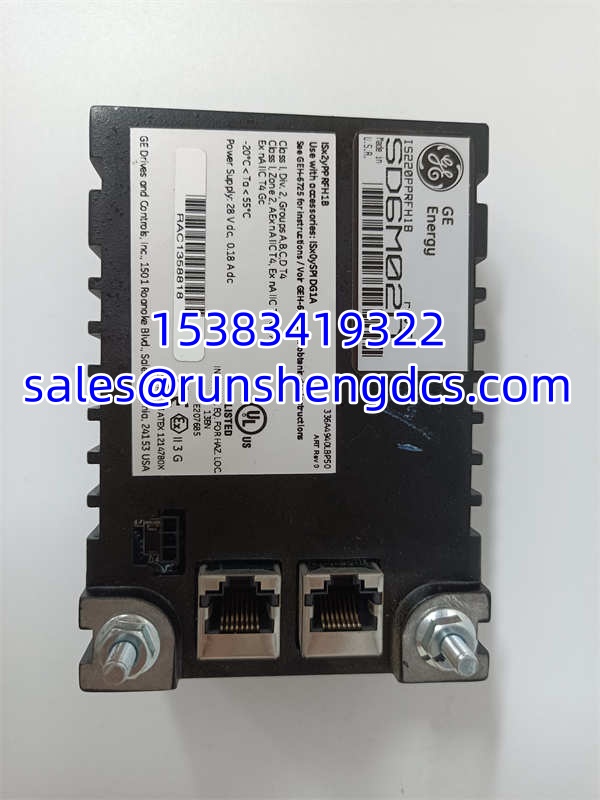
GE IS220PPRFH1B 336A5026ADP2
Application Scenarios
- Gas Turbine Combined Cycle — Auxiliary Drive Integration: In a GE Frame 7 gas turbine combined cycle plant, the Mark VIe controller uses the IS220PPRFH1B to integrate PROFIBUS-connected variable frequency drives (VFDs) that control the lube oil pump motor, hydraulic power unit pump, and cooling water circulation pump. The PPRF module exchanges control words (start/stop, speed reference) and status words (running, fault, actual speed) with each VFD cyclically at 1.5 MBaud. The operator can start and stop auxiliary motors from the Mark VIe HMI, and VFD fault codes are displayed on the HMI for rapid troubleshooting. A failed PPRF module would lose communication with all three VFDs, potentially causing the lube oil system to trip and initiating an unplanned turbine shutdown. This is why keeping a verified spare PPRF module on the shelf is critical for plants that rely on PROFIBUS-connected auxiliary drives.
- Steam Turbine — Remote I/O Drop for Field Instrumentation: In a coal-fired power plant’s steam turbine island, field instruments (pressure transmitters, temperature sensors, flow meters, valve positioners) are distributed across a large area. Rather than running individual instrument cables back to the control room, the instruments connect to PROFIBUS remote I/O drops (such as Siemens ET 200 or GE Fanuc RX3i PROFIBUS adapters) that aggregate the signals and communicate over a single PROFIBUS cable back to the in the Mark VIe rack. The PPRF module maps each remote I/O drop’s data into the Mark VIe controller’s I/O image, making the remote instruments appear as if they were locally connected. This reduces cable costs significantly and simplifies commissioning. The hot-backup redundancy configuration ensures that a single PPRF module failure doesn’t cause the loss of all remote instrumentation data.
- Wind Turbine — Pitch Drive & Yaw Drive Control: In a GE wind turbine equipped with the Mark VIe wind turbine control system, the serves as the communication gateway to the pitch drive controllers and yaw drive controllers, which are PROFIBUS-connected servo drives. The PPRF module exchanges pitch angle commands and actual position feedback with each blade’s pitch drive at high speed (12 MBaud), enabling precise blade pitch control for power optimization and overspeed protection. The yaw drive controllers receive yaw position commands and report nacelle orientation. The conformal coating on the PPRF module protects it from the harsh environmental conditions inside the wind turbine nacelle — temperature extremes, humidity, and vibration. A failed PPRF module would lose communication with the pitch drives, triggering an immediate emergency stop and feathering the blades via the backup battery-powered pitch system.
FAQ
A: The is a PROFIBUS Master Gateway I/O module for the GE Mark VIe turbine control system. It acts as a PROFIBUS DPV0/1 Class 1 master, enabling the Mark VIe controller to communicate with PROFIBUS slave devices such as VFDs, actuators, remote I/O drops, and instrumentation.
Q: How many PROFIBUS slaves can this module support?
A: Up to 125 PROFIBUS slave devices per PPRF module, with up to 244 bytes of input data and 244 bytes of output data per slave.
Q: What baud rates are supported?
A: 9.6 KBaud to 12 MBaud, auto-negotiated with each slave device. The actual baud rate is configured in ToolboxST and must be compatible with the cable length and all slave devices on the segment.
Q: What terminal board does this module require?
A: The mounts on the PROFIBUS Master Gateway terminal board, which provides the electronic ID for automatic module recognition by the Mark VIe controller.
Q: Can this module be used in a redundant configuration?
A: Yes. In hot-backup mode, two PPRF modules are installed — one active and one passive standby. If the active module fails, the passive module takes over seamlessly without interrupting PROFIBUS communication.
Q: Does this module include PROFIBUS termination resistors?
A: No. PROFIBUS termination (120Ω resistors) must be provided externally, typically in the last slave device’s connector or via a dedicated terminating resistor module. The PPRF module itself does not include built-in termination.
Q: What communication interface does the PROFIBUS connection use?
A: A DE-9 D-sub female connector carrying RS-485 differential signaling, per the PROFIBUS DP physical layer specification.
A: The Mark VIe platform continues to be supported by GE Vernova, but specific module revisions may be discontinued. The is available as surplus stock from secondary suppliers. For new installations, verify GE Vernova’s current Mark VIe I/O module offerings for the latest revision.
Q: What’s the lead time for a replacement?
A: Surplus stock is typically available for 1-3 day shipment. Since the PPRF module is the sole communication path between the Mark VIe controller and all PROFIBUS field devices on its segment, a failed module can cause loss of critical drive control, instrumentation data, and remote I/O — potentially tripping the turbine. We strongly recommend keeping a verified spare on the shelf.