
Description
Key Technical Specifications
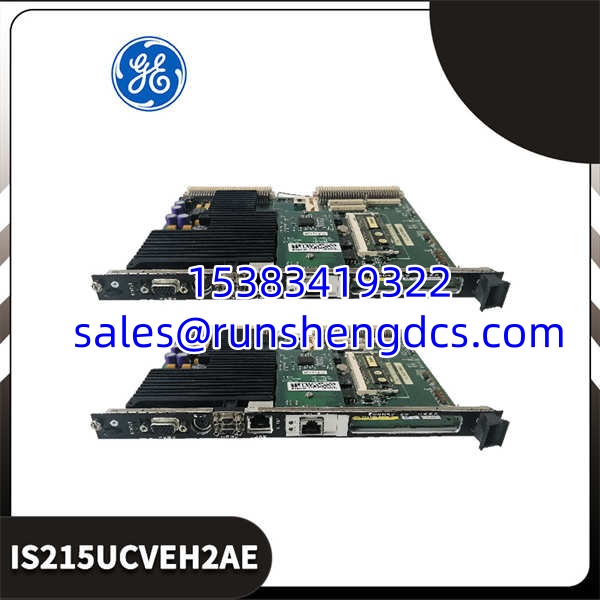
- Product Type: Universal Controller CPU Board
- Compatible Systems: GE Mark VI, Mark VIe, EX2100e
- Processor: Intel Celeron 300 MHz
- Memory: 32 MB DRAM, 16 MB to 128 MB Flash
- Input Voltage: 24V DC
- Bus Architecture: VME64
- Communication: 10/100 Mbps Ethernet, RS-485/RS-232
- Operating Temp: -40°C to +85°C
- Physical Form Factor: Standard VME Card (~233mm x 173mm x 25mm)
- Diagnostics: Front-panel LED status indicators
Product Introduction
Gas turbines don’t tolerate latency. When a turbine trips because the controller missed a temperature spike, the cost isn’t measured in parts—it’s measured in lost generation. The GE IS215UCVEH2AE is the brain inside the Mark VI and EX2100e racks, executing control logic on a hard real-time schedule. It reads analog inputs, calculates firing limits, and drives actuators with deterministic timing that standard PLCs simply cannot guarantee.
This board runs on a 300 MHz Celeron with 32 MB DRAM, which sounds ancient by IT standards but is exactly what you want in safety-critical control. Predictable execution beats raw speed every time. The 24V DC input and VME64 backplane interface make it a drop-in replacement for failed UCVEH2 boards in aging turbine control systems. Bottom line — if your Mark VI is throwing “Controller Fault” or “Watchdog Timeout,” this is likely your culprit. But verify the suffix; AE and BE revisions aren’t always cross-compatible.
QA/QC Transparency SOP
- Intake & Origin Verification: We validate the IS215UCVEH2AE suffix against GE’s internal revision tracking. Visual inspection checks for capacitor bulging, thermal damage on the Celeron heatsink, and VME connector pin integrity.
- Live Functional Testing: The board is installed in a live Mark VI test chassis. We verify 24V DC regulation, confirm the processor boots, and check that all front-panel LEDs sequence correctly during POST.
- Electrical Parameter Tests: Using a Fluke 115, we measure 5V and 3.3V rail ripple under load. Any deviation beyond ±5% triggers a failure. We also verify VME backplane signal integrity with an oscilloscope.
- Firmware/Config Verification: We read the Flash memory to log the exact firmware version and hardware revision. This ensures you’re not installing a board with incompatible firmware in your existing TMR configuration.
- Final QC & Anti-Static Packaging: Passed units receive a test report documenting boot sequence, power rail measurements, and firmware version. Sealed in ESD-safe packaging with humidity indicators.
Field Engineer Gotchas
- Suffix Matters: IS215UCVEH2AE is not the same as IS215UCVEH2BE. The suffix indicates hardware revision and factory firmware. Mixing revisions in a TMR (Triple Modular Redundancy) rack will cause synchronization failures. Always match the exact suffix on your existing board.
- VME Seating Force: VME connectors have hundreds of pins. If you don’t feel uniform resistance during insertion, stop. Bent pins on the backplane are a $10,000 mistake. Use the proper VME extraction/insertion tool, not a screwdriver as a lever.
- 24V DC Power Quality: This board requires clean 24V DC. I’ve seen “bad CPU” diagnoses that were actually failing power supplies with excessive ripple. Measure the 24V at the board’s input terminals, not at the power supply. Voltage drop across corroded wiring can cause intermittent resets.
- Flash Memory Degradation: These boards are 15+ years old. The Flash memory can develop bad blocks. If you’re getting “Configuration Load Failed” errors after a successful POST, the Flash may be failing. Don’t assume it’s a firmware issue.
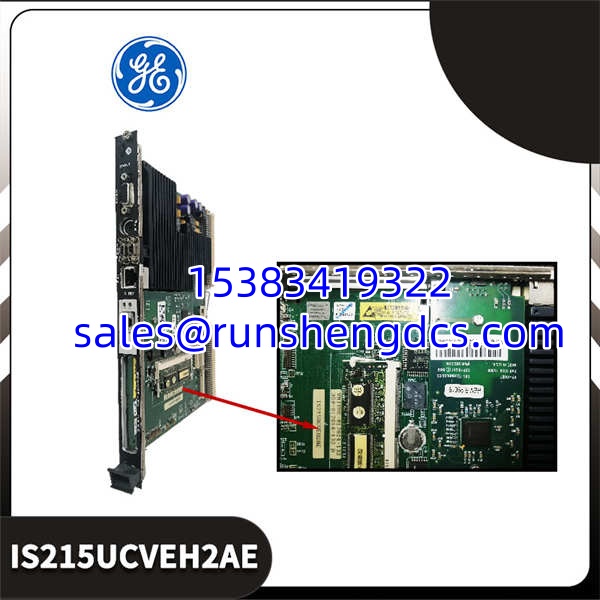
GE IS215UCVEH2AE
Application Scenarios
- Gas Turbine Primary Control: Executing speed/load control, temperature limiting, and startup sequencing in Frame 6/7/9 turbines where millisecond-level response prevents hot section damage.
- Steam Turbine EHC Systems: Managing electro-hydraulic control valve positioning with deterministic scan times that prevent steam chest pressure oscillations.
- EX2100e Excitation Control: Regulating generator field voltage during grid faults, where controller availability directly impacts grid stability.
FAQ
Can I mix UCVEH2AE and UCVEH2BE in a TMR rack?
No. Triple Modular Redundancy requires identical hardware revisions. Mixing suffixes causes synchronization faults and defeats the redundancy. All three processors must match exactly.
My board powers up but shows a solid red FAULT LED. What now?
Check the 24V DC input first. If power is good, the FAULT LED typically indicates a failed POST or corrupted Flash. Try reseating the board. If it persists, the board likely needs replacement. Don’t keep cycling power; you could corrupt the Flash further.
Is this board hot-swappable?
In a TMR configuration, Mark VI supports online module replacement. However, “supported” doesn’t mean “risk-free.” Verify the replacement board has the exact same suffix and firmware version before inserting. Mismatches during hot-swap can cause a TMR desync and potential trip.
What firmware does this board ship with?
Surplus boards ship with whatever firmware was last loaded. You must reflash to match your existing Mark VI configuration before installation. Use ToolboxST or the Mark VI Configuration Tool. Never install a board with mismatched firmware.
Can I use this in an EX2100e exciter?
Yes, but verify the part number. EX2100e systems use UCVEH2 boards, but some early units had different Flash configurations. Cross-reference your exciter’s documentation before ordering.
How do I verify Flash health before installation?
You can’t without test equipment. That’s why we test every board’s Flash and document it. If you’re buying from a vendor who can’t provide Flash verification, assume it’s a gamble.