
Description
Key Technical Specifications
| Parameter | Specification |
|---|---|
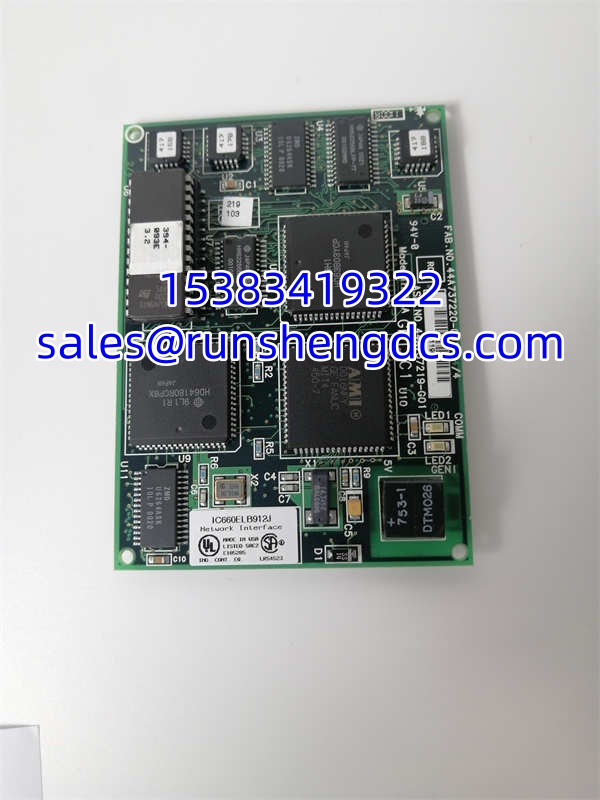
| Model | IC660ELB912J |
| Base Model | IC660ELB912 (µGENI / MicroGENI) |
| Manufacturer | GE Fanuc Embedded Systems / GE Intelligent Platforms |
| Product Family | Genius I/O Bus Interface – µGENI Daughterboard |
| Form Factor | Daughterboard (sub-board) — installs into PCIM host module |
| Compatible Host Modules | Single-slot or dual-slot IBM PC Interface Module (PCIM), e.g., IC660ELB921, IC660ELB921MM |
| Processor – Communication | 6303 serial interface microprocessor (handles Genius bus communication and data processing) |
| Processor – Management | 64180 microprocessor (independently manages system tasks and memory) |
| Memory | Dual-port RAM (shared between host CPU and µGENI) + 8 KB dedicated RAM (64180 exclusive); 16 KB total shared RAM |
| Genius Bus Capacity | Up to 30 Genius bus devices (remote I/O stations) per daughterboard |
| Communication Baud Rates | 38.4K, 76.8K, 153.6K bps (standard); 153.6K bps (extended) |
| Communication Redundancy | Dual redundant communication paths for enhanced network reliability |
| Genius Protocol Support | Global Data, Datagrams, Directed Control Data, background messaging independent of I/O commands |
| Status Indicators | 2× LEDs: GENI OK (module operation status), COMMS OK (communication status) |
| Bus Interface Chip | MIT chip — handles Genius bus hardware interface, error checking, LED driving, and timing |
| Power Requirement | +5 VDC ±5%, maximum 400 mA (supplied by host PCIM module) |
| Operating Temperature | -40°C to +85°C (wide industrial temperature range) |
| Storage Temperature | -40°C to +85°C |
| Installation | Installs into PCIM slot; secured with washers and screws |
| Hot-Swap Support | No — must be installed/powered down with host PCIM |
| Standards Compliance | Genius Bus protocol (GE proprietary); IBM PC/XT/AT compatible host interface |
| Status | Obsolete / Discontinued — available as surplus, refurbished, or new-old-stock |
| Typical Applications | PC-based supervision of Genius I/O networks, legacy SCADA host integration, distributed I/O control in power generation, oil & gas, manufacturing, and process industries |
Product Introduction
The IC660ELB912J is a Genius Bus network interface daughterboard (also called a “sub-board”) from GE Fanuc’s Genius I/O product line. It is not a standalone module — it must be installed into a compatible IBM PC Interface Module (PCIM) host card, such as the IC660ELB921 or IC660ELB921MM, which in turn plugs into an ISA slot of an IBM PC/XT/AT-compatible industrial computer.
What it does in the system:
The IC660ELB912J serves as the communication bridge between a host PC and a Genius I/O bus. Once installed, it allows the PC to:
- Control up to 30 remote Genius I/O devices on the bus — including digital I/O blocks, analog I/O blocks, smart transmitters, and other Genius-enabled field devices.
- Maintain a real-time data image of all controlled devices via dual-port RAM, ensuring the host CPU always has access to the latest I/O values without polling delays.
- Exchange background messages with other controllers on the same Genius network, independent of I/O scan commands — enabling peer-to-peer data sharing and distributed control.
- Monitor bus health via GENI OK and COMMS OK LEDs, providing immediate visual feedback on module operation and communication status.
Architecture overview:
The µGENI daughterboard uses a dual-processor architecture:
- The 6303 serial interface microprocessor handles all Genius bus communication — protocol encoding/decoding, error checking, timing, and data exchange with remote I/O devices. This offloads all bus-level communication from the host CPU.
- The 64180 management processor independently manages system tasks, memory allocation, and host interface coordination. It has 8 KB of dedicated RAM for its own operations.
- Dual-port RAM is shared between the host CPU and the µGENI processors, enabling high-speed, deterministic data exchange without bus contention. The host writes output values to the dual-port RAM, and the µGENI reads them and transmits them to the Genius bus. Input values from the bus are written by the µGENI into the dual-port RAM for the host to read.
Communication capabilities:
The IC660ELB912J supports multiple configurable baud rates: 38.4K, 76.8K, and 153.6K bps (standard), plus a 153.6K extended mode. When two daughterboards are installed in a dual-slot PCIM and connected to the same Genius bus, both must be configured to the same baud rate. The board supports dual redundant communication paths, meaning if one communication path fails, the other can maintain bus connectivity — a critical feature for high-availability applications in power generation and process industries.
Genius protocol support:
The daughterboard implements GE’s proprietary Genius Bus protocol, which includes:
- Global Data — broadcast data shared across all devices on the bus
- Datagrams — point-to-point messages between specific devices
- Directed Control Data — targeted I/O commands to specific devices
- Background messaging — non-I/O data exchange that runs independently of the I/O scan cycle
Status indication:
Two LEDs provide at-a-glance diagnostics:
- GENI OK — indicates the µGENI daughterboard is operating correctly
- COMMS OK — indicates successful communication with the Genius bus
If either LED is off or flashing, it indicates a fault condition that can be diagnosed via the host PC’s Genius configuration software.
Power and installation:
The daughterboard draws +5 VDC ±5%, maximum 400 mA from the host PCIM module — it does not have its own power connector. It installs into the PCIM’s daughterboard slot and is secured with washers and screws. The PCIM host module itself plugs into an ISA slot of an IBM PC/XT/AT-compatible computer.
Operating environment:
The IC660ELB912J is rated for -40°C to +85°C operating temperature, making it suitable for harsh industrial environments including outdoor installations, unheated warehouses, and process plants with wide temperature swings.
Troubleshooting Quick Reference
| Fault Symptom | Likely Cause | Probability | Quick Check | Fix |
|---|---|---|---|---|
| GENI OK LED off | Daughterboard not seated properly; host PCIM not powered; 5 VDC supply absent | ~25% | Verify PCIM is fully seated in ISA slot; measure +5 VDC at PCIM power pins; reseat daughterboard | Reseat daughterboard firmly; verify PCIM power supply; replace PCIM if +5 VDC is absent. |
| COMMS OK LED off or flashing | Genius bus wiring fault; baud rate mismatch; no devices responding on bus | ~30% | Check Genius bus cable connections; verify baud rate configuration matches other devices on bus; check for bus terminator | Verify bus wiring polarity and continuity; configure correct baud rate in Genius software; install bus terminator at end of bus segment. |
| Host PC cannot read/write I/O data | Dual-port RAM not initialized; Genius configuration software not loaded; driver mismatch | ~20% | Verify Genius configuration software is running; check device driver installation; confirm I/O block addresses match configuration | Reinstall Genius configuration software and drivers; verify I/O block addressing in software matches physical bus layout. |
| Intermittent communication drops | Bus cable damage; electrical noise interference; loose daughterboard connection | ~15% | Inspect Genius bus cables for damage; check for EMI sources near bus cabling; verify daughterboard retention screws are tight | Replace damaged bus cables; route bus cables away from high-voltage or high-current conductors; tighten daughterboard retention hardware. |
| Only some I/O devices respond | Device address conflict; faulty Genius I/O block; bus segment isolation issue | ~10% | Check device addresses in Genius configuration software; swap suspected faulty block with known-good unit | Resolve address conflicts in software; replace faulty I/O block; verify bus segment integrity. |
| Daughterboard overheats | Insufficient airflow in PC host; PCIM power supply overloaded | ~5% | Check PC chassis airflow; measure PCIM +5 VDC current draw (should be <400 mA) | Improve PC chassis ventilation; verify no other daughterboards or options are overloading the PCIM power budget. |
| Baud rate mismatch error | Two daughterboards on same bus set to different baud rates | ~5% | Check baud rate configuration of all daughterboards connected to the same Genius bus | Set all daughterboards on the same bus to identical baud rate; save configuration and restart. |
GE IC660ELB912J
Application Scenarios & Pain Points
PC-based SCADA host for a water treatment plant. A municipal water treatment facility used a Windows NT industrial PC with an IC660ELB921 PCIM host card and IC660ELB912J daughterboard to supervise a distributed Genius I/O network spanning 25 remote I/O blocks across the plant. Pain point: after a lightning strike, the COMMS OK LED began flashing intermittently, and several remote I/O blocks became unreachable. Investigation revealed that the lightning-induced surge had damaged the Genius bus cable shield at one junction box, creating a ground loop. The fix: replacing the damaged bus cable segment and installing a IC660ELB921M electronic line barrier (bus isolator) to provide 1500 VAC isolation between bus segments, preventing future surge propagation.
Legacy turbine control PC interface. A combined-cycle power plant used a PC with daughterboard to interface with a Genius I/O network controlling auxiliary systems on a gas turbine. Pain point: after the original industrial PC failed, a replacement PC with a different ISA bus timing caused the dual-port RAM to fail initialization, resulting in no I/O data exchange. The fix: adjusting the ISA bus wait-state settings in the replacement PC’s BIOS to match the timing expectations of the PCIM/µGENI hardware. Lesson: when replacing the host PC for a µGENI system, always verify ISA bus compatibility and timing settings.
Manufacturing line distributed I/O. An automotive parts manufacturer used multiple PCs with daughterboards to supervise Genius I/O networks on three assembly lines. Pain point: one daughterboard’s GENI OK LED went dark after a power outage, and the board would not reinitialize. The root cause was a depleted CMOS-like configuration memory on the PCIM host module (not the daughterboard itself), which lost its baud rate and device configuration. The fix: reconfiguring the PCIM via Genius software and saving the configuration to nonvolatile memory. As a preventive measure, the facility implemented annual configuration backups for all Genius network hosts.
Oil & gas remote station monitoring. An oil production facility used -equipped PCs to monitor remote wellhead I/O via Genius bus over long-distance shielded cable runs. Pain point: communication drops increased during thunderstorm season due to induced noise on the long bus cables. The fix: installing electronic line barriers (IC660ELB921M) at strategic points along the bus to segment the network electrically, limiting the impact of noise-induced faults to individual segments rather than the entire bus.