
Description
Key Technical Specifications
| Parameter | Specification |
|---|---|
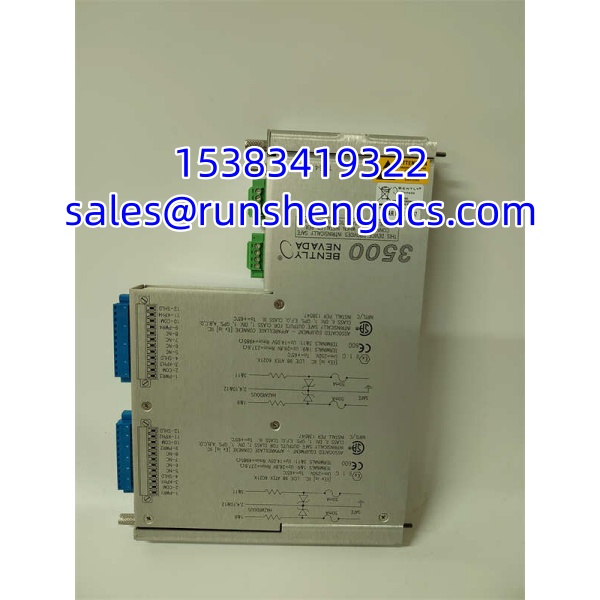
| Part Number | 135473-01 |
| Module Designation | 3500/40M Proximitor Monitor |
| Channels | 4 proximity probe inputs |
| Sensor Compatibility | Bently Nevada 3300 XL series (5mm, 8mm, 11mm) and compatible proximity probes |
| Measurement Types | Radial vibration, thrust/axial position, differential expansion, eccentricity, REBAM |
| Channel Pairing | Channels 1-2 and 3-4 configured as pairs; each pair can run a different measurement function |
| Alarm Levels | Programmable Alert and Danger setpoints per static value; up to two Danger setpoints per channel |
| TMR Support | Yes — three modules for 2oo3 voting via relay module |
| Power Consumption | Typical ~9 W (verify with OEM datasheet) |
| Operating Temperature | -30 °C to +65 °C |
| Storage Temperature | -40 °C to +85 °C |
| Humidity | Up to 95% non-condensing |
| Configuration | 3500 Rack Configuration Software (P/N 3500/01) via 3500/22M TDI |
| Hot-Swap | Yes — replaceable while rack is powered |
| Standards Compliance | API 670 (when properly configured with required relay modules) |
Product Introduction
A steam turbine trips on high radial vibration at 3,400 rpm, and the post-mortem reveals the 3500/40M channel had been configured for thrust position instead of radial vibration. The wrong measurement type, the wrong alarm thresholds — a silent misconfiguration that nearly destroyed a $2M rotor. The 3500/40M (135473-01) is the module that sits between the proximity probes and the trip logic, converting raw -24 VDC to -2 VDC probe signals into meaningful engineering units and comparing them against setpoints that should stop the machine before catastrophic damage occurs.
The 135473-01 is the 4-channel variant of the 3500/40M proximitor monitor. It handles radial vibration on journal bearings, thrust position on Kingsbury bearings, differential expansion between rotor and casing, shaft eccentricity during slow-roll, and REBAM (radial vibration by axis measurement). Channels are paired — 1-2 and 3-4 — so each pair can run a different function. In TMR configuration, three 3500/40M modules vote 2oo3 to eliminate single-point failures. The module stores its configuration in dual-region non-volatile memory, so a power cycle won’t wipe your setpoints. It’s been the backbone of API 670-compliant protection schemes for decades. Note: exact power draw and frequency response vary by firmware — verify with the OEM datasheet for your specific revision.
QA/QC Transparency SOP
- Intake & Origin Verification — Serial number and hardware revision logged. Visual inspection for burnt traces, corroded probe connectors, and bent backplane pins. Cross-reference against known OEM production batches for the 135473-01.
- Live Functional Testing — Module seated in a powered 3500 rack with a known-good 3500/22M TDI. All four channels stimulated with a calibrated proximity probe simulator (e.g., Bently Nevada probe simulator or equivalent). Radial vibration, thrust position, and differential expansion functions verified per channel pair. Alert and Danger setpoints confirmed via 3500/32 relay module output.
- Electrical Parameter Tests — Input impedance and signal conditioning verified on each channel. Insulation resistance (megger) tested between terminal block and chassis ground. Backplane continuity check on all pins.
- Firmware/Config Verification — Module firmware revision read via 3500 Rack Configuration Software. Configuration uploaded and compared against a known-good template. Dual-region non-volatile memory consistency check performed.
- Final QC & Anti-Static Packaging — Module removed from test rack, connectors capped, sealed in ESD bag with desiccant. Test report including channel-by-channel readings, firmware revision, and configuration backup included with shipment.
Field Engineer Gotchas
- Channel Pair Configuration Trap — The 3500/40M configures channels in pairs (1-2 and 3-4). If you’re monitoring radial vibration on bearings 1 and 2, and differential expansion on the same module, channels 1-2 must be set to radial vibration and 3-4 to differential expansion. You cannot mix measurement types within a pair. A technician who wired a differential expansion probe into channel 2 while channel 1 was set to radial vibration will get garbage readings. Always verify the channel pair configuration matches the physical wiring.
- 135473-01 vs. 135473-02 (M-Series Firmware) — The -01 suffix typically denotes the base 3500/40M monitor. The -02 suffix often indicates an M-series (enhanced) variant with updated firmware and possibly different frequency response characteristics. Swapping a -01 for a -02 without verifying firmware compatibility can cause setpoint mismatches or communication errors with the 3500/22M TDI. Check the nameplate suffix and firmware revision before installing.
- Probe Gap Voltage Must Be Verified After Replacement — A new 3500/40M module doesn’t automatically know the correct probe gap voltage. After installation, verify the gap voltage reading in the 3500 Configuration Software matches the expected value (typically -8 to -12 VDC for 3300 XL 8mm probes). An incorrect gap voltage means the probe isn’t properly positioned — and your vibration readings will be wrong regardless of the module’s accuracy.
- TMR Requires Three Identical Modules — You cannot run TMR with two 3500/40M modules. TMR requires three identical modules installed in adjacent slots, with 2oo3 voting configured in the 3500/32 relay module. A two-module setup is just dual redundancy — a single module failure takes out the vote. Also, all three modules must have matching firmware revisions.
- No 4-20 mA Outputs on the 3500/40M — The 3500/40M provides digital data to the rack backplane and drives relay trip logic. It does NOT provide 4-20 mA analog outputs. If your DCS expects analog vibration signals, you need a separate 3500/40M with recorder output option, or you pull the data via Modbus through the 3500/22M TDI. This is a common procurement mistake.
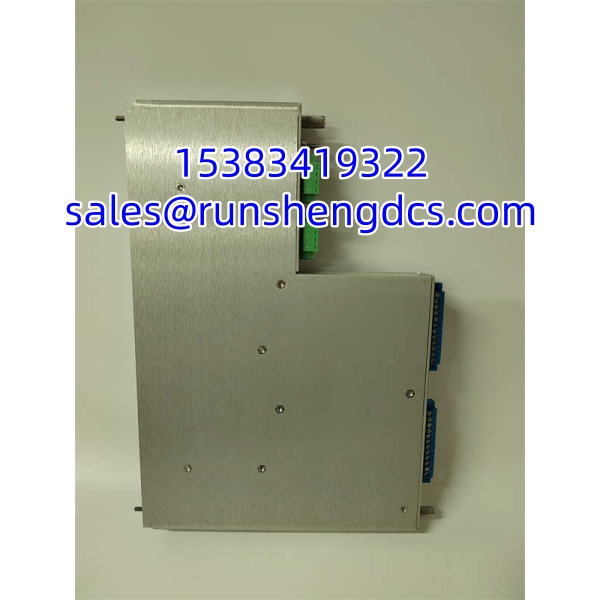
BENTLY 135473-01
Application Scenarios
- Steam turbine journal bearing protection — 3300 XL 8mm proximity probes on each bearing feed radial vibration signals into the 3500/40M. Alert at 25 μm peak-to-peak, Danger at 50 μm per API 670. The module’s sub-second update rate catches rub events and oil whirl before they escalate.
- Centrifugal compressor thrust bearing monitoring — A 3300 XL probe on the thrust collar measures axial position. The 3500/40M compares the reading against a programmable Danger setpoint. If the thrust bearing wears beyond the limit, the module triggers a trip via the 3500/32 relay — preventing rotor-to-stator contact.
- Large generator differential expansion monitoring — During startup and cooldown, the rotor expands and contracts at a different rate than the stator casing. The 3500/40M monitors differential expansion via a dedicated probe and triggers an alarm if the differential exceeds safe limits, preventing axial rubs during thermal transients.
FAQ
Q: What measurement types can the 3500/40M 135473-01 handle?
A: Radial vibration, thrust/axial position, differential expansion, eccentricity, and REBAM (radial vibration by axis measurement). Channels are paired (1-2 and 3-4), with each pair configurable for a different function.
Q: Does the 3500/40M provide 4-20 mA analog outputs?
A: No. The 3500/40M provides digital data to the rack backplane and drives relay trip logic via the 3500/32 relay module. For 4-20 mA outputs, you need a separate recorder output option or pull data via Modbus through the 3500/22M TDI.
Q: Can I mix radial vibration and differential expansion on the same 135473-01 module?
A: Yes, but only across channel pairs. Channels 1-2 can be configured for radial vibration while channels 3-4 are configured for differential expansion. You cannot mix measurement types within a single pair.
Q: Is the 3500/40M still manufactured?
A: No. It is a legacy product. Available units are surplus or refurbished. Always request a test report and verify the firmware revision before purchase.
Q: Can I hot-swap a 3500/40M module?
A: Yes. The 3500 rack supports hot-swapping of monitor modules. The replacement module loads its configuration from dual-region non-volatile memory. Verify firmware compatibility and probe gap voltages after installation.
Q: Does this module support TMR (Triple Modular Redundant) configuration?
A: Yes. Three identical 3500/40M modules installed in adjacent slots can vote 2oo3 via the 3500/32 relay module. All three must have matching firmware revisions.
Q: What probes are compatible with the 135473-01?
A: Bently Nevada 3300 XL series proximity probes (5mm, 8mm, 11mm) and compatible third-party probes with matching electrical characteristics. The 3300 XL 8mm probe is the most common choice for radial vibration and thrust position applications.