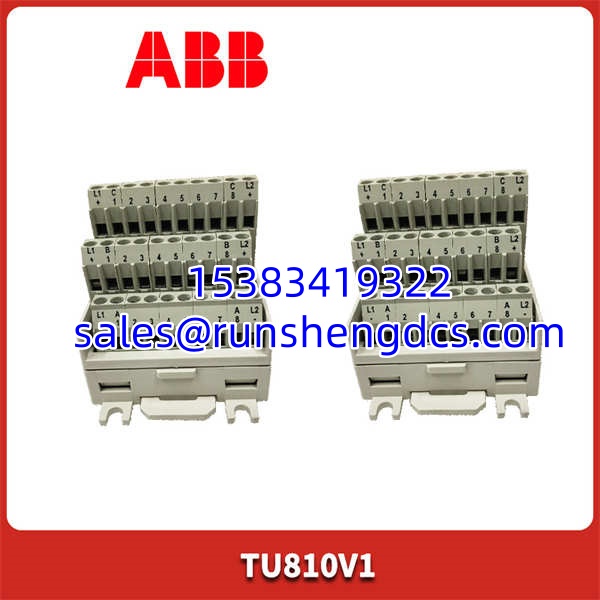

Description
Key Technical Specifications
- Product Type: Compact Module Termination Unit (MTU)
- Material Number: 3BSE013230R1
- Channel Count: 16 channels (2×8 signal terminals)
- Rated Voltage: 50VDC
- Max Current per Channel: 2A
- Max Process Connection Current: 5A
- Dielectric Withstand: 500V AC (1 minute)
- Connection Type: Spring clamp terminals (tool-free)
- Wire Size (Solid/Stranded): 0.2–4 mm² / 0.2–2.5 mm²
- Operating Temperature: -20°C to +70°C
- Protection Class: IP20
- Mounting: Standard 35 mm DIN rail
Product Introduction
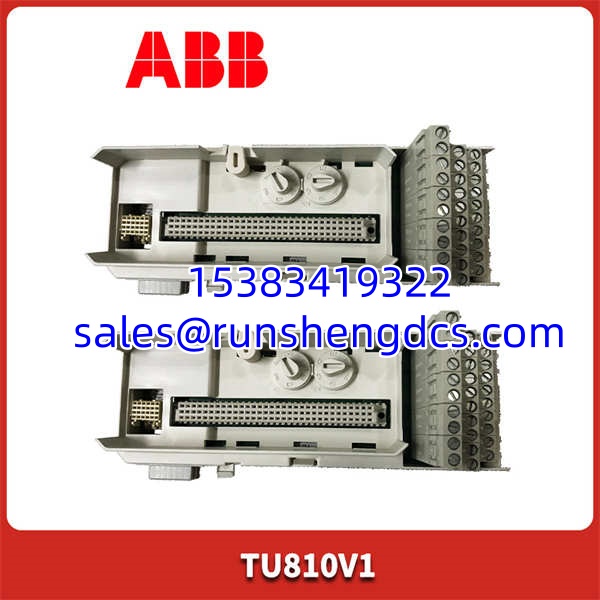
Field wiring failures in distributed I/O systems usually trace back to a degraded termination base. The ABB TU810V1 is a passive 16-channel wiring module designed specifically for the S800 I/O system and AC800M controllers. It acts as the physical bridge, routing field signals to the active I/O modules while distributing the internal ModuleBus to the next unit in the chain.
This base plate handles the mechanical and electrical heavy lifting. It features spring-clamp terminals for tool-free wiring and integrates shield grounding directly to the DIN rail. With a 50VDC rating and 2A per channel capacity, it reliably supports standard digital and analog I/O modules in harsh industrial environments. Bottom line — it’s a critical passive component, and swapping it correctly prevents expensive controller faults.
QA/QC Transparency SOP
We treat passive I/O bases with the same rigor as active controllers. Here is our verification process:
- Intake & Origin Verification: We cross-check the 3BSE013230R1 material number and batch codes against ABB documentation to eliminate grey-market fakes.
- Live Functional Testing: The MTU is mounted on a test rack with a compatible S800 I/O module. We inject signals through all 16 channels to verify continuity and proper ModuleBus routing.
- Electrical Parameter Tests: Using a calibrated Fluke meter, we verify the 500VAC dielectric isolation between channels and check the DIN rail ground path resistance.
- Mechanical Keying Verification: We inspect the dual mechanical keys for wear and confirm the specific 1-of-36 configuration matches the requested variant.
- Final QC & Anti-Static Packaging: Spring clamps are tested for tension. The unit is then sealed in an ESD-safe bag with shock-absorbing foam.
Field Engineer Gotchas
- Mechanical Keying Mismatch: The TU810V1 uses two mechanical keys with 6 positions each, creating 36 possible configurations. If you install a base with the wrong keying, the I/O module physically won’t seat. Solution: Always count the key positions on the old base. I once saw a tech force a DO810 module onto a mismatched TU810V1, bending the backplane pins and destroying a $2,000 I/O card. Never force it.
- ModuleBus Routing Failure: The MTU passes the ModuleBus to the next unit. If the internal routing contacts are corroded, the entire downstream I/O chain will drop off the network. Solution: If downstream modules show comm faults after replacement, check the ModuleBus continuity across the base.
- Spring Clamp Fatigue: After years of thermal cycling, spring clamps can lose tension, leading to intermittent field signal drops. Warning: Always give the wires a gentle tug after reseating them during a swap to ensure a solid bite.
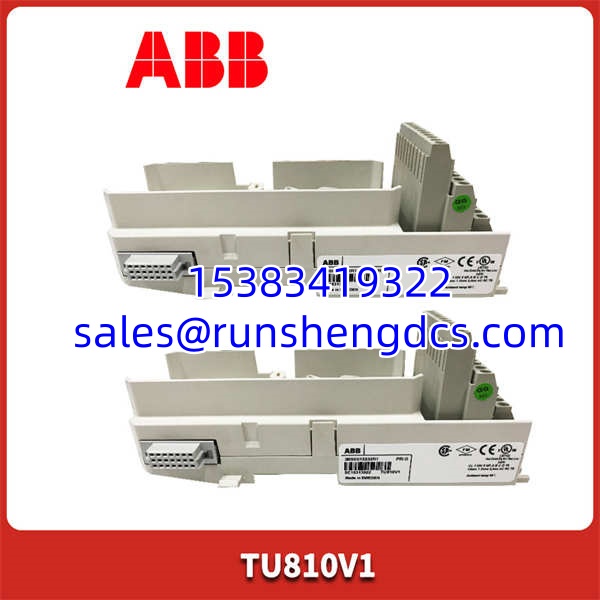
ABB-TU810V1
Application Scenarios
- Petrochemical Distributed Control: Requires reliable signal routing for hundreds of field transmitters in high-EMI environments.
- Power Plant Boiler Control: Demands precise thermocouple and RTD signal termination with proper shield grounding to prevent noise.
- Marine Propulsion Systems: Exposed to extreme vibration; requires secure spring-clamp connections that won’t back out.
- Legacy System Maintenance: Critical for keeping 15+ year old AC800M systems running without migrating to new hardware platforms.
FAQ
Q: Can I use a TU811V1 to replace this TU810V1?
A: They are similar but not always drop-in compatible. The TU811V1 typically supports different channel counts or voltage ratings. Always match the exact 3BSE013230R1 material number.
Q: Does this base plate require any software configuration?
A: No. The TU810V1 is entirely passive. It does not have firmware or require parameterization. Configuration is strictly mechanical (keying) and electrical (wiring).
Q: My I/O module won’t lock onto this new base. Why?
A: Check the mechanical keying. The dual keys must align perfectly with the module’s internal slots. If the keys are in different positions, the module will not seat. Verify the key configuration against your old base.
Q: Can I hot-swap this termination unit?
A: Absolutely not. While S800 I/O modules support hot-swapping, the MTU carries the ModuleBus and process power. Pulling it while energized will crash the entire I/O segment. Always schedule a maintenance window.
Q: What wire sizes are compatible with the spring clamps?
A: The clamps accept 0.2–4 mm² solid wire and 0.2–2.5 mm² stranded wire. Using wire outside this range will result in poor contact or physical damage to the terminal.