
Description
Key Technical Specifications
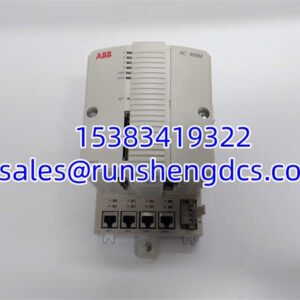
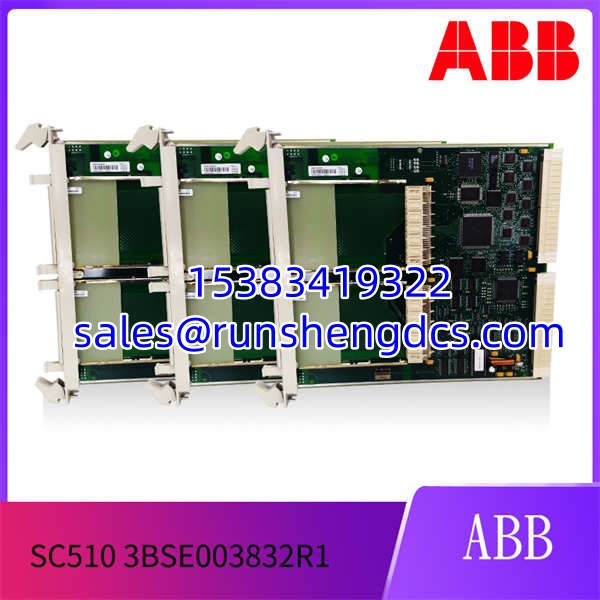
- Product Model: ABB SC510 3BSE003832R1
- Manufacturer: ABB
- Product Type: Submodule Carrier (No CPU)
- Bus Support: MasterBus 300 / 300E (via CPU)
- I/O Capacity: Supports up to 12 S800 I/O modules per carrier
- Power Supply: Requires external 24V DC (e.g., PS511)
- Mounting: Standard 35mm DIN Rail
- Dimensions: 486mm (W) x 22.5mm (H) x 115mm (D) (approx.)
- Weight: ~0.67 kg
- Operating Temp: 0°C to 60°C (verify with PSU derating)
Product Introduction
I’ve seen plants shut down because someone ordered a “CPU” but got a carrier, or vice versa. The ABB SC510 3BSE003832R1 is not a controller. It’s a passive backplane, a metal and plastic skeleton that holds your S800 I/O modules and routes the bus signals to the actual CPU. Think of it as the motherboard without the processor. If you’re replacing a failed unit, check your BOM twice; this part number is strictly for the carrier assembly.
Engineers keep the ABB SC510 3BSE003832R1 in stock because backplane connectors wear out after 20 years of thermal cycling. It supports the MB300/300E bus architecture, allowing you to daisy-chain up to 12 I/O modules in a single vertical stack. The specs are simple: no firmware, no memory, just copper traces and DIN rail clips. But when those traces corrode or the bus connector oxidizes, your entire I/O rack goes dark. Bottom line — it’s dumb hardware, but critical hardware.
QA/QC Transparency SOP
- Intake & Origin Verification: We verify the ABB SC510 3BSE003832R1 against ABB manufacturing records to confirm the 3BSE003832R1 part number matches the S800 carrier specifications, ensuring no cross-contamination with S900 or legacy AC 400 carriers.
- Live Functional Testing: Each unit is mounted on a test rack with a known-good CPU and PSU. We verify bus continuity across all 12 slots and confirm the “BF” (Bus Fault) LED behavior when modules are inserted/removed.
- Electrical Parameter Tests: Using a Fluke 115, we check continuity between the 24V DC input terminals and each module slot’s power pins. Insulation resistance is tested to ensure no internal shorts from moisture or conductive dust.
- Firmware/Config Verification: N/A (Passive Hardware). We verify the bus termination resistors (if integrated) and check for physical damage to the MB300E bus connectors.
- Final QC & Anti-Static Packaging: After passing all tests, the ABB SC510 3BSE003832R1 is sealed in anti-static shielding. A QC sticker with test date and technician ID is applied before shipping.
Field Engineer Gotchas
- Bus Termination Errors: The ABB SC510 3BSE003832R1 often has integrated termination resistors, but they can fail or be misconfigured via jumpers. I’ve seen “Bus Fault” LEDs stay red for days because the previous tech removed the terminator jumper during a swap. Always check the termination switch/jumper before powering up.
- Power Supply Sequencing: Never power the I/O modules before the bus is stable. If you plug in a 24V supply to the while the CPU is still booting, you can corrupt the bus initialization. Power the CPU first, wait for the “RUN” LED, then enable the I/O power.
- Connector Wear: The S800 backplane connectors are rated for ~50 insertions. I’ve seen carriers fail because someone swapped I/O modules weekly during commissioning. If you’re doing frequent changes, inspect the socket pins for spread or oxidation.
- MB300 vs MB300E Confusion: The supports both, but the bus speed and diagnostics differ. Mixing MB300 modules in an MB300E carrier (or vice versa) can cause intermittent timeouts. Check your CPU configuration in Control Builder.
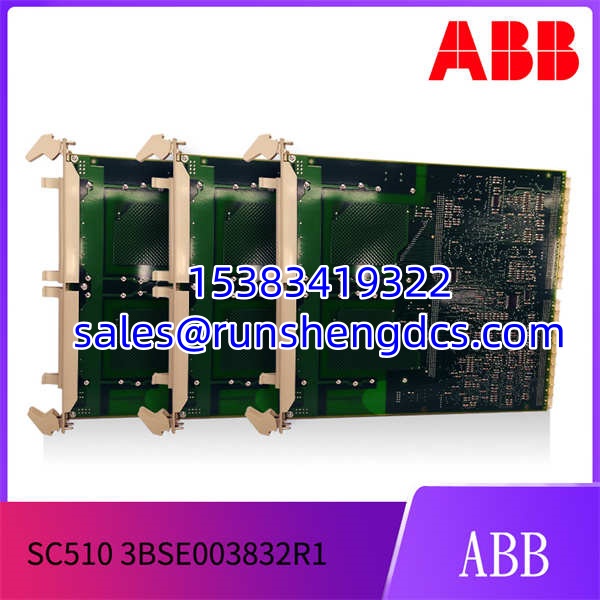
ABB SC510 3BSE003832R1
Application Scenarios
- Remote I/O Stations: Extending the DCS network to pump stations or valve manifolds where local processing isn’t needed, just signal gathering.
- Retrofit Projects: Replacing failed carriers in 20-year-old Advant OCS systems without upgrading the entire CPU architecture.
- Hazardous Area Interfaces: Housing intrinsically safe S800 I/O modules in safe-area carriers before routing signals to field barriers.
FAQ
No. The is strictly for S800 I/O. S900 modules use a different backplane connector and bus protocol. Don’t try to force it.
Does this carrier have its own IP address?
No. The is a passive device. It has no IP, no MAC address, and no firmware. It’s just a conduit for the CPU’s bus.
How many carriers can I daisy-chain?
Typically up to 4 carriers per CPU (48 I/O modules max), but verify with your CPU’s manual. The has bus extension ports, but signal degradation limits the chain length.
Is the 3BSE003832R1 suffix critical?
Yes. Suffixes often indicate minor revisions in bus connector materials or termination resistor values. If you can’t find the exact suffix, send us a photo of your old carrier’s label. We’ll verify compatibility.
Can I hot-swap I/O modules on this carrier?
Yes, the system supports hot-swapping, but the itself is not hot-swappable. Never pull the carrier while the bus is powered.
What’s the max cable length for the bus extension?
Keep it under 10 meters for MB300E. The uses shielded bus cables; longer runs require repeaters or fiber converters. Don’t guess on cable length.
Will this work with my old AC 400 system?
No. The is for Advant OCS / . AC 400 uses a completely different backplane (e.g., SC511). Check your system manual before ordering.