
Description
Product Introduction
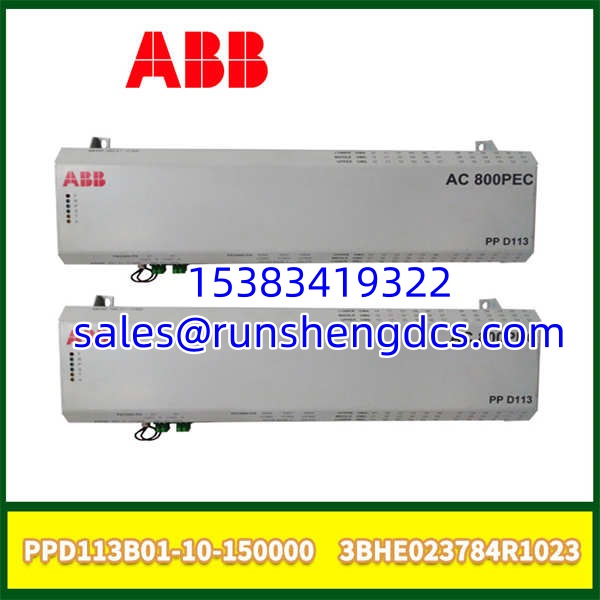
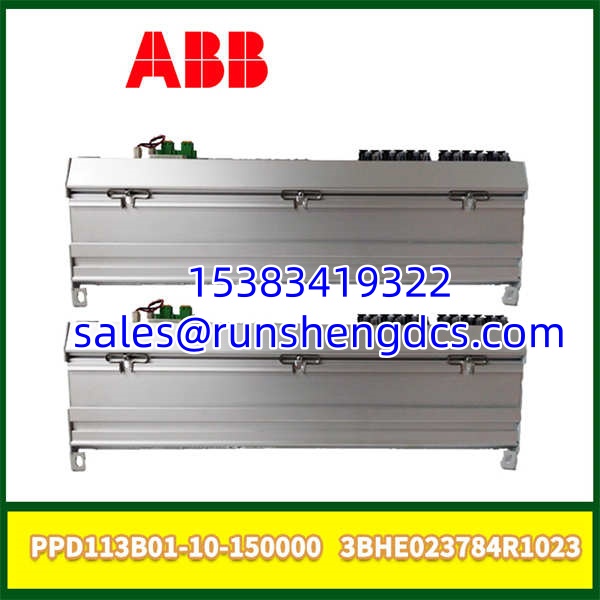
The ABB PPD113B01-10-150000 is a high-performance central processing unit specifically engineered for the AC 800PEC modular controller platform. Designed to tackle the most demanding process control challenges, the ABB PPD113B01-10-150000 serves as the computational brain for critical automation loops in power electronics, transportation, and heavy industrial environments.
Operating at a blistering 750 MHz with a dedicated 64-bit IEEE floating-point unit (FPU), the ABB PPD113B01-10-150000 is optimized for extremely fast control cycles and complex mathematical calculations. Its modular architecture allows it to seamlessly manage extensive I/O configurations and fiber-optic communication links. Whether deployed in power generation, chemical processing, or discrete manufacturing, the ABB PPD113B01-10-150000 delivers the uncompromising speed and reliability required to maintain precise operational control.
Key Technical Specifications
- Processor: 750 MHz RISC
- Math Coprocessor: 64-bit IEEE Floating-Point Unit (FPU)
- Communication Interfaces: Up to 6 Optical Modules (Fiber Links)
- Expansion Slots: 2 AnyIO Interfaces + 1 CEX Extension Slot
- Product Dimensions (H x W x D): 450 mm x 100 mm x 145 mm
- Product Weight: 2.59 kg
- Power Supply: Integrated via Backplane (BP)
- Cooling Method: Passive (No Forced Cooling Required)
- Installation Type: Modular Rack Mount
- System Platform: AC 800PEC
Compatibility & Replacement Matrix
- PPD113B01-10-150000 → PPD113B03-26-100110 : Needs Adaptation — A closely related variant in the PPD113 family. Replacing with this model requires verifying the specific hardware revision and ensuring the application logic is compatible.
- PPD113B01-10-150000 → PPD113B03-23-111615 : Needs Adaptation — Another PPD113 series module. Ensure the backplane slot configuration and firmware versions align before substitution.
- → PPD115A102 : Incompatible — The PPD115 belongs to a different controller family. It cannot be used as a direct drop-in replacement for the AC 800PEC platform.
Quality Inspection & SOP Transparency
We treat every high-performance controller as a critical operational asset. Here is our actual inspection process for the ABB .
- Incoming Inspection: We verify the source documentation and inspect the physical condition of the module. We check the aluminum chassis for bent corners, verify the integrity of the fiber-optic ports, and ensure the backplane connectors are free from bent pins or corrosion.
- Live Functional Test: The module is installed in a live AC 800PEC test rack. We power it on and monitor the boot sequence. We then establish a connection via the engineering software to verify that the 750 MHz RISC processor is executing test logic without timing errors.
- Electrical & Interface Test: We test the integrity of the AnyIO and CEX communication slots using loopback protocols. The optical module slots are inspected for proper alignment and light transmission capabilities.
- Final QC & Packaging: After passing all tests, the module is cleaned with anti-static materials. It is sealed in an anti-static bag, wrapped in protective foam, and placed in a double-walled carton to prevent physical damage during transit.
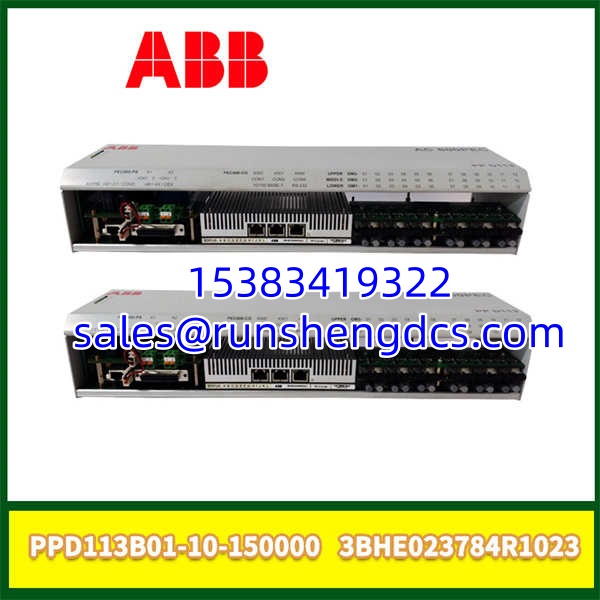
ABB-PPD113B01-10-150000-3BHE023784R1023
Common Replacement Pitfalls
Swapping a high-speed CPU module is a precise operation. Here are the traps we see engineers fall into.
- Ignoring the Optical Link Configuration: The supports up to 6 optical modules for fiber links. If you are replacing a module, ensure the new unit has the exact same optical module configuration. A mismatch will cause communication timeouts with distributed I/O racks.
- Forgetting the FPU Requirements: This module features a 64-bit FPU optimized for fast control cycles. If you are attempting to substitute it with a lower-spec controller, the application may fail to execute complex math functions within the required scan time.
- ESD Damage to Fiber Ports: The optical interfaces are highly sensitive to electrostatic discharge and physical contamination. Always ground yourself before handling the module, and keep the protective caps on the fiber ports until the moment of installation.
- Backplane Seating Issues: At 450 mm tall and 2.59 kg, this is a substantial module. If it is not fully and evenly seated into the backplane, the vibration in a cabinet can cause intermittent communication failures. Apply firm, even pressure until the locking mechanism engages.
- Firmware Version Mismatch: Always record the firmware version from the old module before removal. A new may ship with a newer firmware revision that requires a control builder project conversion or synchronization.
FAQ
Can I just swap this in directly?
Mechanically, yes. However, you will need to connect it to your engineering station to verify the firmware version, synchronize the hardware configuration, and potentially download the application if the new module is blank.
My system runs AC 800PEC — will this module work?
Yes. The is specifically designed for the AC 800PEC platform. Just ensure your engineering PC has the correct communication drivers and that the application is compatible with the module’s firmware revision.
What’s the difference between the PPD113B01 and the PPD115?
It comes down to the system platform. Here is the breakdown:
| Model | Platform | Best For |
|---|---|---|
| PPD113B01 | AC 800PEC | High-speed power electronics and complex process control. |
| PPD115A102 | AC 800PE (Legacy) | Older generation automation systems requiring specific legacy compatibility. |
Is this a genuine ABB part?
Yes. We source our stock from authorized distributors and perform the multi-point inspection detailed above. The condition is New Original (New Surplus), meaning it is a genuine, unused part that was likely an overstock from a large project.
Do I need special tools to install this?
You will need standard ESD-safe handling equipment and appropriate fiber-optic cleaning tools if connecting optical modules. No specialized mechanical tools are required for backplane insertion, but care must be taken to seat the module evenly.