
Description
Product Introduction
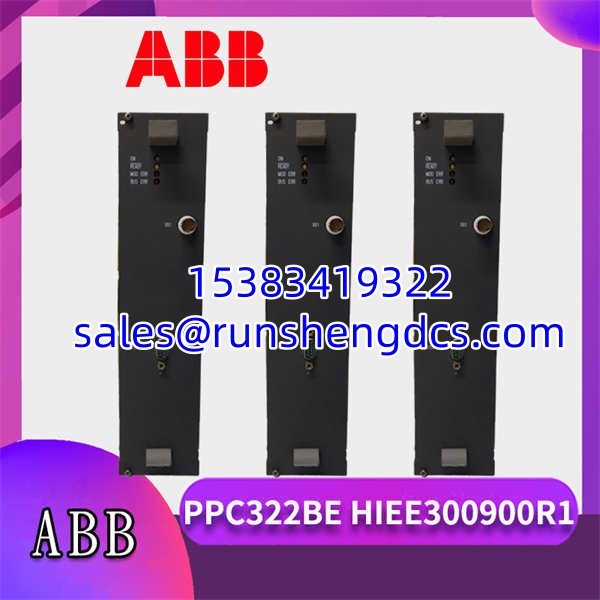
In a large industrial drive system, the controller is the brain, and when it fails, everything stops. The ABB PPC322BE HIEE300900R1 is that brain for many of ABB’s high-power converter systems, engineered to handle the demanding tasks of real-time control and communication.
This module is a specific variant of the PPC322 controller family, designed for the AC 800PEC platform. Its primary role is to manage complex power conversion processes, making it a critical spare for systems like the PCS6000 static var compensator (SVC). In my experience, having a verified spare like the PPC322BE on the shelf is the difference between a few hours of downtime and a multi-day production halt waiting for a specialist.
Key Technical Specifications
- Product Model: PPC322BE
- Ordering Number: HIEE300900R1
- Alternative P/N: 3BHE022291R0101
- Manufacturer: ABB
- Product Type: Controller Module (CPU)
- System Platform: AC 800PEC
- Primary Application: Power Electronics Control (e.g., PCS6000)
- Communication Interfaces: Ethernet (RJ45), Serial (RS-232/RS-485)
- Mounting: DIN Rail / S800 I/O Bus compatible baseplate
- Operating Temperature: 0 to 60 °C (32 to 140 °F)
- Storage Temperature: -40 to 85 °C (-40 to 185 °F)
- Relative Humidity: 5 to 95% (non-condensing)
Compatibility & Replacement Matrix
- PPC322BE HIEE300900R1 → PPC322AE HIEE300899R1 : Needs Adaptation — The “AE” and “BE” variants have different hardware revisions and firmware requirements. A direct swap is not possible without verifying compatibility with your specific converter firmware and potentially updating the entire system.
- PPC322BE HIEE300900R1 → PPC322BE HIEE300900R2 : Direct — The R2 revision is a direct hardware successor to the R1. It is functionally identical and designed to be a drop-in replacement.
- HIEE300900R1 → PPC905BE : Incompatible — The PPC905BE is a different class of controller for other applications within the AC 800PEC family. It is not a substitute for the in a PCS6000 or similar drive system.
Quality Inspection & SOP Transparency
We understand that a controller module is a high-value, critical component. Our inspection process for the ABB is rigorous to ensure it’s ready for your system.
- Incoming Inspection: We verify the full part number, including the HIEE… and 3BHE… codes, against our purchase documentation. The module is visually inspected for any signs of physical damage, corrosion on the bus connectors, or component-level repairs. We ensure all labels are original and legible.
- Live Functional Test: The is installed in a test rack with an AC 800PEC baseplate and power supply. We apply power and monitor the boot sequence via the primary Ethernet port. A successful boot is confirmed when the module obtains an IP and the “Ready” LED is solid green.
- Communication & I/O Test: We establish a Control Builder M Professional connection to the controller. We then run a simple logic program to verify the CPU is executing code correctly. We also test the serial ports for basic data transmit/receive functionality.
- Firmware Verification: We read and record the exact firmware version loaded on the module. This is a critical step, as firmware mismatch is a common cause of startup failure. We document this version in our test report.
- Final QC & Packaging: After passing all tests, the unit is signed off by a QC technician. It is then placed in a static-shielding bag, sealed, and packed securely in a double-walled box with anti-static bubble wrap to prevent damage during shipping.
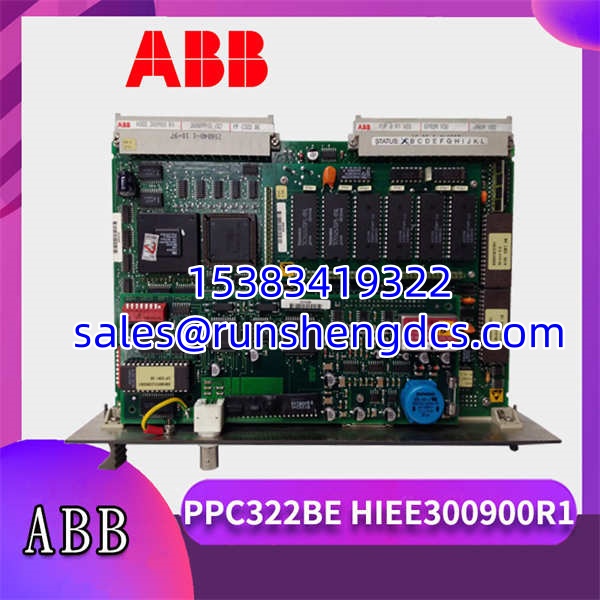
ABB-PPC322BE-HIEE300900R1
Common Replacement Pitfalls
Replacing a main controller is not like changing a fuse. A few overlooked details can lead to significant downtime. Here’s what to watch out for.
- ❗ Firmware Version Mismatch: This is the number one issue. The application project in your engineering tool (Control Builder M) is compiled for a specific firmware version. If the replacement has a different firmware version, the download will fail, or the controller will fault. Always check the firmware on the old module before removing it.
- ❗ Node Address & Network Settings: The new module will have factory default network settings. You must configure the correct node address (often set by a rotary switch on the front) and IP address to match your system’s configuration. If this is wrong, your engineering PC won’t be able to communicate with it.
- ❗ Application Download vs. Load from Memory: Some systems are configured to store the application on a memory card or within the controller itself. In other cases, the application must be downloaded from an engineering workstation. Know which method your system uses before you start. Trying to download a project when the controller expects to load from an internal backup can cause conflicts.
- ❗ Battery-Backed Memory: The has a battery to retain retentive data and the real-time clock. If the replacement module has been in storage for a long time, this battery may be dead. This isn’t always a show-stopper, but it’s something to be aware of, as you’ll lose any retentive data and will need to reset the clock.
FAQ
Can I just swap this in directly without any software changes?
No. You will almost certainly need to download the application program from your engineering workstation (laptop with Control Builder M) to the new module. The new controller comes blank from the factory. The only exception is if your system is configured to automatically load the application from a redundant controller or a specific network location, which is rare for this module type.
The is a later hardware revision of the PPC322 controller. While they look similar, they have different internal components and require different firmware versions. They are not directly interchangeable. You cannot simply swap an AE for a BE or vice-versa without checking system compatibility and likely performing a firmware update.
If the old module is completely unresponsive, you can’t read the firmware directly. Your best option is to open the last known good version of your Control Builder M project file. The firmware version it was compiled for will be listed in the hardware configuration settings for the controller. This is why backing up your project files is critical.
Does this module come with the battery pre-installed?
Yes, the real-time clock (RTC) battery is typically installed on the module. However, if the unit has been in storage for several years, the battery may be depleted. It’s a standard coin-cell battery and can be replaced in the field if necessary.
Yes, the AC 800PEC platform is used in various high-power applications. You might also find the in other industrial drive systems, active front-end (AFE) rectifiers, or custom power electronics applications that utilize the AC 800PEC controller family. Its core function is always high-speed, deterministic control of power semiconductors.