
Description
Key Technical Specifications
| Parameter Name | Parameter Value |
|---|---|
| Product Model | PFTL101A 2.0KN 3BSE004172R1 |
| Manufacturer | ABB |
| Product Series | Pressductor® PillowBlock |
| Nominal Load | 2.0 kN (≈ 450 lbf) |
| Measurement Direction | Horizontal (Transverse Force) |
| Accuracy Class | 0.5% FS |
| Repeatability Error | < ±0.05% FS |
| Overload Capacity | 500% of Nominal Load |
| Deflection at Nominal Load | 0.015 mm |
| Protection Class | IP67 |
| Housing Material | Stainless Steel (SIS 2383 / AISI 430F) |
| Connection | Cylindrical Connector (Pluggable) |
Product Introduction
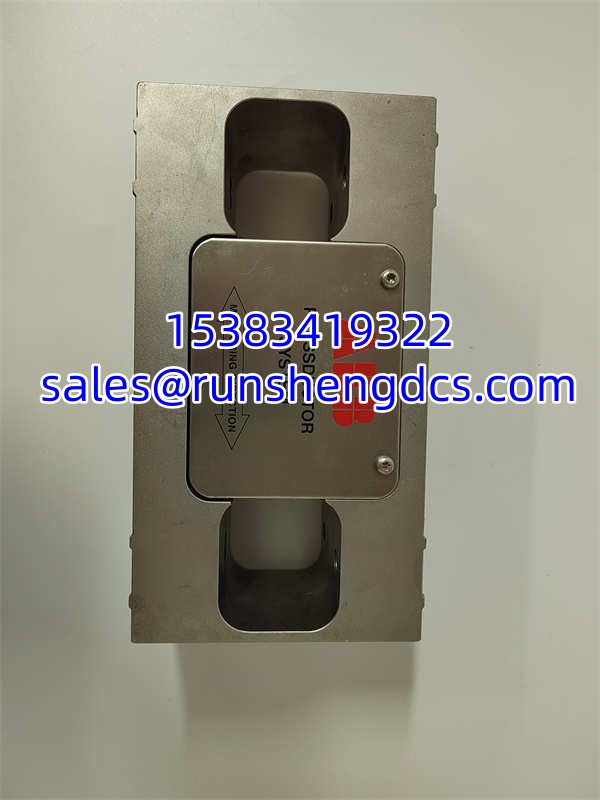
Mechanical load cells drift because springs fatigue and bearings wear out. The ABB PFTL101A 2.0KN 3BSE004172R1 uses piezomagnetic technology, meaning the sensing element is welded into a solid steel block with zero moving parts. It sits horizontally under the roll bearing, measuring the transverse force component to calculate web tension without contacting the web itself.
Engineers specify this sensor because it handles the brutal reality of high-speed lines where mechanical sensors fail in weeks. With a 500% overload capacity and IP67 sealing, it survives the washdowns and shock loads common in paper and foil converting. Bottom line: if you’re tired of recalibrating tension every month, this solid-state design is the fix.
QA/QC Transparency SOP
We don’t trust “calibrated” stickers from unknown sources. Every PFTL101A 2.0KN 3BSE004172R1 undergoes a rigorous five-step validation to ensure your tension loop doesn’t drift:
- Intake & Origin Verification: We trace the serial number against ABB manufacturing records to filter out clones. Visual inspection checks for housing dents, connector pin corrosion, or seal damage.
- Live Functional Testing: Sensor is mounted on a calibrated test stand. We apply known loads at 25%, 50%, and 100% of 2.0 kN to verify linearity and hysteresis against the 0.5% accuracy spec.
- Electrical Parameter Tests: Fluke 115 verifies bridge resistance and insulation resistance (>100 MΩ). No open circuits or moisture ingress.
- Firmware/Config Verification: We check the calibration certificate data against the physical label. Sensitivity (mV/V) is logged and matched to your existing amplifier.
- Final QC & Anti-Static Packaging: Sensor is sealed in ESD-safe shielding with a printed calibration report. No bare connectors in bubble wrap.
Field Engineer Gotchas
- Horizontal vs. Vertical Mounting: The PFTL101A is for horizontal force measurement. Risk: Installing it vertically or using a PFTL101B (vertical) in its place will give you zero signal or garbage data. Fix: Verify the roll bearing load direction. I’ve seen a tech install a horizontal sensor on a vertical load arm and spend a day chasing a “broken” amplifier.
- Bearing Housing Fit: The sensor sits under the bearing housing, not inside it. Risk: If the housing isn’t flat or the mounting screws are over-torqued, you’ll induce pre-load that shifts your zero point. Fix: Clean the mounting surface to mirror finish. Torque the 6 mounting screws in a star pattern to spec. Don’t guess.
- Cable Shield Grounding: The shield must be grounded at the amplifier end only. Risk: Ground loops will inject 50/60Hz noise that looks like tension flutter. Fix: Verify the shield is isolated at the sensor connector. I once had a “noisy” tension signal that was actually a forklift charger on the same ground bus.
- Overload Shock: 500% overload is for transient shocks, not continuous load. Risk: Running at 1.5 kN continuously will cause thermal drift and eventual failure. Fix: Size the sensor so normal operating tension is 20-80% of nominal. If you’re running 1.8 kN continuous, upgrade to the 5.0 kN version.
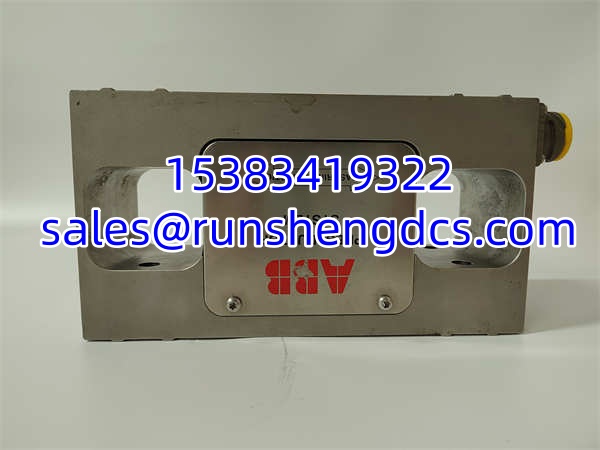
ABB PFTL101A 2.0KN 3BSE004172R1
Application Scenarios
- Paper Machine Dryer Section: Measuring web tension between dryer cans where steam and condensate destroy conventional load cells. The IP67 seal and solid-state design survive the environment.
- Foil Converting Lines: Tracking tension on thin, high-speed foil webs where mechanical sensors introduce too much friction and hysteresis. The 0.015 mm deflection is negligible.
- Steel Strip Processing: Monitoring tension in pickling or galvanizing lines where acid spray and high loads are constant. The stainless steel housing resists corrosion that eats painted sensors.
FAQ
Is the 3BSE004172R1 the same as 3BSE004166R1?
No. The 3BSE004166R1 is the 1.0 kN version. The 3BSE004172R1 is the 2.0 kN version. They are mechanically identical but have different internal calibration. Swapping them without re-calibrating the amplifier will give you 50% error.
Can I use this for vertical tension measurement?
No. The PFTL101A is for horizontal force. For vertical loads, you need the PFTL101B series. The internal sensing element is oriented differently.
Does it require external excitation?
Yes. It’s a passive piezomagnetic sensor. You need a compatible ABB tension amplifier (e.g., PFEA112, PFEA113) or a standard bridge amplifier with 5-12V DC excitation. It does not output 4-20mA directly.
What’s the max cable length?
Keep it under 50 meters for standard shielded cable. Longer runs increase capacitance and noise susceptibility. If you need 100m+, use the AE version with fixed cable or add a signal conditioner.
How do I zero it?
Zero it with the web off and the roll stationary. Never zero under load. If you can’t remove the web, use the amplifier’s “tare” function, but document the offset.
Is it compatible with Siemens S7?
Only if you have an ABB tension amplifier between them. The PFTL101A is an analog sensor, not a digital fieldbus device. The amplifier converts the mV signal to 4-20mA or Profibus.
What’s the difference between PFTL101A and PFTL101AE?
The AE version has a fixed cable and is rated for emulsion environments (e.g., rolling mills). The A version has a pluggable connector. If you’re in a wet, corrosive environment, get the AE. The connector on the A version will eventually corrode.