
Description
Key Technical Specifications
| Parameter | Value |
|---|---|
| Product Model | PFTL101A-2.0 |
| Order Code | 3BSE004172R1 |
| Manufacturer | ABB (Sweden) |
| Product Family | Pressductor PFTL 101 — Pillow-Block Tension Load Cell |
| Measuring Principle | Magnetoelastic (Pressductor) |
| Measuring Direction | Horizontal (transverse force component) |
| Rated Capacity | 2.0 kN (2000 N, approx. 200 kgf) |
| Accuracy Class | 0.5% FS |
| Non-linearity | ±0.05% FS |
| Hysteresis | ±0.03% FS |
| Repeatability | < ±0.05% FS |
| Short-term Overload | 500% of rated capacity |
| Mechanical Deflection | approx. 0.015 mm at rated load |
| Excitation / Bridge Sensitivity | approx. 2.0 mV/V; 5–12 V DC excitation |
| Output (with PFEA electronics) | 0–10 V / 4–20 mA (signal conditioning in electronics) |
| Connection | Cylindrical plug connector (PFTL101A); cable assemblies 3BSE018741R15/R30/R50 |
| Body Material | Stainless steel (AISI 430F / SIS 2383 equivalent) |
| Protection Class | IP66 / IP67 (application dependent; AE/AER variants differ) |
| Operating Temperature | approx. -30 °C to +80 °C |
| Typical Response | single-digit ms range; suitable for high-speed lines |
| Mounting | Pillow-block between machine frame and roll bearing housing; 6-screw fixation |
| Weight | approx. 2.5 kg (family-typical) |
Product Introduction
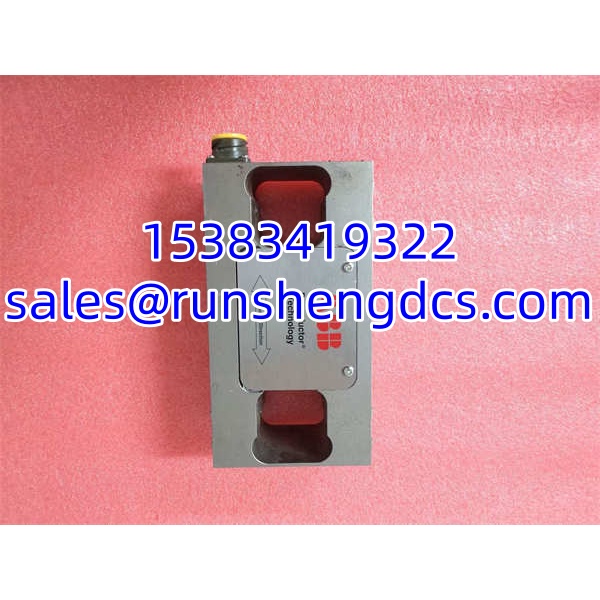
PFTL101A-2.0 is a pillow-block horizontal tension load cell from ABB’s Millmate web tension measurement system. It uses ABB’s Pressductor magnetoelastic principle — two coils wound at right angles through a special alloy steel body. With no load, the coils are magnetically decoupled. When horizontal force is applied, the steel’s permeability changes along the force axis, coupling flux into the measuring coil and inducing a voltage proportional to the load.
The practical consequence is that the sensor has no strain gauges, no moving parts, and virtually no fatigue limit. It tolerates short overloads up to 500% of rated capacity — useful on lines where strip breaks and roll jams are a fact of life. The 2.0 kN rating places it at the top of the PFTL101A range (0.5 / 1.0 / 2.0 kN), making it suitable for medium-tension stations on narrower webs: finishing lines, coaters, slitters, and light-gauge metal processing.
It is a passive sensing element. It does not output 4–20 mA on its own — that conversion happens in the paired tension electronics (PFEA 111 / PFEA 112 / PFEA 113, or legacy PFSA units). Bottom line — confirm the rated capacity matches the removed unit, verify the connector type (plug vs. fixed cable), and pair it with the correct ABB tension electronics.
QA/QC Transparency SOP
- Intake & Origin Verification
Confirm model PFTL101A-2.0, order code 3BSE004172R1, ABB labeling, serial number, and manufacturing date. Cross-check against photos of the installed pillow-block position and bearing housing. - Mechanical Inspection
Check the polished measuring surface and unpainted faces for corrosion, pitting, or impact damage. Verify the six mounting holes and confirm no signs of localized overload or uneven load distribution. - Electrical Tests
Measure primary (excitation) and secondary (signal) coil resistance and insulation. Verify coil-to-coil orthogonality and check for shorted turns. Confirm the cylindrical connector pins are straight and clean. - Functional Verification
Where a test fixture is available, apply known horizontal load and verify output signal proportionality. Check zero balance and sensitivity against the calibration certificate. Do not rely on resistance checks alone. - Cable & Accessory Check
Inspect the mating cable assembly (3BSE018741R15/R30/R50) for sheath damage and connector integrity. Confirm shield continuity to the SG terminal. - Final QC & Packaging
Document all readings, photograph nameplate and measuring faces, then pack in anti-static shielding with moisture protection. Surplus units ship with clear condition notes and, where available, calibration records.
Field Engineer Gotchas
- A vs. B range confusion.
Risk: PFTL101A tops out at 2.0 kN; PFTL101B starts at 2.0 kN and runs to 20 kN. The 2.0 kN overlap means a wrong-family unit can physically fit but carry different calibration and mechanical characteristics.
Fix: Match the exact model and order code on the nameplate — -2.0 / 3BSE004172R1.
War story: A line kept tripping tension alarms after a “2 kN load cell” swap. The replacement was a PFTL101B; the electronics scaling and mechanical stiffness did not match the original calibration. - Horizontal-only measurement.
Risk: Mounting the pillow-block so that vertical roll weight dominates the signal.
Fix: The sensor responds to horizontal force only. Orient it so web tension resolves into the horizontal axis, and account for wrap angle in the tension calculation.
Blunt take: A vertically loaded will read near zero and look like a dead sensor. - Connector type matters.
Risk: Ordering PFTL101AE (fixed cable) or PFTL101AER (acid-resistant, fixed cable) when the installation uses a plug-in cable.
Fix: uses a cylindrical plug connector. Verify before procurement.
Field note: The AE and AER variants exist for emulsion and acid environments — do not substitute unless the environment demands it. - Calibration and scaling in the electronics.
Risk: Replacing the load cell without verifying Load Division and range settings in the PFEA unit.
Fix: Confirm the electronics are scaled for 2.0 kN. A 5.0 kN setting on a 2.0 kN cell will read roughly 40% of true tension.
Simple rule: New cell, re-verify scaling and force direction. - Force direction polarity.
Risk: Tension reads negative or backwards after replacement.
Fix: The signal wires (typically pins 2 and 4) can be swapped to correct direction. Excitation is on pins 1 and 3. Shield to SG.
Field note: Half of “new sensor doesn’t work” calls are polarity, not hardware. - Cable and grounding.
Risk: EMI from drives and servos corrupting the low-level signal.
Fix: Keep signal cables away from power cables (≥20 cm), maintain single-point ground to the controller SG terminal, and use the shielded ABB cable assembly.
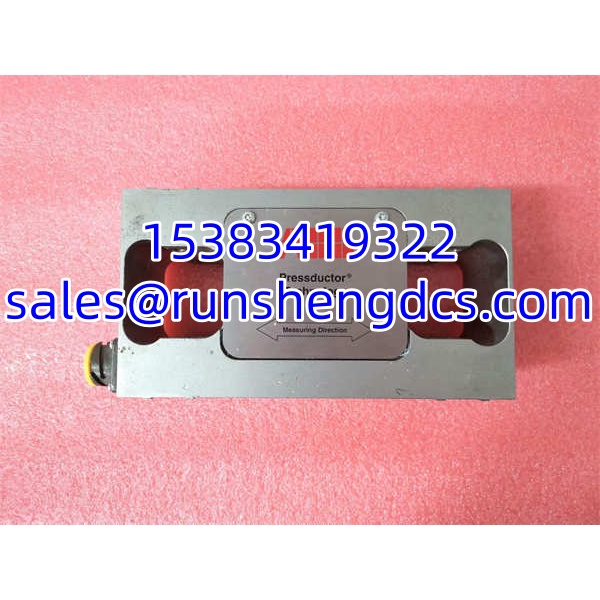
ABB PFTL101A 2.0KN 3BSE004172R1
Application Scenarios
- Cold-rolled strip finishing lines where 2.0 kN tension control is required on narrower gauge material.
- Paper machine dryer section and winder stations where horizontal tension measurement drives closed-loop control.
- Film, foil, and label converting lines needing stable tension through acceleration, splice, and deceleration phases.
- Textile and wire/cable manufacturing lines where low-to-medium tension accuracy affects product uniformity.
FAQ
- .0 a strain gauge load cell?
No. It uses ABB’s magnetoelastic (Pressductor) principle — no strain gauges, no mechanical deformation-based measurement. - What is the difference between , AE, and AER?
: standard stainless steel with cylindrical plug connector. PFTL101AE: fixed cable, IP66, for emulsion environments (e.g., rolling mills). PFTL101AER: acid-resistant stainless steel (AISI 316L), fixed cable, IP66/67, for pickling lines and paper machine wet ends. - What electronics does it pair with?
ABB PFEA 111, PFEA 112, PFEA 113 tension electronics, or legacy PFSA units. The sensor itself is passive. - Can I substitute a PFTL101B-2.0?
Not recommended without verifying calibration, mechanical characteristics, and electronics scaling. Same nominal rating, different family. - What cable assemblies are compatible?
ABB cable with male plug connector, e.g., 3BSE018741R15 (15 m), 3BSE018741R30 (30 m), 3BSE018741R50 (50 m). - Is surplus stock safe to use?
It can be, if the nameplate, coil resistance, insulation, mechanical faces, and calibration are verified. Do not install untested surplus on a live tension-controlled line. - What is the lead time?
Availability varies with surplus inventory. Confirm order code 3BSE004172R1, revision, and test documentation before committing to a maintenance window.