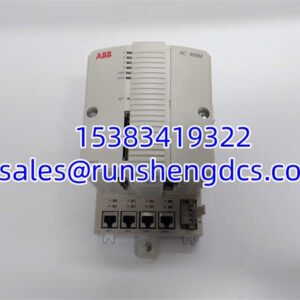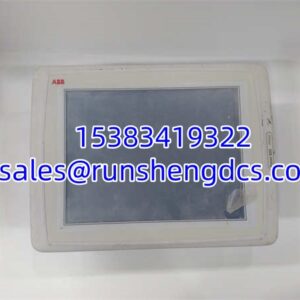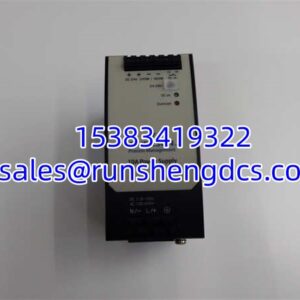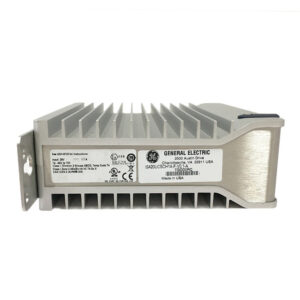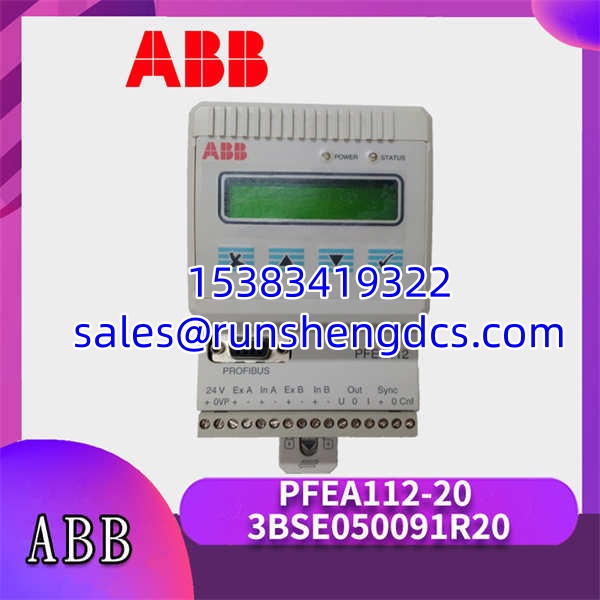

Description
Key Technical Specifications
| Parameter | Specification |
|---|---|
| Product Model | PFEA112-20 (3BSE050091R20) |
| Manufacturer | ABB Automation Technologies |
| Sensor Inputs | 2x Pressductor (PFCL/PFTL series) |
| Excitation Signal | 330 Hz, 0.5 A RMS |
| Control Accuracy | ±0.5% Full Scale |
| Communication | Profibus-DP V0/V1 |
| Supply Voltage | 24 VDC (18-36 VDC range) |
| Power Consumption | 7.5 W typical |
| Protection Rating | IP20 (DIN Rail) / IP65 option |
| Operating Temp | -20°C to +50°C |
| Dimensions | 170 x 105 x 32 mm |
| Weight | ~120g |
Product Introduction
Tension control loops fail silently. A drift of 2% in the measurement amplifier doesn’t trip an alarm, but it ruins edge alignment on a slitter or causes wrinkles in a coating line. The ABB PFEA112-20 sits directly in this critical path, converting the micro-volt changes from pressductor sensors into a stable tension value. It’s not a general-purpose PLC; it’s a dedicated signal conditioner with a 330 Hz excitation frequency specifically tuned to reject mechanical vibration noise from rollers.
We specify the 3BSE050091R20 revision for its integrated Profibus-DP interface, which removes the need for separate analog I/O cards in the main controller. The ±0.5% FS accuracy is the real metric here; cheaper amplifiers drift with temperature, but this unit maintains stability across the -20°C to +50°C range. Bottom line: it handles the math so your PLC doesn’t have to, and it does it with enough headroom to manage the inertia spikes during roll changes.
QA/QC Transparency SOP
We don’t trust “tested” stickers. Every PFEA112-20 3BSE050091R20 goes through a five-step validation process before it ships:
- Intake & Origin Verification: We trace the 3BSE050091R20 batch code against OEM production records to rule out counterfeit clones. Visual inspection checks for cold solder joints on the DB9/terminal blocks and signs of liquid ingress.
- Live Functional Testing: The unit is mounted on a live test rack. We inject a simulated 330 Hz sensor signal and verify the digital output matches the expected tension value within ±0.2%. Profibus communication is cycled for 1 hour to check for bus dropouts.
- Electrical Parameter Tests: Using a Fluke 115, we verify 24VDC input tolerance and check isolation resistance between sensor inputs and the backplane. Ground continuity is mandatory.
- Firmware/Config Verification: We read the internal parameter set. If the previous user left custom PID gains or filter settings, we perform a factory reset to default. Firmware version is logged and matched against the requested revision.
- Final QC & Anti-Static Packaging: Unit is cleaned with contact-safe solvent, sealed in an ESD bag with desiccant, and shipped with a test certificate showing the actual measured accuracy at the time of shipment.
Field Engineer Gotchas
- Sensor Excitation Mismatch: The PFEA112-20 outputs a 330 Hz excitation signal. If you wire this to a strain gauge load cell designed for DC excitation, you will fry the load cell. War Story: Saw a tech swap a pressductor amp for a generic tension controller without checking the excitation type. Melted two PFCL201 sensors in 30 seconds. Check the sensor datasheet first.
- Ground Loop Hum: Pressductor signals are high-impedance. If you ground the shield at both the sensor and the PFEA112-20, you create a ground loop that looks like tension noise. Solution: Ground the shield only at the amplifier side. Use the dedicated shield terminal on the module, not the chassis ground.
- Profibus Node Address: The 3BSE050091R20 doesn’t auto-detect its node address. It uses DIP switches or software config. Warning: I’ve seen entire lines stop because a replacement unit was set to Node 0 while the master expected Node 3. Always photograph the DIP switch settings on the old unit before removal.
- Wrap Angle Calculation: The amplifier needs the correct wrap angle to convert force to tension. If you swap the unit and forget to enter the wrap angle (or enter 180° when it’s actually 90°), your tension reading will be off by a factor of 2. Check: Verify the “Wrap Gain” parameter immediately after power-up.
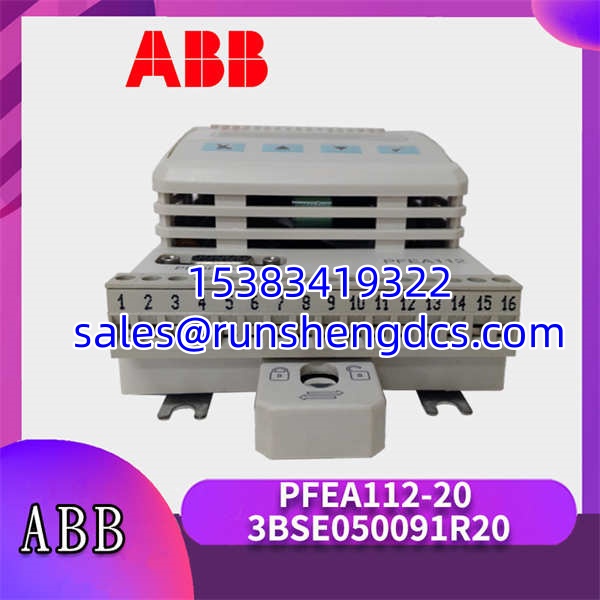
ABB PFEA112-20 3BSE050091R20
Application Scenarios
- Steel Cold Rolling Mills: High-inertia rolls and rapid acceleration require tension control that rejects mechanical vibration. The PFEA112-20’s digital filtering handles the 330 Hz excitation to ignore roller chatter, maintaining ±0.5% tension even during speed changes.
- Film & Foil Slitting: Thin materials (30μm) wrinkle if tension fluctuates >1%. The dual-channel input allows differential measurement to cancel out roller eccentricity errors.
- Lithium Battery Coating: Solvent-based coatings require precise tension to prevent substrate stretching. The 3BSE050091R20 provides the stable 24VDC supply and isolated outputs needed in explosive atmospheres (when used with proper barriers).
FAQ
Can I use this with non-ABB load cells?
No. The is designed specifically for ABB Pressductor sensors (PFCL/PFTL series). It outputs a 330 Hz AC excitation. Standard DC strain gauges will not work and may be damaged.
Is 3BSE050091R20 compatible with 3BSE030369R20?
Generally, yes. Both are units. The suffix change usually indicates a manufacturing site shift or minor component update. However, always verify the firmware version. If your system is on V2.0 and the new unit is V4.0, check the release notes for parameter changes.
Does this support hot-swapping?
No. The does not support hot-swap on the Profibus bus or the sensor inputs. Pulling it while energized will cause a bus fault and potentially damage the sensor excitation circuit. Power down the 24VDC supply first.
Why is my tension reading jumping?
Check your cabling. The sensor cable must be shielded and twisted pair. If you’re running it parallel to a VFD cable, the 330 Hz signal is picking up noise. Fix: Reroute cables or add a ferrite core. Also, verify the sensor isn’t mechanically overloaded; the will saturate if the force exceeds 120% of the sensor’s nominal rating.
Can I configure this without a PC?
Yes. The front panel has a 2×16 character display and navigation keys. You can set the wrap angle, zero the sensor, and adjust the PID loop right at the machine. Tip: Use the “Simulation Mode” in the menu to test outputs without applying actual tension.
What is the MTBF?
ABB typically rates the PFEA112 series at >100,000 hours MTBF under normal industrial conditions. The most common failure point isn’t the electronics; it’s the terminal block corrosion or connector wear. Inspect the physical connectors during your annual shutdown.
Do I need the IP65 version?
If your is inside a NEMA 12 cabinet, the standard IP20 is fine. If you’re mounting it directly on a machine frame in a washdown area, get the PFEA112-65. Don’t rely on cabinet seals; humidity kills these boards eventually.