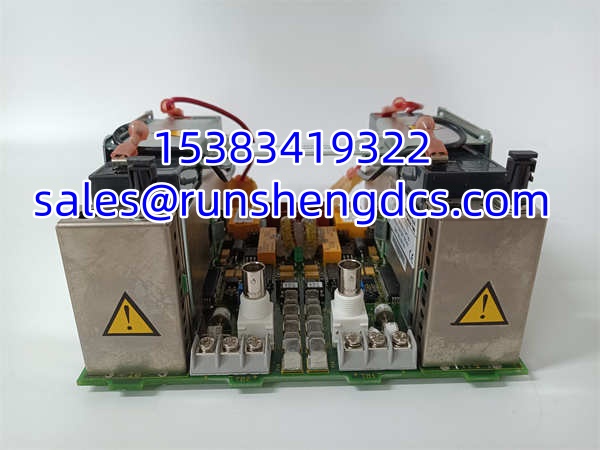

Description
Key Technical Specifications
- System Platform: ABB Bailey INFI 90 DCS
- Module Function: Fiber optic communication terminal — converts electrical signals from the INFI 90 backplane to optical signals for fiber loop transmission
- Network Topology: Supports INFI 90 fiber optic loop architecture (redundant dual-loop capable)
- Interface Type: Fiber optic connectors (ST or similar — verify physical connector type on unit)
- Slot Compatibility: Standard INFI 90 module slot (fits INFI 90 chassis/rack)
- Redundancy: Supports redundant communication paths when paired with matching NTCF modules
- Hot-Swap: Yes — replaceable without powering down the INFI 90 rack (standard INFI 90 hot-swap architecture)
- Environmental Rating: Industrial grade; IP20 typical for INFI 90 modules mounted in enclosed cabinets
- Operating Temperature: -25°C to 70°C (per Bailey INFI 90 environmental specs)
- Humidity Tolerance: Up to 85% non-condensing
- EMC Compliance: IEC 61000 series (industrial electromagnetic compatibility)
- MTBF: 100,000+ hours (per Bailey INFI 90 series reliability data)
Product Introduction
You’ve got an INFI 90 system running a power plant or a pulp mill, and the fiber loop between two control cabinets just went dark. The NTCF22 is the module sitting at the edge of that loop — it’s the bridge between the copper traces on the INFI 90 backplane and the fiber optic cables running between racks, sometimes across hundreds of feet of cable tray. Without it, your control nodes can’t talk to each other, and the loop is broken.
The NTCF22 isn’t a processor. It isn’t an I/O card. It’s pure communication infrastructure — a physical layer device that handles optical-to-electrical signal conversion for the INFI 90 fiber network. Its value is in reliability and hot-swap capability. When a fiber transceiver inside the module degrades after 15 years of continuous operation, you can pull it and slide in a replacement without tripping the unit. That matters when you’re staring at a forced outage clock. Bailey designed these modules to be swapped by a technician with a screwdriver, not a controls engineer with a laptop.
Troubleshooting Quick Reference
| Fault | Cause | Probability | Quick Check | Fix |
|---|---|---|---|---|
| Fiber loop communication loss | Failed optical transceiver in NTCF22 | 50% | Check LINK/ACT LEDs on module front panel; verify fiber patch cable is seated | Replace NTCF22 module (hot-swap); verify fiber polarity (TX/RX swap) |
| Intermittent loop errors | Dirty or damaged fiber connector | 35% | Inspect fiber end-face with scope; check for bent patch cable | Clean fiber connector with isopropyl alcohol and lint-free swab; replace patch cable |
| Module not recognized in rack | Backplane connector corrosion or poor seating | 25% | Reseat module firmly; inspect backplane pins for bent contacts | Clean backplane contacts; ensure module is fully latched into slot |
| Redundant loop degraded | Single NTCF22 failure in redundant pair | 40% | Check status of paired NTCF22 on opposite loop path; verify both loops active | Replace failed module; confirm loop redundancy restored in configuration |
| No power to module | INFI 90 rack power supply fault | 15% | Verify rack power supply LEDs; measure +5V/+15V at backplane | Replace rack power supply; check AC input to INFI 90 cabinet |
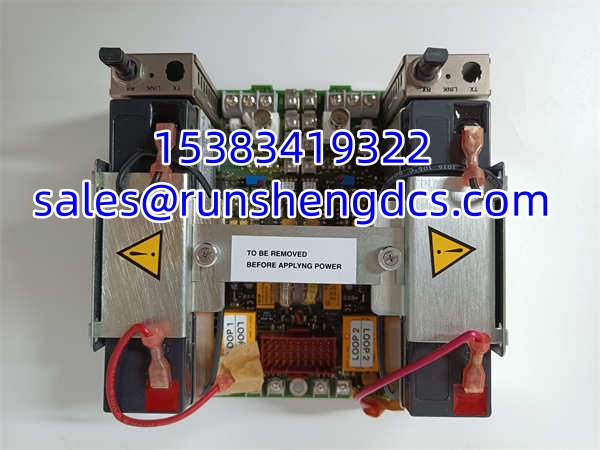
ABB NTCF22
Application Scenarios & Pain Points
Power Generation — Boiler Control Network: INFI 90 systems in coal-fired plants use fiber loops to connect the boiler master controller to remote I/O racks in the furnace area. The modules at each end of the fiber run handle the optical conversion. Pain point: after 20+ years, the optical transceivers inside the degrade. The module doesn’t fail catastrophically — it starts throwing CRC errors on the loop, causing intermittent communication drops that look like network congestion. Replacing the module is a 10-minute job, but diagnosing it as the root cause can take hours.
Pulp & Paper — Digestor Control: Fiber optic links between control cabinets in the digestor area are exposed to heat, vibration, and chemical vapors. The ‘s industrial-grade construction handles the environment, but the fiber patch cables between the module and the cabinet penetration are the weak link. A loose ST connector here mimics an failure. Always check the cable first.
Water/Wastewater — Remote Lift Station Communication: INFI 90 fiber loops running between a central control room and remote pump stations over long distances (500+ meters). The handles the optical conversion at each end. Pain point: if the fiber run is single-mode but the is specified for multi-mode (or vice versa), you get no link. Verify the fiber type matches the module’s optical spec before blaming the hardware.