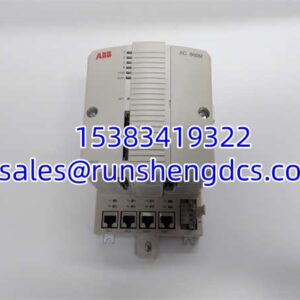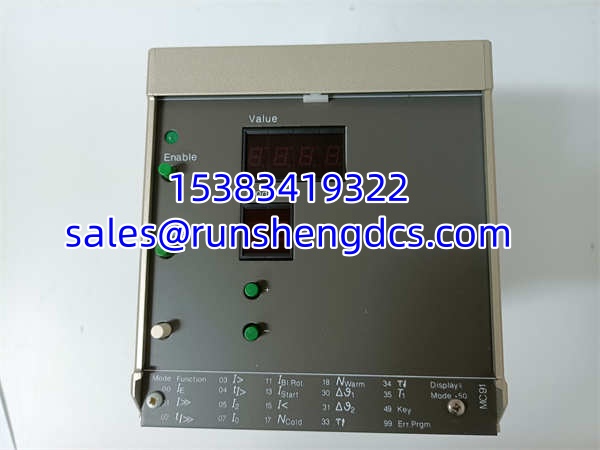

Description
Key Technical Specifications
- Processor: High-performance ARM Cortex-A series or PowerPC (specific model varies by hardware revision), clock speeds in the hundreds of MHz range
- System Platform: ABB Advant OCS (Open Control System) distributed control system
- Communication Protocols: MB300 (Master Bus 300, up to 10 Mbps), AF100 (Advant Fieldbus 100), TCP/IP Ethernet, Profibus DP
- Redundancy: Dual-controller hot-standby configuration supported — automatic failover to standby unit on primary failure
- Operating Temperature: -40°C to +85°C (wide-range industrial design)
- EMC Compliance: IEC 61000 standard for electromagnetic interference immunity
- Input Power: 24V DC system supply
- Diagnostic Capability: Real-time monitoring of system voltage, current, temperature; LED status indicators; event logging for fault追溯
- Protection Features: Overcurrent, overvoltage, overtemperature, and short-circuit protection integrated on-board
- I/O Expansion: Modular architecture — supports connection to Advant OCS I/O modules, communication modules, and third-party devices via OPC UA or Modbus
- Response Time: Millisecond-level safety interlock response (documented sub-20ms fault trip in field applications)
- Origin: Manufactured in Switzerland
Product Introduction
You’re standing in a control room at a 2,000 t/d cement plant. The kiln temperature is drifting, the raw mill feed rate needs adjustment, and the operator at the AS520i station is watching trends on the screen. The MC91 is the module crunching those PID loops in real time — reading temperature transmitters over AF100, adjusting damper positions, logging every alarm, and talking back to the operator station over MB300 at 10 Mbps. If that controller hiccups, the kiln doesn’t just run inefficiently. It can brick the refractory lining.
The MC91 is ABB’s workhorse CPU for the Advant OCS platform — a distributed control system that’s been deployed across power generation, refining, cement, and metallurgy for decades. It handles everything from simple discrete logic to complex multi-loop cascade control. The hot-standby redundancy option means you can swap a failed primary controller without taking the process offline — the standby unit takes over seamlessly. That said, this is a legacy platform. ABB has moved on to newer DCS architectures, and the MC91 is no longer in active production. Surplus units are available, but lead times and pricing vary wildly depending on the distributor.
Troubleshooting Quick Reference
| Fault | Cause | Relevancy | Quick Check | Fix |
|---|---|---|---|---|
| Controller unresponsive / no communication | Power supply failure or MB300/AF100 network break | 70% chance it’s power or comms | Measure 24V DC at controller terminals; check MB300 cable continuity and termination resistors | Replace power supply module; repair/replace communication cable; verify network topology |
| Redundancy switchover failure | Standby controller not synchronized or firmware mismatch | 60% chance it’s a sync issue | Check redundancy module status LEDs; compare firmware versions on both controllers | Re-synchronize controllers via engineering station; update firmware to matching revision |
| PID loop oscillation or drift | Tuning parameters degraded or I/O signal noise | 55% chance it’s tuning or signal quality | Go online with control builder — monitor PV, SP, and OP trends; check for signal spikes | Retune PID parameters; install signal filters or replace noisy I/O module |
| Intermittent fault trips | EMC interference or loose terminal connections | 50% chance it’s noise or wiring | Inspect cable shielding and grounding points; check for loose screw terminals | Re-terminate connections; verify single-point grounding per IEC 61000; add ferrite cores if needed |
| Overtemperature alarm on controller | Control cabinet ventilation failure or ambient temp exceeding spec | 45% chance it’s cooling | Measure cabinet internal temperature; verify cooling fans are operational | Replace cabinet fans; clean air filters; consider adding forced-air cooling if ambient exceeds 40°C |
| Configuration lost after power cycle | Backup battery depleted or flash memory corruption | 40% chance it’s battery or memory | Check battery voltage on controller board; verify if project downloads correctly after power-up | Replace CR2032 or equivalent backup battery; re-download configuration from engineering workstation |
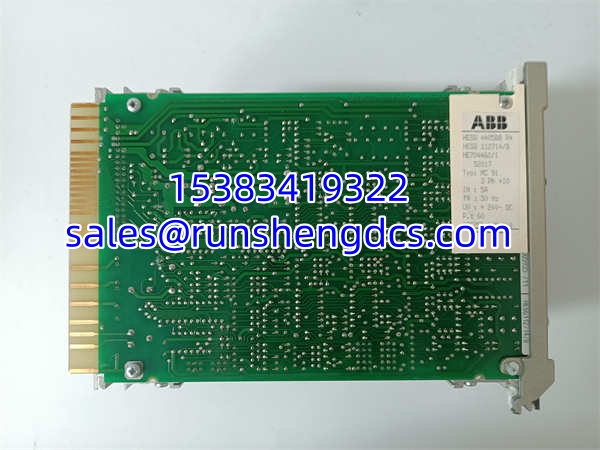
ABB MC91 HESG440588R4 HESG112714B
Application Scenarios & Pain Points
Cement production — kiln and mill control: The MC91 manages the entire pyroprocessing chain: raw mill feed rate, preheater cyclone temperatures, kiln rotation speed, and clinker cooler airflow. It reads dozens of analog inputs over AF100 and adjusts setpoints in real time. Pain point: cement plants are dusty, hot, and electrically noisy. After 8-10 years, backplane connectors corrode and communication cables degrade. Schedule preventive inspection of all fieldbus terminations during annual shutdowns.
Power generation — substation automation: Deployed as the core of a 110kV substation protection and monitoring system, the MC91 processes breaker status, current/voltage measurements, and differential protection logic. When a fault occurs, it trips the appropriate breakers within milliseconds and uploads event records to the dispatch center via TCP/IP. Pain point: substation environments demand extreme EMC immunity. Verify that all communication cables are properly shielded and that the controller’s IEC 61000 certification matches your site’s interference profile.
Refining — reactor ESD interlocks: In a petrochemical reactor control application, the MC91 runs emergency shutdown logic in a redundant configuration. If pressure or temperature exceeds safe limits, it closes feed valves and initiates cooling within sub-20ms. Pain point: redundant systems give a false sense of security. If the standby controller has been sitting in a fault state for months unnoticed, you don’t actually have redundancy. Test the switchover function quarterly — don’t wait for a real emergency to find out the backup doesn’t work.