
Description
Key Technical Specifications
| Parameter | Typical / Verified Detail |
|---|---|
| Ordering Number | 3BSE013175R1 |
| Model Designation | GRBTU / GRBTU-01 |
| Manufacturer | ABB |
| Product Type | Redundant ModuleBus termination unit for S800 I/O |
| System Compatibility | ABB S800 I/O, AC 800M-based ModuleBus architectures |
| Bus Interface | ModuleBus (redundant A/B channels) |
| Function | End-of-line bus termination to maintain signal integrity |
| Power Requirement | None — passive hardware device |
| Configuration Required | No active configuration |
| Mounting | DIN-rail / S800 I/O accessory footprint |
| Operating Temperature | Typically aligned with S800 I/O limits (approx. -25 °C to +55 °C); confirm nameplate |
| Weight | Approx. 0.5 kg (reported by distributor listing) |
| Country of Origin | Sweden (reported by distributor listing) |
Product Introduction
The most common procurement error with S800 I/O accessories is confusing a passive terminator with an active communication module. The GRBTU does not convert protocols, does not talk to Profibus or Modbus, and does not process data. It is a small, passive component that sits at the end of a redundant ModuleBus segment and ensures proper bus impedance — the kind of part that gets overlooked until a sporadic communication fault appears on an otherwise healthy I/O cluster.
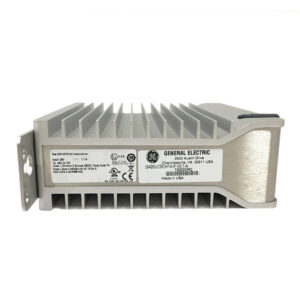
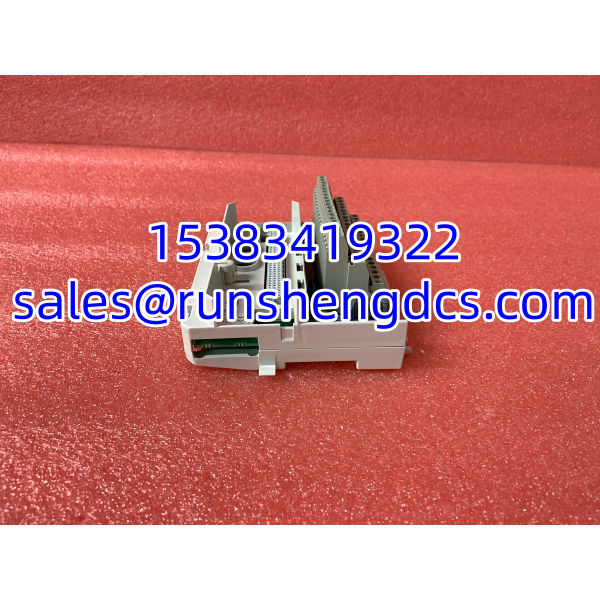
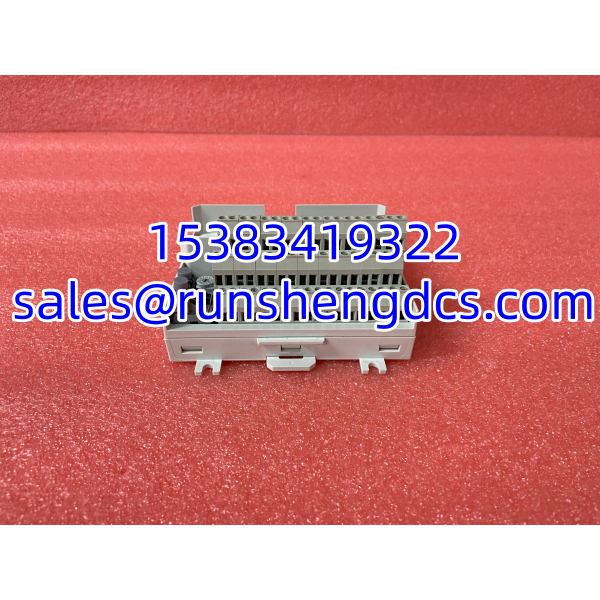
The ABB GRBTU (3BSE013175R1), also referenced as GRBTU-01, is a redundant ModuleBus termination unit for I/O installations, typically deployed alongside AC 800M controllers. It terminates both A and B channels of a redundant ModuleBus segment, reducing signal reflections and improving communication stability on longer or more complex I/O branches. Because it is passive — requiring no power supply, firmware or configuration — it introduces minimal additional points of failure.
Bottom line: this is a low-cost but critical accessory for maintaining bus integrity in redundant I/O architectures. Its value is in correct placement and verified compatibility — not in standalone functionality.
QA/QC Transparency SOP
- Intake & Origin Verification — Confirm ordering number 3BSE013175R1, model designation GRBTU/GRBTU-01, and physical condition. Reject units with cracked housings, damaged connectors, missing mounting hardware or signs of moisture ingress.
- Visual & Mechanical Inspection — Inspect ModuleBus connector pins for corrosion, bending or oxidation. Verify DIN-rail mounting clips and label legibility. Check for physical damage consistent with improper removal from a live rack.
- Continuity & Impedance Verification — Perform continuity checks across the redundant A/B channel terminations. Verify that termination resistors (if accessible) are within expected tolerance. Confirm no short circuits between bus lines.
- Functional Placement Verification — Confirm the unit is intended for end-of-segment placement on a redundant ModuleBus branch. Cross-reference the installed I/O topology to ensure it is not being placed mid-segment, which would degrade bus performance.
- Final QC & Packaging — Seal in ESD-safe, anti-static packaging with photos, ordering number, test notes and a packing list noting which checks were performed and which require on-site validation.
Field Engineer Gotchas
- It is NOT a communication gateway. Listings that describe the GRBTU as supporting Modbus RTU/TCP, Profibus DP, Ethernet, or IEC 61850 are conflating it with entirely different products. The GRBTU is a passive termination unit — it has no processor, no protocol stack and no network ports.
- Placement matters. The GRBTU belongs at the end of a redundant ModuleBus segment. Placing it mid-segment or on a non-redundant branch can cause communication errors.
- Do not confuse it with a base/terminal unit for I/O modules. Some listings describe it as a “communication base module” or “mounting base” for I/O cards. That is misleading — it terminates the ModuleBus itself, not individual I/O channels.
- It is passive — no LEDs, no diagnostics. You cannot troubleshoot it by looking at indicator lights. Bus faults that persist after installing a GRBTU are likely upstream (cabling, IM module, power supply or controller).
- Verify redundancy architecture first. If your I/O cluster is not configured for redundant ModuleBus, this part may not be applicable. Check the system topology before ordering.

ABB GRBTU 3BSE013175R1
Application Scenarios
- The GRBTU terminates the redundant ModuleBus at the end of a remote I/O island, ensuring stable communication between the AC 800M controller and distributed modules.
- Power plant auxiliary I/O expansion. Redundant ModuleBus segments serving turbine auxiliary systems are properly terminated to prevent intermittent communication drops during plant transients.
- Water/wastewater treatment facility. Distributed I/O racks across multiple process areas use GRBTU terminators to maintain bus integrity over extended cable runs.
- During a planned outage, aging termination units are replaced to eliminate sporadic bus errors that had been misdiagnosed as IM module failures.
FAQ
Is the GRBTU 3BSE013175R1 a Profibus or Modbus gateway?
No. It is a passive ModuleBus termination unit for I/O. Any listing describing it as supporting Profibus DP, Modbus RTU/TCP, Ethernet or IEC 61850 is incorrect and likely refers to a different product.
Does it require power or configuration?
No. The GRBTU is a passive hardware device. It requires no power supply, no firmware and no software configuration.
Where should it be installed?
At the end of a redundant ModuleBus segment in an I/O cluster. It terminates both the A and B channels of the redundant bus.
Can I use it on a non-redundant ModuleBus?
The GRBTU is designed for redundant ModuleBus architectures. For non-redundant segments, a different termination accessory may be required. Consult the ABB I/O hardware manual.
Is it compatible with AC 800M controllers?
Yes. The GRBTU is used within AC 800M-based I/O ModuleBus topologies.
What is the difference between GRBTU and GRBTU-01?
Both designations appear in distributor listings for 3BSE013175R1. The “-01” suffix may indicate a revision or packaging variant. Verify the exact ordering number and physical compatibility with your installed hardware before purchase.
Should I stock spares of this part?
Given its passive nature and low failure rate, the GRBTU is not typically a high-priority spare. However, for sites with multiple redundant I/O segments, keeping one or two on hand can prevent extended troubleshooting during bus integrity issues.