
Description
Product Introduction
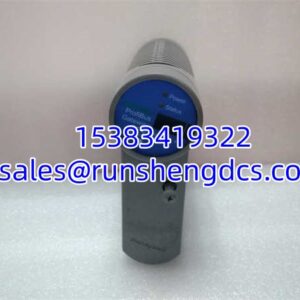
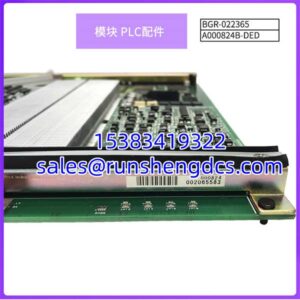
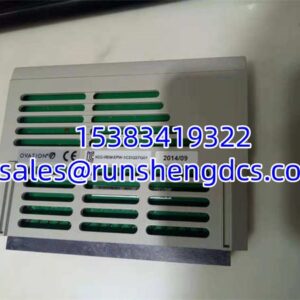
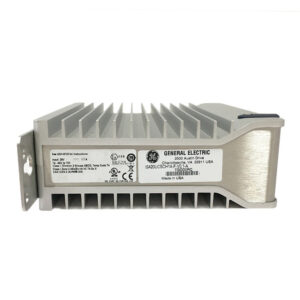
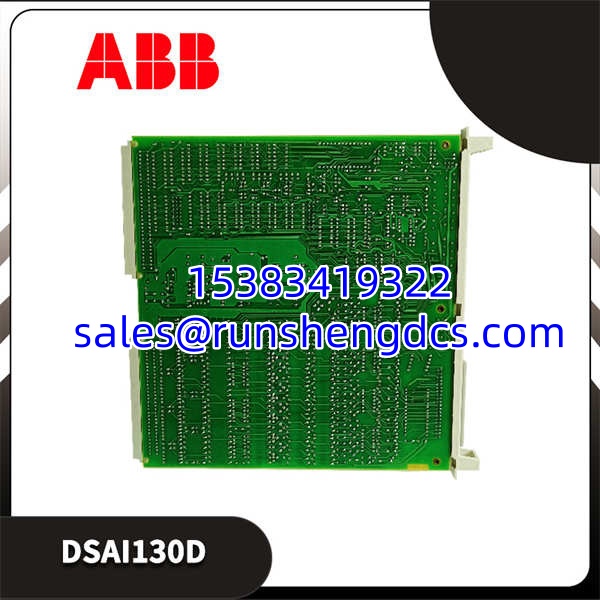
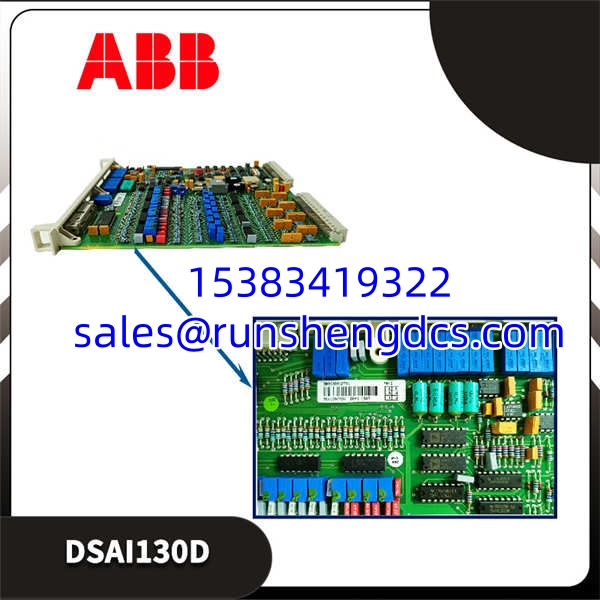
For the engineer maintaining a legacy Freelance rack, the ABB DSAI130D is the workhorse for gathering analog field data. It slots into the Freelance 800F or 200F chassis, handling the critical task of converting raw mA or voltage signals into usable process values.
This module delivers predictable performance with an 8-channel scan time of 20 ms. It supports standard industrial ranges like 0/4-20 mA and ±10 V. While not the latest hardware, its long-standing presence in the field means spare management is key to avoiding unplanned downtime.
Key Technical Specifications
- Channels: 8 differential inputs
- Input Ranges: 0/4-20 mA, 0-10 V, ±10 V, 0-5 V, ±5 V (configurable per channel)
- Resolution: 12-bit
- Accuracy: ±0.2% of full scale (at 25 °C)
- Cycle Time: 20 ms (for all 8 channels)
- Isolation: 500 V AC (channel to backplane)
- Power Consumption: 120 mA (at 5 V DC from backplane)
- Operating Temp: 0 to +60 °C
- Relative Humidity: 5 to 95% (non-condensing)
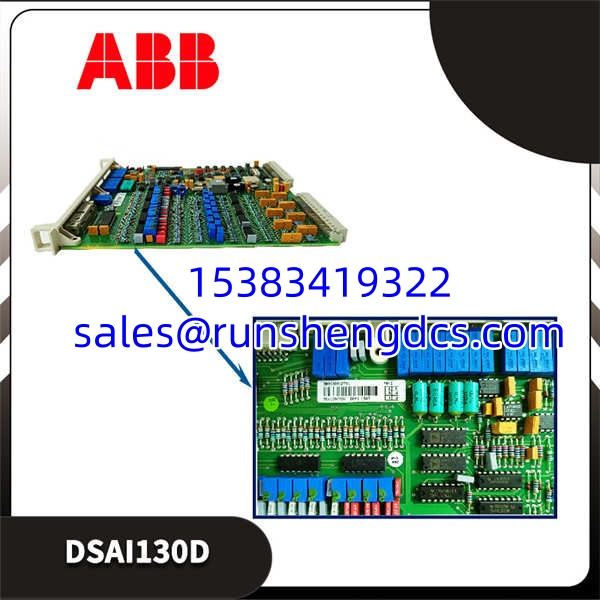
ABB DSAI130D
Compatibility & Replacement Matrix
- ABB DSAI130 → ABB DSAI130D: Direct Replacement — Identical functionality, D is the revision.
- ABB DSAI110 → ABB DSAI130D: Needs Adaptation — Different wiring terminal block required.
- ABB AI810 (S800 I/O) → ABB DSAI130D: Incompatible — Different system architecture (S800 vs. Freelance).
Quality Inspection & SOP Transparency
- Incoming Inspection: Verify the “DSAI130D” label against the serial number database to rule out gray market goods. Check the terminal block screws for tool marks — heavy cross-threading indicates prior use.
- Live Functional Test: Powered on a Freelance 800F test rack. Confirmed the “5V OK” and “RUN” LEDs illuminate solid green. Simulated 4-20 mA on all 8 channels; verified data consistency in the ABB DigiVis operator interface.
- Electrical Parameter Test: Measured backplane current draw at 118 mA (within spec). Conducted a continuity test on the shield connection (Pin 9) to ensure noise immunity.
- Firmware Verification: Read firmware version from module properties. Photographed the DIP switch settings (usually all OFF for default).
- Final QC & Packaging: Sealed in a static-shielding bag with desiccant. Labeled with “QC Passed” and inspection date.
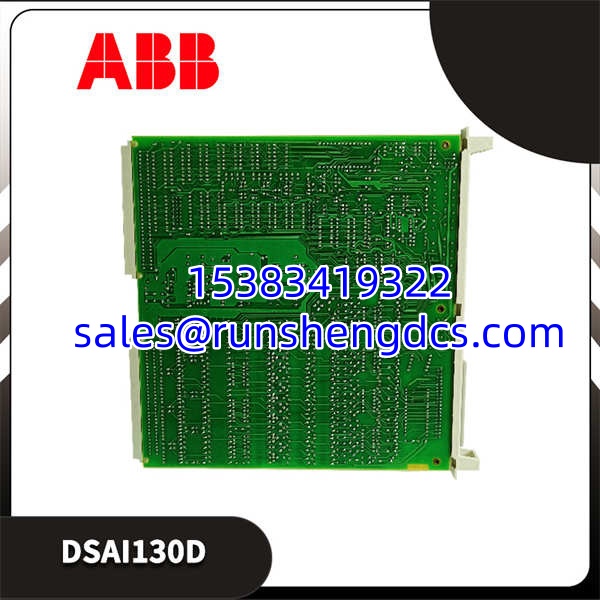
ABB DSAI130D
Common Replacement Pitfalls
- Wiring Terminal Confusion: The DSAI130D uses a specific 20-pin terminal block. Swapping in a module without the correct配套 (配套 means配套) terminal block will leave you with loose wires. Always check the terminal block part number separately.
- DIP Switch Settings: While rare, some older racks require specific addressing via DIP switches. Take a photo. Then take another. Misconfiguration here leads to “Module Missing” faults.
- Grounding Loops: This module is sensitive to ground potential differences. If you see erratic readings after install, check that the signal shield is grounded at the field side only, not at the module.
- Power Budget in Dense Racks: Each module draws ~120 mA. Fill a rack with 10+ analog modules and you’re pulling 1.2 A. Ensure the rack’s 5 V supply can handle the load.
- ESD Damage: The CMOS chips on these older boards are fragile. Watched an engineer grab a module bare-handed once. It smoked on power-up. $2,000 gone.
FAQ
Q: Can I just swap this in directly?
A: Generally, yes — if the firmware is compatible. However, you must match the terminal block. The requires a specific connector; don’t assume the old block from a DSAI110 will fit.
Q: My system runs Freelance 200F — will this module work?
A: It depends on the system version. The is compatible with Freelance 800F and 200F systems using the older “Classic” hardware configuration. Verify your system version in ABB Control Builder before ordering.
A: The “D” suffix typically denotes a minor revision or specific regional variant. Functionally, they are identical. The key difference is often the wiring diagram on the label — always check the pinout matches your existing cables.
Q: Do you test the analog accuracy?
A: Yes. We use a Fluke 754 process calibrator. We inject 4 mA, 12 mA, and 20 mA into each channel and log the deviation. Any channel exceeding ±0.3% error is flagged.
Q: What if I get noise/interference on the signals?
A: This is usually a wiring issue, not the module. First, ensure the cable shield is connected to the terminal block’s ground (Pin 9). Second, verify you’re not running signal wires parallel to 240 VAC power lines in the same conduit.