
Description
Key Technical Specifications
| Parameter | Value |
|---|---|
| Product Model | 07AC91F |
| ABB Order Number | GJR5252300R3101 |
| Product Family | Advant Controller 31 (AC31) Analog I/O Unit |
| Module Type | Mixed analog I/O |
| Typical Signal Range | ±10 V, 0–20 mA (verify per nameplate) |
| Typical Resolution | 12-bit + sign (family-typical; confirm on label) |
| Supply Voltage | 24 V DC |
| Mounting | AC31 DIN-rail module |
| Protection Class | IP20 (panel-mounted) |
| Operating Temperature | Typically 0 to +55 °C for AC31 analog modules |
| Storage Temperature | Typically −25 to +75 °C |
| Availability | Surplus / refurbished only |
Product Introduction
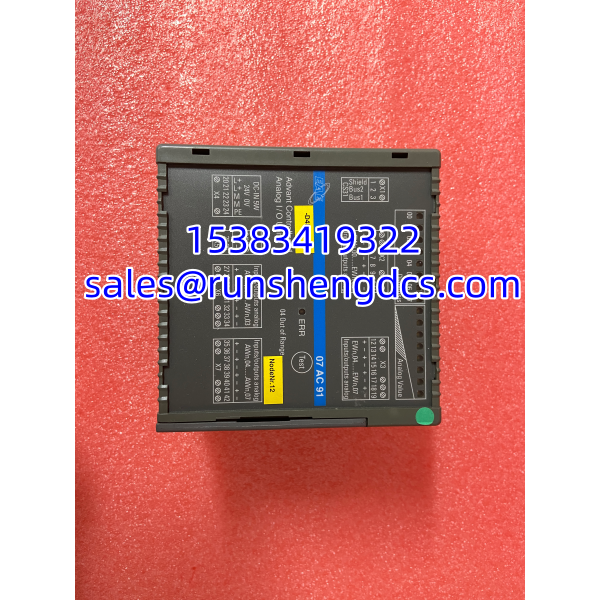
Replacing a failed analog module in an AC31 rack is rarely just a parts swap. The real risk is mismatched scaling, wrong signal range, or a revision difference that shifts calibration enough to upset a loop that has been running for years. The ABB 07AC91F / GJR5252300R3101 sits in that category: a legacy AC31 analog I/O module that still appears in older process control, utility, and machinery systems where a full controller migration is not yet justified.
This module belongs to the ABB Advant Controller 31 family and handles analog process signals such as temperature, pressure, flow, level, or valve position feedback. Typical AC31 07AC91-family modules operate on 24 V DC, support ±10 V or 0–20 mA signals, and use 12-bit-class resolution. It is not an AC800M module, not an S800 I/O block, and not a fieldbus communication card. Treat it as a like-for-like spare, not a platform upgrade.
QA/QC Transparency SOP
- Intake & Origin Verification: Confirm both markings — 07AC91F and GJR5252300R3101 — and check for revision suffixes. Reject units with cracked terminal blocks, corroded DIN-rail clips, burnt components, or missing labels.
- Live Functional Testing: Install in a compatible rack. Verify module recognition, LED diagnostics, and bus communication. Apply known 4–20 mA and ±10 V references and confirm scaled values match the control system.
- Electrical Parameter Tests: Measure 24 V DC supply current against the nameplate. Check terminal insulation, channel isolation, and signal reference integrity. Look for offset drift or noisy channels under load.
- Firmware/Config Verification: Read module identification, revision, and any stored scaling data. Compare with the removed module and the existing configuration. Mismatched scaling is a common source of post-replacement process upsets.
- Final QC & Anti-Static Packaging: Document channel test results, supply current, revision, and observed LED status. Pack in anti-static shielding with terminal block protection and include photos of the nameplate.
Field Engineer Gotchas
Revision mismatch can shift calibration. The “F” suffix and the R3101 order number must both match. A different 07AC91 revision may use different scaling or diagnostic behavior. Verify against the original module label before closing the loop.
Do not assume 8 AI / 8 AO without checking. Some 07AC91 variants are mixed analog I/O, but public listings are inconsistent. Treat channel count as unconfirmed until you read the nameplate and the hardware configuration.
Signal range errors cause immediate loop errors. ±10 V, 0–10 V, 0–20 mA, and 4–20 mA are not interchangeable without re-scaling. If the replacement module defaults differently, valve positions and displayed process values will jump.
24 V DC supply quality matters. analog modules are sensitive to noisy or low supply voltage. Check the 24 V rail before blaming the module, especially after a cabinet power disturbance.
This is not an AC800M or S800 module. Forcing it into the wrong backplane family will not work. It belongs in an Advant Controller 31 rack.
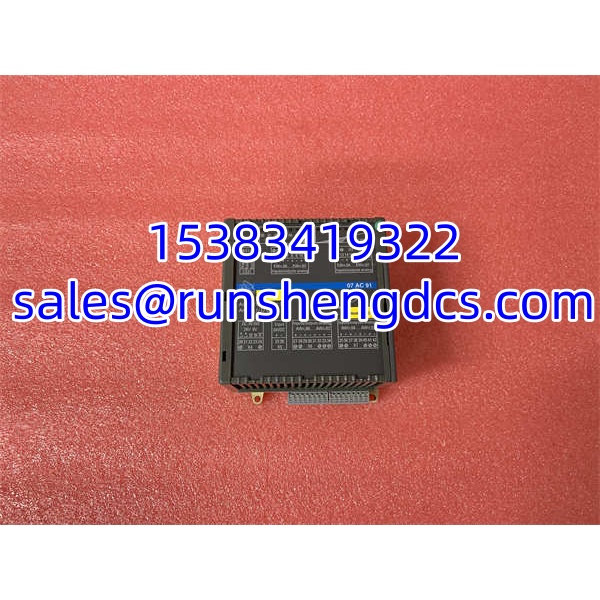
ABB GJR5252300R3101 07AC91F
Application Scenarios
Legacy process control racks. Used in older chemical, power, water, or manufacturing systems where controllers still manage temperature, pressure, flow, or level loops.
Retrofit hold points. Suitable when a plant is migrating to AC800M or a modern DCS but needs to keep an rack alive during phased replacement.
OEM machinery support. Found in older packaged equipment that used for analog measurement and analog output control.
Case snapshot: A water treatment site reported a sudden offset on a chlorine dosing loop after a cabinet power reset. The control program had not changed, but the analog output value no longer matched the valve positioner. Inspection showed a replaced 07AC91 module with a different revision and default scaling. After installing a verified ABB 07AC91F / GJR5252300R3101 matched to the original revision and restoring the correct scaling, the loop returned to normal without program changes.
FAQ
Is 07AC91F the same as 07AC91 or 07AC91D?
Not automatically. They belong to the same 07AC91 family, but suffixes and order numbers can differ in channels, scaling, or diagnostics. Match the full label.
Can I use this in an AC800M or S800 rack?
No. It is an Advant Controller 31 module. AC800M/S800 use different I/O hardware.
How many analog channels does it have?
Public listings vary. Confirm from the module nameplate and the hardware configuration before installation.
Does it support 4–20 mA and ±10 V?
The 07AC91 family typically supports ±10 V and 0–20 mA signals, with 4–20 mA handled by scaling. Verify the exact range on the installed module.
Is it still in production?
No. It is a legacy module available mainly as surplus or refurbished stock.
What is the biggest replacement risk?
Scaling mismatch. Even if the module powers up and communicates, wrong signal range or resolution can shift process values enough to upset control loops.