
Description
Key Technical Specifications
| Parameter | Specification |
|---|---|
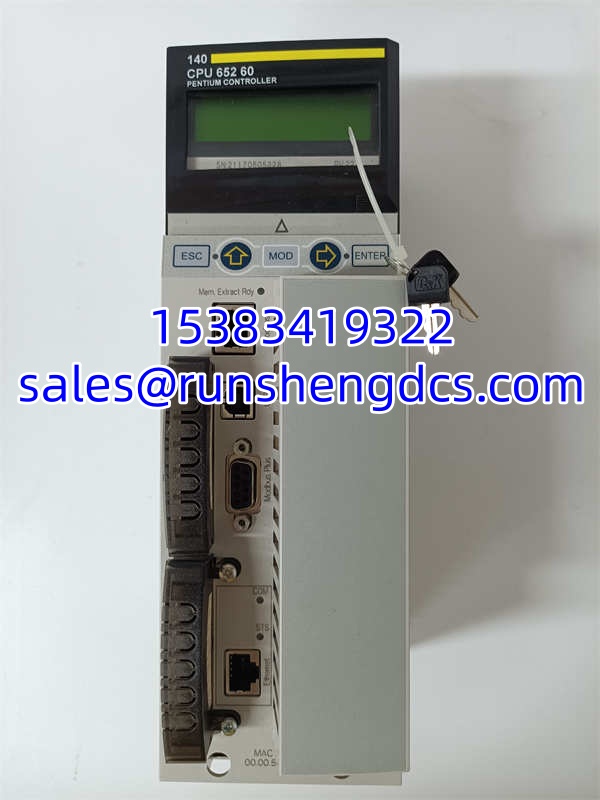
| Model Number | 140CPU65260 |
| Brand | Schneider Electric |
| Product Series | Modicon Quantum |
| Processor Type | Unity Processor (Pentium-class) |
| Clock Frequency | 266 MHz |
| Internal RAM | 4 MB (without PCMCIA card) |
| Program Memory | 2816 kB (without PCMCIA card) |
| Integrated Ports | 1× Ethernet TCP/IP, 1× Modbus (RS-232/RS-485), 1× Modbus Plus (RS-485), 1× USB |
| Communication Slots | Up to 6 option modules on local rack |
| Local I/O Racks | 2 |
| Remote I/O Stations | 31 stations (2 racks for remote network) |
| Distributed I/O Stations | 63 stations (1 rack per network) |
| Discrete I/O Capacity | 31,744 inputs / 31,744 outputs (remote) |
| Analog I/O Capacity | 1,984 inputs / 1,984 outputs (remote) |
| Bus Current Draw | 2760 mA |
| Battery | 3V lithium, 12 mAh, 10-year shelf life |
| Programming Languages | IEC 61131-3 (LD, ST, FBD, SFC, IL) |
| Math Coprocessor | None |
| Place of Origin | France |
Product Introduction
You inherit a Quantum rack from a plant that has been running for fifteen years, and the CPU module throws a fault you cannot clear with a power cycle. The 140CPU65260 is the replacement that keeps the existing backplane, I/O modules, and fieldbus wiring intact — no re-engineering, no migration project, no re-validation of the entire control strategy. It slots into the same chassis, recognizes the same I/O map, and resumes execution of the same Unity Pro project.
The 266 MHz processor with 4 MB of internal RAM handles multitasking across cyclic control, acyclic messaging, and diagnostics without forcing you to split logic across multiple processors. Six communication option slots on the local rack give you room for Ethernet, Modbus Plus, Profibus DP, or SERCOS modules depending on what your field devices demand. The integrated Ethernet TCP/IP port handles SCADA connectivity. Modbus and Modbus Plus ports cover legacy serial device integration. The USB port is reserved for programming PC connection. For a mid-range Quantum CPU, the I/O addressing ceiling — 31,744 discrete points remote, 1,984 analog points remote — covers most process control and infrastructure applications without hitting hardware limits.
QA/QC Transparency SOP
- Intake & Origin Verification
Photograph the module label. Capture model 140CPU65260, firmware version (PV), revision level (RL), software version (SV), serial number, and date of manufacture. Confirm “Made in France” marking. Cross-reference the firmware version against the target project’s Unity Pro configuration. - Visual & Mechanical Inspection
Inspect the backplane connector for bent or corroded pins. Check the keyswitch and memory port for physical damage. Examine the PCB for burnt components, cracked solder joints, or signs of liquid ingress. Verify the PCMCIA card slot (if populated) seats correctly. - Electrical Parameter Tests
Measure bus current draw with a calibrated multimeter. The module should draw approximately 2760 mA from the Quantum backplane at nominal voltage. Check the 3V lithium battery voltage — anything below 2.7V means the battery needs replacement before the module can retain memory during power loss. - Functional Verification
Install in a Quantum test rack with a known I/O configuration. Power up and confirm the processor reaches RUN state without fault codes. Load a test project via USB or Ethernet. Verify cyclic scan execution, discrete I/O toggling, and communication on each integrated port. Test Modbus register read/write. Confirm Ethernet TCP/IP connectivity. Log all results. - Final QC & Anti-Static Packaging
Label with QC pass status, firmware version, test date, and port verification results. Pack in anti-static shielding bag with foam protection on the backplane connector. Include a note that firmware version must match the production project before installation.
Field Engineer Gotchas
- Firmware Version Lock-In
The Unity Pro project is compiled against a specific firmware version. Drop a CPU with a different PV/RL/SV into the rack and the controller may refuse to enter RUN, or worse — it runs but behaves unpredictably on edge cases in the logic. Always read the firmware version off the old CPU before pulling it. Match it exactly on the replacement, or plan a controlled firmware upgrade with full regression testing. - Battery Failure Silently Kills Your Program
The 3V lithium battery retains the program and data in RAM during power loss. When that battery dies, the CPU loses its program on the next power cycle. You get a blank controller and a very bad morning. If the module has been sitting on a shelf for years, check the battery voltage before installing it. Replace proactively if it reads below 2.7V. - Bus Current Budget
At 2760 mA, this CPU is not a light load on the Quantum backplane power supply. If your rack is already packed with communication modules, high-density I/O, and specialty cards, verify the power supply can handle the total bus current before adding this CPU. An overloaded backplane causes intermittent faults that are a nightmare to diagnose. - PCMCIA Card Compatibility
The memory map changes depending on whether a PCMCIA card is installed. Without the card, program memory sits at 2816 kB. With the card, it jumps to 7168 kB. If your project was developed with a PCMCIA card and you install the CPU without one, the program will not fit. Confirm the card is present and recognized before attempting to load. - Communication Slot Count
Six option modules maximum on the local rack. If your existing system already has six communication cards installed and you need to add another protocol, you have hit the ceiling. Count your communication modules before ordering.
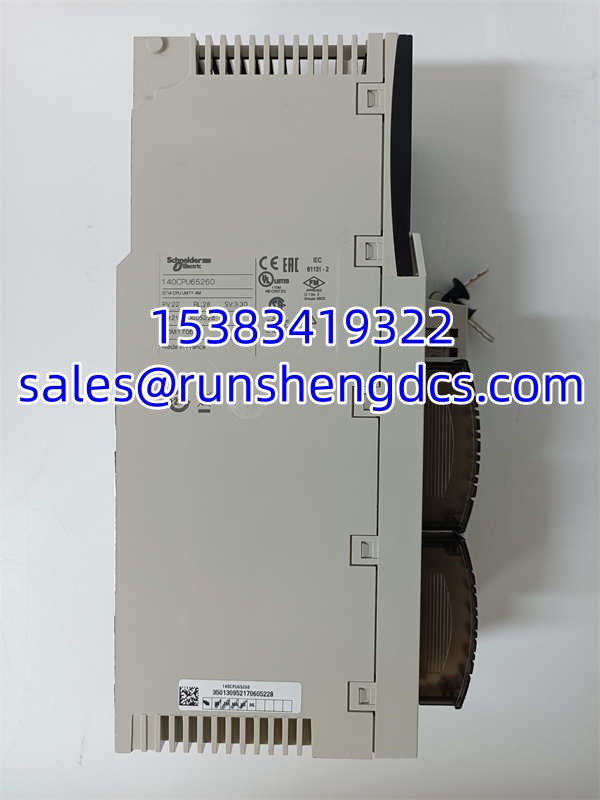
Schneider 140CPU65260
Application Scenarios
- Water/wastewater treatment plant SCADA integration — The 140CPU65260 manages distributed pump stations, flow meters, and valve actuators across a municipal water system. Ethernet TCP/IP connects to the SCADA server. Modbus Plus handles legacy RTU communication. Profibus DP modules interface with variable frequency drives on the plant floor.
- Oil and gas process control — A refinery uses the Quantum platform for distillation column control. The 140CPU65260 executes PID loops on temperature, pressure, and flow, with analog I/O modules reading 4-20 mA transmitters and driving control valves. The 1,984 analog I/O remote capacity covers the dense instrumentation typical of process units.
- Brownfield CPU replacement — A manufacturing facility’s existing 140CPU65260 fails after a power surge. The maintenance team sources a surplus unit with matching firmware, installs it in the same rack slot, loads the backed-up Unity Pro project, and restores production within one shift — no rewiring, no I/O reconfiguration, no SCADA changes.
FAQ
Is the 140CPU65260 the same as the 140CPU65160?
No. They share the Quantum platform and similar I/O capacity, but the 140CPU65260 has a 266 MHz processor while the 65160 runs at a lower clock speed. The 65260 also supports a different maximum communication module count in certain configurations. They are not drop-in substitutes for each other without verifying the project’s performance requirements.
Can I use this CPU without a PCMCIA card?
Yes. Without the card, the CPU operates with 4 MB of internal RAM and 2816 kB of program memory. The PCMCIA card expands memory to 7168 kB for program storage. If your project fits within the base memory, no card is needed.
What programming software does this CPU use?
Unity Pro (now part of EcoStruxure Control Expert). It supports all five IEC 61131-3 languages: Ladder Diagram (LD), Structured Text (ST), Function Block Diagram (FBD), Sequential Function Chart (SFC), and Instruction List (IL).
Does this CPU support hot standby?
No. The 140CPU65260 is a standard (non-redundant) processor. If you need hot standby, the 140CPU67160 is the redundant CPU variant in the Quantum family.
How many remote I/O stations can this CPU handle?
Up to 31 remote I/O stations across 2 racks on the remote network, and up to 63 distributed I/O stations per network (1 rack per network).
Is this CPU still manufactured?
The Modicon Quantum platform has been in production for many years. Availability and lifecycle status should be confirmed directly with Schneider Electric. Surplus units are available through spare parts channels.
What should I check before buying a surplus 140CPU65260?
Get the firmware version (PV, RL, SV) from the seller and confirm it matches your project. Verify the battery voltage. Confirm the PCMCIA card slot condition if your project requires one. Ask for a photo of the label — if the seller cannot provide one, walk away.