
Description
Key Technical Specifications
| Parameter | Specification |
|---|---|
| Manufacturer | Honeywell Process Solutions |
| Product Type | C300 Low-Level Analog Input Multiplexer (LLMUX) Process Module |
| Platform | Experion PKS C300 Process Module I/O |
| Primary Function | 64-channel low-level analog input acquisition for TC/RTD temperature signals |
| Channel Count | 64 points (LLMUX architecture) |
| Supported Signal Types | Thermocouple (TC) and RTD inputs |
| Paired IOTA | CC-TAIM01 — LLMUX IOTA terminal board |
| Architecture | C-Series I/O — module inserts into IOTA; no separate FTA chassis required |
| Power Source | Receives 24 VDC from IOTA carrier bus |
| Typical Applications | Furnace zone temperature, reactor bed temperature, pipeline temperature monitoring |
| Documentation | Honeywell C300 & Series C I/O hardware manuals |
Product Introduction
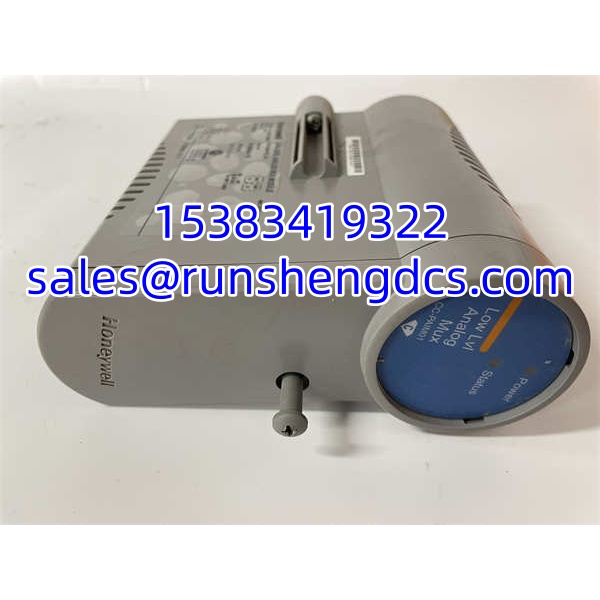
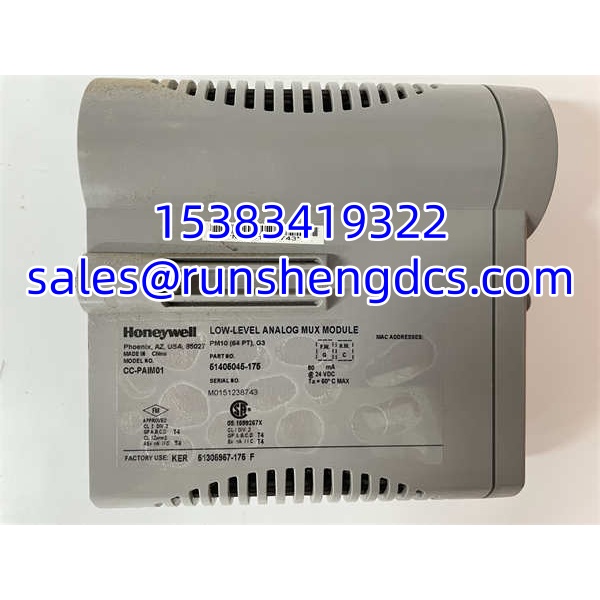
In a Honeywell Experion PKS C300 cabinet, temperature acquisition at scale is handled differently from standard 4–20 mA AI. The HONEYWELL CC-PAIM01 is the C300 low-level analog input multiplexer — the LLMUX process module that consolidates up to 64 low-level TC/RTD channels into a single C-Series I/O position. Unlike standard HLAI modules such as CC-PAIX01 or CC-PAIH01, which accept conditioned 4–20 mA or voltage signals, the CC-PAIM01 is designed for direct low-level sensor input, making it the go-to module for dense temperature measurement arrays.
Its practical value is channel density and wiring simplification. By pairing with the CC-TAIM01 LLMUX IOTA, it eliminates the need for separate external multiplexers or dense FTA wiring for large temperature point lists. This makes it especially common in furnace, reactor, and heat-exchanger applications where dozens of thermocouples must be monitored from a single I/O rack. Bottom line — this is a specialized temperature multiplexer module, not a general-purpose AI card. It must be paired with the correct CC-TAIM01 IOTA and configured for the specific TC/RTD sensor types in the application.
QA/QC Transparency SOP
- Intake & Origin Verification — Confirm label reads CC-PAIM01. Inspect for physical damage, corrosion, bent IOTA mating pins, and connector integrity.
- Visual & Mechanical Inspection — Verify IOTA connector condition, module seating latches, and PCB coating. Reject units with cracked housings or corroded contacts.
- Channel Continuity & Isolation Tests — Spot-check multiplexer channel paths for opens, shorts, and inter-channel isolation. Flag any channels with abnormal resistance or leakage.
- IOTA Compatibility Verification — Confirm pairing with CC-TAIM01 LLMUX IOTA. The CC-PAIM01 cannot be installed on standard AI IOTAs such as CC-TAIX01 or CC-TAIX11.
- Final QC & Anti-Static Packaging — Document part number, revision, test results, and paired IOTA. Pack in ESD-safe materials with connector protection to prevent pin damage during shipment.
Field Engineer Gotchas
- CC-PAIM01 is not a standard AI module. It is a low-level multiplexer for TC/RTD signals. Do not attempt to wire 4–20 mA transmitters directly to it unless the OEM documentation explicitly supports it.
- It requires CC-TAIM01 IOTA. The CC-PAIM01 must be paired with the CC-TAIM01 LLMUX IOTA terminal board. Installing it on a standard AI IOTA will cause mechanical and electrical incompatibility.
- 64 channels share multiplexer hardware. A single failed multiplexer stage can affect multiple channels. If several temperature points fail simultaneously, suspect the module rather than individual field sensors.
- Cold-junction compensation matters. For thermocouple applications, CJC accuracy depends on the IOTA/module assembly environment. Temperature gradients across the IOTA can introduce measurement error.
- Configuration must match sensor type. Each channel must be configured for the correct TC type (J, K, T, etc.) or RTD type (Pt100, etc.). A mismatch causes systematic offset, not random noise.
HONEYWELL CC-PAIM01
Application Scenarios
- Furnace temperature monitoring: Consolidates dozens of thermocouple zones into a single C300 I/O position for fired heaters, reformers, and cracking furnaces.
- Reactor bed temperature profiling: Supports dense RTD/TC arrays in catalytic reactors where temperature gradient monitoring is critical.
- Heat exchanger monitoring: Provides multi-point temperature acquisition across shell-and-tube or plate heat exchangers.
- Spare parts provisioning: Maintains a verified LLMUX module for racks where original CC- units have failed or drifted out of calibration.
FAQ
No. It is a low-level analog input multiplexer (LLMUX) designed primarily for TC and RTD temperature signals, not for standard 4–20 mA transmitters.
2. How many channels does it support?
64 channels in LLMUX architecture.
3. Which IOTA does it pair with?
CC- — the LLMUX IOTA terminal board.
4. Can it accept 4–20 mA signals?
It is designed for low-level TC/RTD inputs. Using it for 4–20 mA signals requires explicit OEM confirmation; in most cases, CC-PAIX01 or CC-PAIH01 is the correct module for current-loop AI.
5. Does it support HART?
No. HART capability is associated with CC-PAIH01 (HLAI with HART). CC- is a low-level multiplexer, not a HART-enabled module.
C-Series I/O supports redundancy at the IOTA level for many module types. Verify with the current Honeywell I/O hardware manual whether CC-/CC- supports redundant deployment in your rack configuration.
7. Is refurbished stock acceptable?
Yes, if connector condition, channel continuity, and IOTA compatibility are verified. For critical temperature interlocks or furnace safety applications, require documented QA and post-installation channel verification.