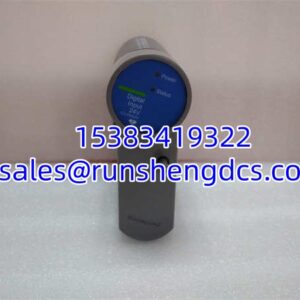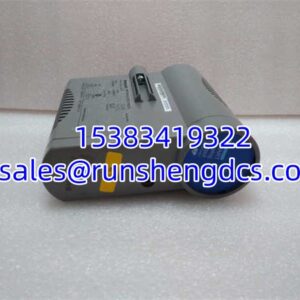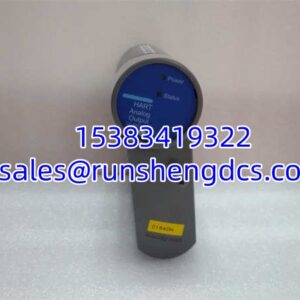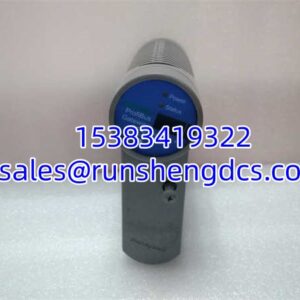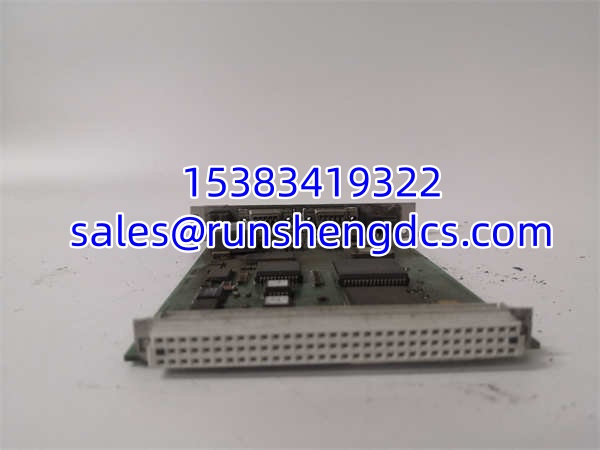

Description
Key Technical Specifications
| Parameter | Value |
|---|---|
| Product Model | F8621A |
| Assembly Reference | 98 4862160 (third-party listing) |
| Manufacturer | HIMA |
| Product Family | HIQuad / HIMA F-series safety system module |
| Module Type | Communication module |
| Communication Interface | 2 × RS-485 (master/slave) |
| Supported Protocols | Modbus RTU; PROFIBUS-compatible serial links per third-party listings |
| Baud Rates | 300 to 57,600 bps (selectable) |
| Data Format | ASCII, binary, or mixed |
| Error Checking | CRC |
| Safety System Role | Communication interface within HIMA SIL-rated SIS |
| Safety Certification | IEC 61508 / IEC 61511 SIL 3 (system-level; module-specific certificate must be verified) |
| Typical Operating Voltage | 24 V DC (system-dependent; verify on nameplate) |
| Mounting | HIMA rack/chassis module |
| Condition | Surplus/used unless factory-sealed with OEM documentation |
Product Introduction
The HIMA F8621A is a communication module for HIMA safety systems, most commonly associated with the HIQuad/F-series architecture. Its job is not to execute safety logic, but to move data between the safety system and external hosts. In typical installations, it connects a HIMA SIS to a DCS, PLC, RTU, or serial instrument network so that process values, alarm states, trip status, and diagnostic information can be exchanged without replacing the safety controller.
This module is often specified where a safety system must remain electrically and functionally separate from the basic process control system, but still provide monitored status data. Because it operates within a HIMA safety-rated architecture, communication faults can be diagnosed and alarmed rather than silently degrading system visibility.
It should not be confused with HIMA CPU modules, power supplies, digital I/O cards, analog output cards, or safety relay modules. Several online listings misclassify F8621A as a controller, analog output, or safety relay; those descriptions do not match its established role as a communication interface.
QA/QC Transparency SOP
- Identity Verification — Confirm model F8621A and assembly reference 98 4862160. Record serial number, hardware revision, and firmware version if accessible.
- Mechanical Inspection — Check the module housing, backplane connectors, LEDs, and labeling. Reject units with cracked housings, bent pins, or missing nameplates.
- Power-Up Test — Install in a compatible HIMA rack with correct system power. Verify module initialization and status LEDs.
- Communication Test — Configure RS-485 parameters (baud rate, data format, node address). Test Modbus RTU read/write with a known-good master or slave device.
- Error Handling Validation — Verify CRC error detection, timeout behavior, and diagnostic reporting. Confirm that communication faults are visible in the safety system diagnostics.
- Final Documentation — Record test configuration, communication parameters, firmware revision, and condition. Package with ESD protection and include test summary.
Field Engineer Gotchas
- Not a CPU or safety relay. F8621A is a communication module. It does not replace a HIMA processor, I/O card, or safety relay.
- Public listings are inconsistent. Some sources describe F8621A as a TMR/QMR controller or analog output module. Those claims conflict with HIMA catalog references that list it as a communication module.
- RS-485 wiring matters. Termination, polarity, grounding, and node addressing must match the remote device. Incorrect termination is a common cause of intermittent Modbus faults.
- Baud rate must match end-to-end. The module supports multiple baud rates, but all devices on the same RS-485 segment must agree.
- SIL certification applies to the system. The module itself is part of a SIL-rated architecture, but the applicable certificate, hardware version, and firmware must be confirmed before safety-critical use.
- Compatibility is rack/system dependent. must be validated against the specific HIMA system generation, backplane, and firmware before deployment.
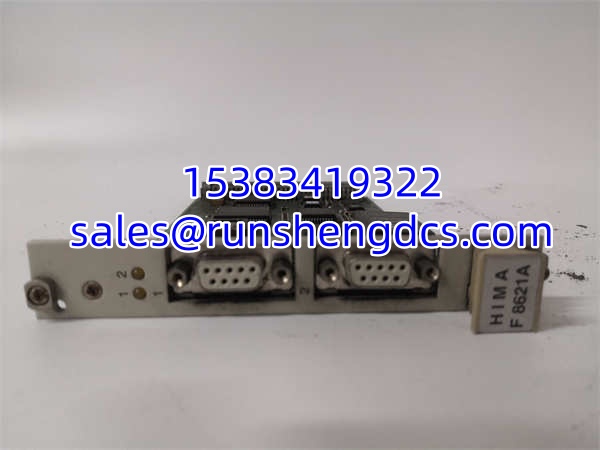
HIMA F8621A
Application Scenarios
- ESD-to-DCS status link. A HIMA emergency shutdown system sends trip-ready, trip-active, and permissive status to a DCS over Modbus RTU without sharing control execution.
- Legacy instrument integration. Older serial instruments or RTUs are connected to a HIMA safety system through RS-485, avoiding custom gateway hardware.
- Remote diagnostics interface. The module provides a monitored communication path for alarm acknowledgment, setpoint visibility, and diagnostic data collection.
- Brownfield SIS migration. During a control system upgrade, maintains serial communication with existing PLCs while the HIMA safety system remains in service.
FAQ
It is a communication module for HIMA safety systems. Descriptions calling it a CPU, safety relay, or analog output module come from inconsistent third-party listings and should be verified against OEM documentation.
What protocols does it support?
Modbus RTU is the most commonly referenced protocol. PROFIBUS-compatible serial communication is also mentioned in third-party listings. Confirm supported protocols for the installed firmware revision.
Can it be used in SIL 3 systems?
It is used within HIMA SIL-rated safety architectures. The exact certification scope, hardware revision, and firmware must be confirmed from HIMA documentation before safety-critical deployment.
Does it replace a HIMA CPU module?
No. provides communication only. Safety logic execution remains on the appropriate HIMA processor module.
Is it still supported by HIMA?
is a legacy module. Current support, spare availability, and replacement paths should be confirmed directly with HIMA or an authorized partner.