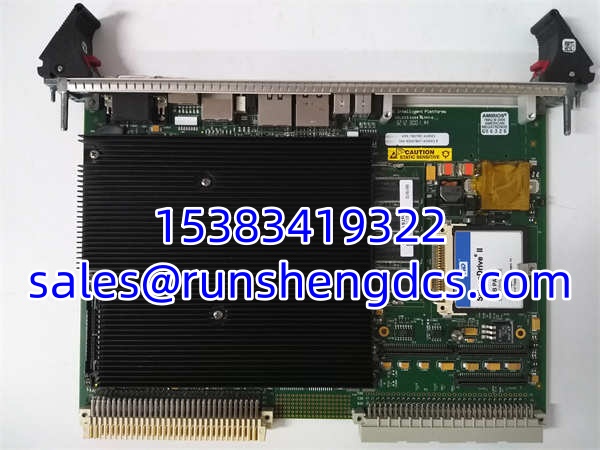

Description
Key Technical Specifications
- Processor: Intel Pentium M (1.1GHz, 1.4GHz, or 1.8GHz options)
- Memory: Up to 1.5GB DDR SDRAM with optional ECC
- Storage: Up to 2GB CompactFlash (bootable via IDE)
- VME Interface: Tundra Universe II, supports VME64 (A32/A24/D32/D08/MBLT64/BLT32)
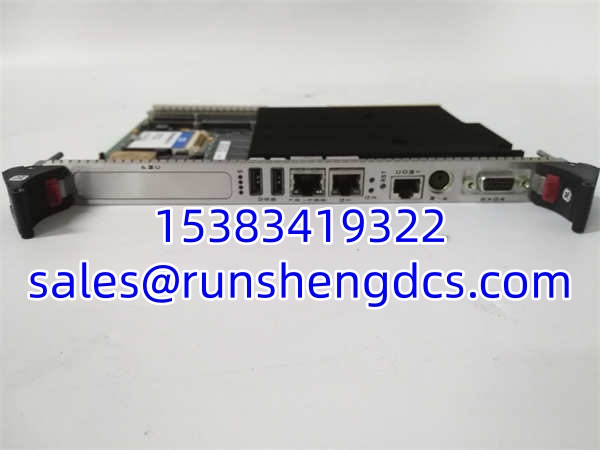
- Network: Dual Gigabit Ethernet (Intel 82546EB) + 10/100 Fast Ethernet
- Serial Ports: 4x 16550-compatible (RS-232/422 configurable)
- USB: 4x USB 2.0 ports (2 front, 2 rear P2)
- Expansion: 1x 5V PMC slot (PCI-X 66MHz)
- Graphics: Integrated SVGA (front) and DVI-D (rear P2)
- Operating Temp: -40°C to +85°C
- Power: 9V to 36V DC input
- OS Support: VxWorks, QNX, Linux, Windows XP/2000
Product Introduction
You don’t buy this board for a web server. The GE VME-7807RC-410001350-93007807-410001 K is a VME64 single-board computer built for the trenches of industrial automation, defense, and aerospace. It packs an Intel Pentium M processor (up to 1.8GHz) and 1.5GB of DDR SDRAM into a single-slot Eurocard form factor that fits right into your legacy VME chassis. With dual Gigabit Ethernet, four serial ports, and a PMC expansion slot, it’s designed to be the central brain in a rack full of I/O modules, handling real-time control loops, data aggregation, and protocol conversion without breaking a sweat.
Bottom line—this is a workhorse, not a show pony. The GE VME-7807RC-410001350-93007807-410001 K runs hot (passively cooled, so airflow is mandatory) and demands clean power (9-36V DC). It supports VxWorks, QNX, and Linux, meaning your 15-year-old application code might just boot without a full rewrite. The real value isn’t the clock speed; it’s the VME64 backplane compatibility and the fact that it still has a PMC slot for that custom FPGA card you can’t replace. When your old 90MHz Pentium board finally dies, this GE VME-7807RC-410001350-93007807-410001 K is the fastest path to getting the line back up without a $200K system migration.
Troubleshooting Quick Reference
- No Boot / No Video: 80% chance it’s a RAM or CompactFlash issue. Reseat the SODIMM and CF card. Try booting with minimal RAM (single stick). If it still fails, check the BIOS battery—these boards lose settings and can hang on POST if the CR2032 is dead.
- VME Bus Timeout / Comm Errors: 70% likely a backplane or termination issue. Verify the VME64 P1/P2 connector is fully seated and free of oxidation. Check that the Tundra Universe II chip isn’t overheating (touch test: warm is fine, burning hot is bad). Ensure your VME address switches match the software configuration.
- Random Reboots / Watchdog Resets: 60% chance of thermal throttling or power sag. This board is passively cooled. Verify chassis airflow is >100 LFM across the heatsink. Measure the 5V and 3.3V rails at the P1 connector under load; if they droop below 4.75V or 3.1V, your backplane power supply is failing.
- PMC Card Not Detected: 50% chance of 5V vs 3.3V keying mismatch. The PMC slot is 5V only. If you’re trying to plug in a 3.3V-only PMC card, it won’t work. Check the mechanical keying and verify the PMC card’s voltage requirement in its datasheet.
Application Scenarios & Pain Points
- Legacy VME Radar/Defense Systems: The GE VME-7807RC-410001350-93007807-410001 K is often the last line of defense in military radar and signal processing systems. The pain point is that the original software was written for VxWorks 5.x and the OEM support contract expired in 2010. Finding a board with the exact BIOS/firmware revision to avoid recompiling 50,000 lines of C code is a full-time job.
- Power Plant Turbine Control: Gas turbine controllers running GE VME-7807RC-410001350-93007807-410001 K boards in harsh, high-vibration environments. The challenge is that these boards run hot (-40°C to +85°C rated, but ambient cabinet temps can hit 60°C). When one fails, the plant faces a 12-week lead time for a new surplus unit, costing $50K/day in lost generation.
- Industrial Data Acquisition: Test stands and lab automation using GE VME-7807RC-410001350-93007807-410001 K with custom PMC data acquisition cards. The pain point is the CompactFlash controller. These boards are picky about CF card brands and capacities; using a modern 32GB card often fails where a 2GB industrial-grade card works fine.
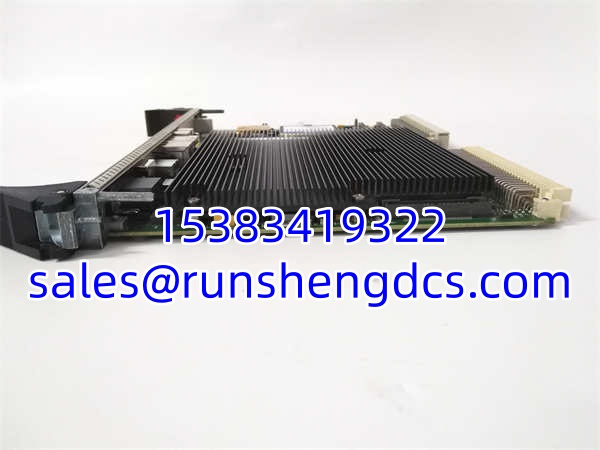
GE VME-7807RC-410001350-93007807-410001 K
Compatible Replacement Models
- ✅ Drop-in Replacement: (exact match). No hardware changes needed. Copy the VME address switches, jumper settings, and CompactFlash card. Cost: 4,000–8,000. Verify the Pentium M clock speed (1.1/1.4/1.8GHz) matches your existing board; faster isn’t always better if your timing loops are calibrated to a specific CPU speed.
- ⚠️ Software Compatible: VMIVME-7807-411001 (if available). Same platform, but may require BIOS update or VxWorks BSP patch. Budget 8-16 hours of engineering time. Confirm the VME64 backplane timing and PMC slot voltage match before ordering.
- ❌ Hardware Incompatible: GE VMIVME-7750 or VMIVME-7805. Different VME connector pinout, different chipset, different BIOS. This is a full system revalidation project requiring I/O driver rewrites and SIL re-certification. Do NOT attempt as a field swap.