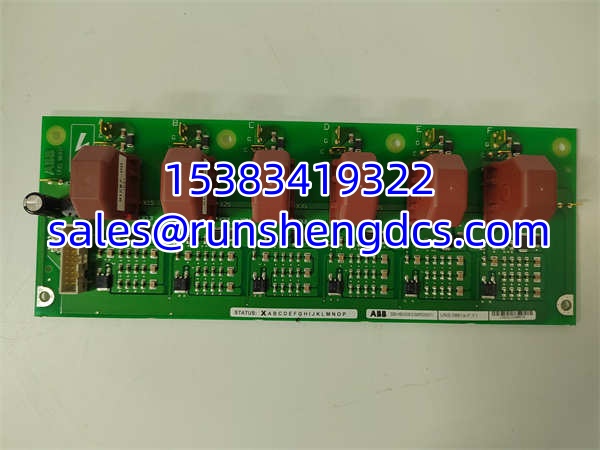
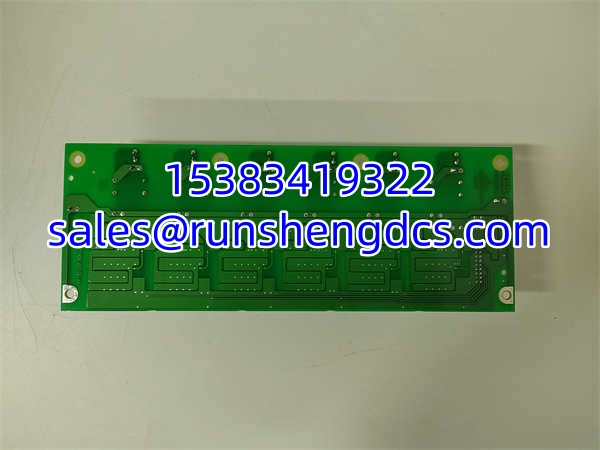

Description
Key Technical Specifications
| Parameter | Specification |
|---|---|
| Model Number | UNS0881A-P, V1 |
| Order Code | 3BHB006338R0001 |
| Brand | ABB |
| Product Type | Gate Drive Interface (GDI) PCB / Firing Board |
| Hardware Revision | V1 (V2 is a newer revision) |
| Host System | ABB Excitation Systems (T6S-O / U541-S8000) |
| Function | Controls and powers gate drivers for thyristor/SCR firing in rectifier bridges |
| Related Boards | UNS0880A-P V2 (Rectifier Bridge Interface CIN), UNS0885A-2 V1 (Rectifier Display) |
| Approximate Dimensions | 27 × 10 × 4 cm (verify against physical unit) |
| Approximate Weight | 0.34 kg (verify against physical unit) |
| Application Environments | Power plants, nuclear power, industrial excitation systems |
Product Introduction
A generator loses excitation and the unit trips offline. The root cause traces back to a failed firing pulse on one thyristor leg of the rectifier bridge. The UNS0881A-P, V1 is the gate drive interface board sitting inside the ABB excitation system rectifier cabinet. It receives firing commands from the excitation controller, conditions those signals, and delivers properly timed gate drive pulses to the thyristor gate drivers — which then fire the SCRs that feed DC current into the generator field winding.
This board is part of a tightly coupled control chain. It works alongside the rectifier bridge interface board (UNS0880A-P), the power supply module, and the rectifier display board. A failure on the GDI board means lost or mistimed firing pulses, which translates directly to unbalanced rectifier output, field current instability, or a complete loss of excitation. The V1 revision has been superseded by a V2 variant — confirm with ABB whether the V2 is backward-compatible with your excitation system firmware and hardware configuration before ordering a replacement.
QA/QC Transparency SOP
- Intake & Origin Verification
Photograph the board markings. Capture the UNS0881A-P designation, the V1 revision marking, the 3BHB006338R0001 order code, and any date or lot codes. Cross-reference against the excitation system bill of materials to confirm the board revision matches the installed system configuration. - Visual & Mechanical Inspection
Inspect all connector headers and pin rows for bent, corroded, or missing pins. Check the PCB for cracked solder joints, burnt traces, bulging capacitors, or signs of thermal damage. Verify mounting holes and board dimensions match the target rectifier cabinet slot. - Electrical Parameter Tests
Measure power rail continuity and verify no short circuits between supply rails and ground. Check isolation between the control signal side and the gate drive output side. Verify component-level integrity of critical passive components (resistors, capacitors, diodes) using a calibrated multimeter or component tester. - Functional Verification
If a compatible excitation test bench is available, install the board and verify that firing pulse outputs are generated with correct timing, amplitude, and isolation when commanded by the excitation controller. Confirm pulse symmetry across all output channels. Log pass/fail results. - Final QC & Anti-Static Packaging
Label with QC pass status, test date, revision level, and channels verified. Pack in an anti-static shielding bag with foam protection on connectors. Include a note that the board must be verified against the excitation system configuration before commissioning.
Field Engineer Gotchas
- V1 vs. V2 Revision Mismatch
The UNS0881A-P exists in V1 and V2 revisions. The V2 is a newer version and may have different component layouts, firmware expectations, or signal conditioning parameters. Dropping a V2 board into a system configured for V1 — or vice versa — can result in incorrect firing timing or communication failures with the excitation controller. Check the excitation system documentation for the required revision before ordering. - Confusing This Board with the Rectifier Bridge Interface (UNS0880A-P)
The UNS0881A-P (GDI board) and the UNS0880A-P (rectifier bridge interface / CIN board) are different boards with different functions. The GDI board handles gate drive pulse generation and power. The CIN board handles the rectifier bridge interface signals. Procurement mix-ups between these two part numbers are common. Verify the exact part number on the failed board before ordering. - Misidentifying This as a Generic Digital Input Module
Some surplus listings incorrectly label the UNS0881A-P as a “digital input module.” It is not. It is a gate drive interface board specific to ABB excitation systems. If your application needs a standard PLC digital input card, this is the wrong part. - Gate Drive Isolation Integrity
The GDI board provides electrical isolation between the low-voltage control side and the gate drive output side. If this isolation is compromised — from moisture ingress, contamination, or prior fault damage — the board can pass destructive voltages to the gate drivers or fail to deliver firing pulses. Megger-test the isolation before energizing a surplus board. - Missing Companion Board Dependencies
The GDI board does not operate in isolation. It depends on the rectifier bridge interface board, the excitation power supply, and the controller. If you are replacing the GDI board after a system fault, verify that the companion boards are also functional. A new GDI board fed by a faulty CIN board will not fix the problem.
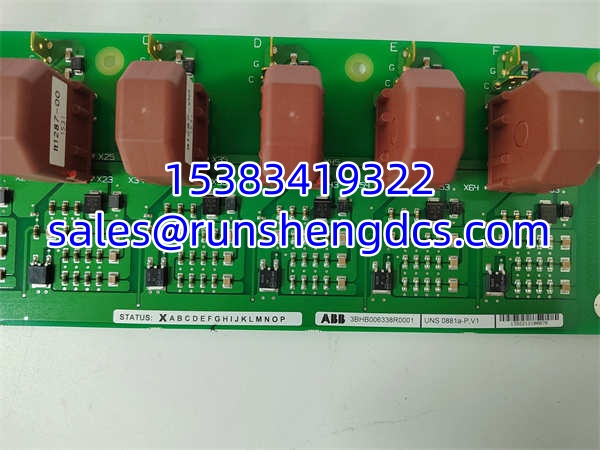
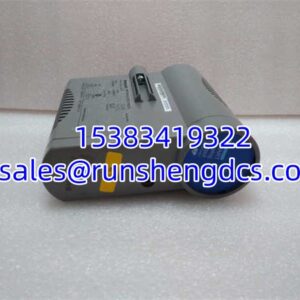
ABB UNS0881a-P,V1 3BHB006338R0001
Application Scenarios
- Generator excitation systems in thermal power plants — The GDI board fires thyristors in the rectifier bridge that converts AC to DC field current for synchronous generators. Reliable firing pulse timing is critical for voltage regulation and grid stability.
- Hydroelectric generator excitation — Similar thyristor-based rectifier bridges control field excitation in hydro generators. The GDI board ensures precise firing angles under varying load and speed conditions.
- Nuclear power plant excitation systems — The board is specified for use in nuclear plant excitation applications, where high reliability and safety-critical performance are mandatory. Redundancy and diagnostic monitoring requirements are typically more stringent in these environments.
- Industrial synchronous motor excitation — Large synchronous motors in mining, cement, or petrochemical plants use thyristor excitation systems. The GDI board controls the rectifier bridge that maintains the motor’s field current.
FAQ
Not guaranteed. The V2 is a newer revision and may have different firmware expectations, signal timing, or connector configurations. Confirm with ABB or your excitation system documentation whether the V2 is backward-compatible with your installed system before substituting.
They are different boards. The is the Gate Drive Interface board that generates firing pulses for the thyristors. The UNS0880A-P is the Rectifier Bridge Interface (CIN) board that handles bridge-level signals and monitoring. Do not substitute one for the other.
Is this board the same as a generic digital input module?
No. Some surplus listings incorrectly label it as a digital input module. The is a gate drive interface board designed specifically for ABB excitation system rectifier bridges. It is not a general-purpose I/O card.
What excitation systems use this board?
The is used in ABB excitation systems, including the T6S-O and U541-S8000 platforms. Confirm compatibility with your specific excitation system model and firmware version before ordering.
Can I test this board on a bench without the full excitation system?
Limited testing is possible — you can verify power rail continuity, isolation, and basic component integrity. Full functional testing requires the excitation controller and rectifier bridge to generate and verify firing pulses. A bench test alone does not confirm the board will work in your system.
Get a photo of the board showing the full part number and revision marking (V1 or V2). Confirm the connector pins are intact. Ask whether the seller has performed isolation and functional tests. Verify the revision matches your excitation system requirements.