
Description
Key Technical Specifications
| Parameter | Specification |
|---|---|
| Rated capacity | 1.0 kN (≈225 lbf / 102 kgf) |
| Measuring direction | Horizontal (lateral force) |
| Measuring principle | Magnetoelastic (Pressductor), no strain gauges |
| Accuracy class | 0.5% FS |
| Repeatability | < ±0.05% FS |
| Hysteresis | ±0.03% FS |
| Deflection at rated load | 0.015 mm |
| Spring constant | 65 kN/mm |
| Overload capacity (measurement direction) | 5.0 kN (500% of nominal) |
| Permitted transverse load | 10 kN |
| Body material | Stainless steel (AISI 430F / SIS 2383 type) |
| Operating temperature | Typically −20 to +80 °C for standard A version; verify against OEM datasheet |
| Protection class | Standard A: typically IP20; AE/AER variants reach IP66/IP67 |
| Output signal | Passive millivolt-level sensor signal; requires PFEA/PFCA electronics |
| Typical electronics | PFEA111, PFEA112, PFEA113, PFCA401 |
| Weight | Approx. 0.8 kg |
Product Introduction
Replacing a failed tension cell during a paper-machine outage is easy to mess up if the spare is the wrong variant. The PFTL101A family has standard, mill-duty AE, and acid-resistant AER versions, and the protection rating changes with the suffix. Buying the wrong one means rewiring or re-machining adapter plates while the line is down.
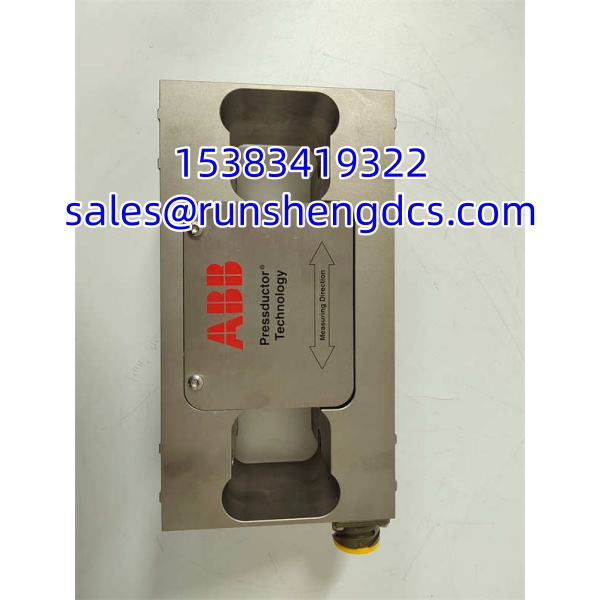
The 3BSE004166R1 is the ABB Pressductor PillowBlock load cell rated at 1.0 kN for horizontal web-tension measurement. It uses magnetoelastic sensing rather than strain gauges, so there is no foil element to fatigue under repeated loading. Deflection stays at 0.015 mm, and the cell can survive short 500% overload peaks without permanent damage. It must be paired with ABB tension electronics such as PFEA112 or PFEA113 to produce usable 4–20 mA or 0–10 V signals for a PLC or DCS. The standard PFTL101A version is not intended for wet-end or corrosive environments; those applications need the AER variant.
QA/QC Transparency SOP
- Intake and Origin Verification: Confirm full model PFTL101A-1.0kN and order number 3BSE004166R1. Check nameplate, cable connector type, and whether the unit is A, AE, or AER. Record any physical damage on the machined measuring faces.
- Live Functional Testing: Mount the cell on a flat test plate with proper adapter blocks. Apply a calibrated horizontal load and verify output through a PFEA112/PFEA113 test unit. Check zero balance, linearity at 25%, 50%, 75%, and 100% of 1.0 kN, and return-to-zero after unloading.
- Electrical Parameter Tests: Measure coil resistance between excitation and signal pairs against the OEM datasheet. Inspect cable continuity, shield integrity, and connector pin condition. Look for moisture ingress in the cable gland or plug.
- Firmware/Config Verification: Not applicable to the sensor itself. Verify the paired PFEA/PFCA electronics configuration: range set to 1.0 kN, correct filtering, and analog output scaling. Save the electronics parameter backup.
- Final QC and Anti-Static Packaging: Tag the unit with model, order number, test date, and measured zero/output values. Protect the machined surfaces. Pack with desiccant if the unit shows any storage-age risk.
Field Engineer Gotchas
- Wrong variant for the environment: The standard PFTL101A is not acid-resistant. Installing it in a wet-end paper-machine section or a washdown area will shorten its life. Use PFTL101AER for corrosive or high-moisture zones.
- Treating it like a 4–20 mA transmitter: The cell itself does not output 4–20 mA. It produces a low-level magnetoelastic signal that must go through PFEA or PFCA electronics first. Wiring it directly to a PLC analog input will give nothing usable.
- Mounting surface flatness ignored: The base must be flat and rigid. Poor mounting transfers bending stress into the cell and causes drifting readings. Use grade 12.9 bolts and torque them evenly.
- Vertical load applied by mistake: PFTL101A measures horizontal force only. If the roll load is vertical, this is the wrong sensor family. A PFCL vertical cell would be needed instead.
- Cable damage during roll changes: The connector and cable are common failure points. A crushed cable or bent pin looks like a sensor fault but is usually just bad wiring.
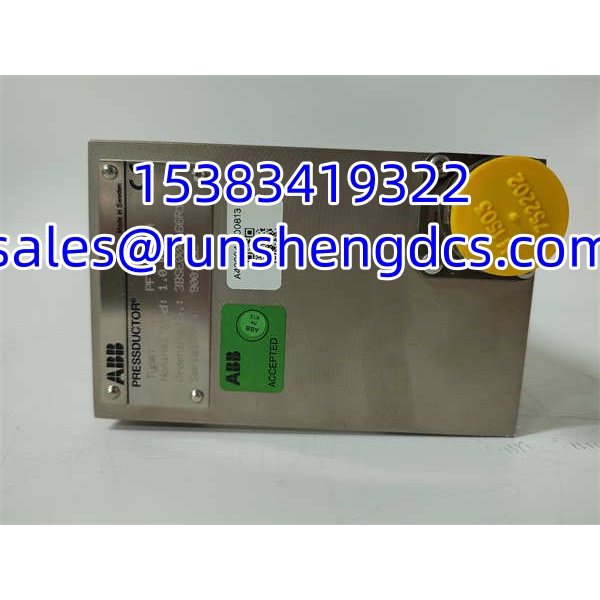
ABB PFTL101A 1.0KN 3BSE004166R1
Application Scenarios
- Paper-machine dryer-section tension control: Measures web tension on light paper grades where small force changes affect sheet stability.
- Film and foil converting lines: Monitors tension on narrow webs before slitting or coating stations.
- Label-printing and packaging presses: Keeps tension steady during acceleration, deceleration, and splice events.
- Light metal-strip handling: Suitable for thin aluminum or copper strip where load stays within 1.0 kN.
FAQ
Q: Is 3BSE004166R1 a PLC module?
No. It is a -1.0kN magnetoelastic load cell. Some surplus listings mislabel it as an analog I/O card.
Q: Can I connect it directly to a PLC analog input?
No. It requires ABB tension electronics such as PFEA111, PFEA112, PFEA113, or PFCA401 to condition the signal.
A is the standard version. AE has a fixed cable and higher ingress protection for dryer sections. AER is acid-resistant for wet-end environments.
Q: Can it measure vertical roll weight?
No. measures horizontal force. Vertical-force applications need a PFCL-type cell.
Q: What happens if the web breaks?
The cell can survive short overload peaks up to 500% of rated capacity in the measurement direction, which helps it survive web-break shocks.
Q: Is this unit still available new?
Availability depends on region and distributor. Many units circulate as surplus or refurbished stock. Confirm the exact suffix and protection class before purchasing.
Q: What cable should be used?
Use the ABB-specified shielded sensor cable with the correct connector. Run it separately from VFD output cables and motor power lines to avoid induced noise.