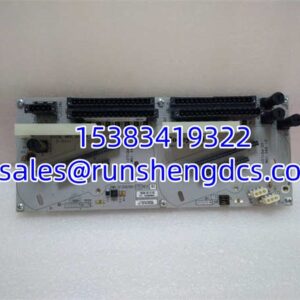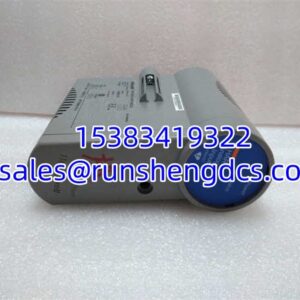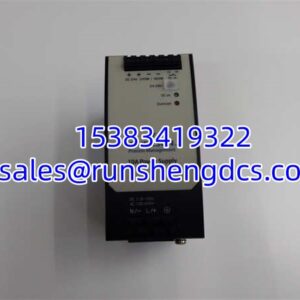

Description
Key Technical Specifications
- Product Model: PFEA113-20
- Order Code: 3BSE028144R0020
- Manufacturer: ABB
- Product Category: Web Tension Controller
- Input Type: Dual-Channel Pulse & Analog
- Dynamic Range: -2.5 x F_nom to +3.5 x F_nom
- Communication: Profibus DP (Max 12 Mbit/s)
- Signal Output: 4-20mA / 0-10V (via PXUB 201)
- Zero Setting Range: ±2.0 x F_nom
- Operating Temp: 0°C to +55°C
- Mounting: DIN Rail
- Protection: IP20
Product Introduction
Web tension isn’t something you can eyeball; a 2% deviation in a paper machine or film line means wrinkles, breaks, or rejected rolls. The ABB PFEA113-20 is the dedicated brain for this job, taking raw signals from load cells and converting them into precise, stable tension control. It’s not a general-purpose PLC; it’s a specialized instrument designed to handle the physics of moving webs, calculating wrap gain, and compensating for inertia in real-time.
Bottom line — it’s a workhorse for continuous process lines. The ABB PFEA113-20 features a dynamic measurement range of -2.5 to +3.5 times the nominal load, giving you massive headroom for threading and transients without saturation. It supports Profibus DP at 12 Mbit/s for seamless DCS integration and includes dual-channel pulse inputs for encoder feedback. If your line is running ABB PFEA113-20 units, don’t try to substitute a generic controller; the internal algorithms for web tension are proprietary and tuned for this hardware.
QA/QC Transparency SOP
- Intake & Origin Verification: We verify the ABB PFEA113-20 order code (3BSE028144R0020) and inspect the PCB for counterfeit markers. Tension controllers are high-value; we check solder quality and component date codes against OEM standards.
- Live Functional Testing: The module is mounted on a test rack with a simulated load cell signal. We verify zero calibration, span adjustment, and response to step changes in tension setpoint.
- Electrical Parameter Tests: Input current draw is measured under load. We verify isolation between signal inputs and power to prevent ground loops that cause tension oscillation.
- Firmware/Config Verification: We read the firmware version and parameter set. The ABB PFEA113-20 is factory reset to ensure no residual customer configuration remains.
- Final QC & Anti-Static Packaging: The unit is cleaned, inspected for physical damage, and packed in an ESD-safe bag with protective foam to prevent connector damage during transit.
Field Engineer Gotchas
Load Cell Mismatch:
- Risk: The must be configured with the exact nominal load (F_nom) of the connected PFCL load cell. Wrong F_nom = wrong tension reading.
- Solution: Check the load cell nameplate. Enter the exact kN rating into the controller parameters. Verify the wiring matches the cable diagram (3BSE028144D0065).
- War Story: Tech replaced a PFCL201C-10kN with a 20kN unit but didn’t update the config. Tension read 50% low, causing slack and web breaks. He blamed the “bad controller.”
PXUB 201 Amplifier Settings:
- Risk: The analog output requires a PXUB 201 insulation amplifier. Incorrect DIP switch settings (S1/S2) on the PXUB will give you 0-10V when you need 4-20mA, or vice versa.
- Solution: Verify the output signal type in the parameters matches the PXUB 201 switch positions.
- Blunt Warning: The controller doesn’t know what’s plugged into the output. It sends the signal; the PXUB conditions it. If the DCS reads garbage, check the PXUB switches first.
Profibus Address Conflicts:
- Risk: The defaults to address 0 or 1. If you plug in a spare without changing the address, you’ll crash the entire Profibus segment.
- Solution: Set the address via the front panel or service tool before connecting to the live network.
- Reality Check: I’ve seen entire lines trip because a tech swapped a tension controller and forgot to change the node ID from 0 to 15.
Application Scenarios
Paper & Pulp Mills:
Reel drums and winders rely on the to maintain constant tension during roll buildup. As the roll diameter grows, the controller adjusts speed references to prevent crushing the inner layers or stretching the outer layers.
Film & Foil Converting:
Slitters and rewinders use for high-speed tension control. The fast response time prevents wrinkles in thin films (e.g., BOPP, PET) where even minor tension fluctuations cause permanent defects.
Textile & Nonwovens:
Spunbond and meltblown lines use to control web stretching and winding. The dual-channel pulse input allows direct encoder feedback for precise speed synchronization between drafting rollers and winders.
Case Study:
A plastic film plant had chronic edge-tear issues on their slitter. Maintenance replaced load cells, motors, and drives. Finally, they pulled the and found the wrap gain parameter was set to 0.8 instead of 1.2 for their specific roll geometry. We shipped a tested replacement with correct factory defaults. Edge tear vanished. Total cost: 4,500. Cost of 3 months of scrap: 180,000.
FAQ
Yes. The is designed for the PFCL201C series. Verify the nominal load (e.g., 10kN, 20kN) matches your application and configure the controller accordingly.
Can I use a PFEA113-65 as a direct replacement?
Generally, yes. The PFEA113-65 (3BSE028144R0065) is a later revision with enhanced diagnostics. Hardware is pin-compatible, but verify your firmware version supports the newer module.
If in stock, same-day shipping. Sourcing a specific revision can take 3-7 days. Always specify your required firmware when requesting a quote.
Does this module support battery-backed RAM?
No. The stores parameters in non-volatile EEPROM. Configuration is retained indefinitely without power.
How do I verify the module is genuinely ABB?
Check the PCB silkscreen for the ABB logo and the 3BSE028144R0020 order code. Counterfeits often have blurry printing. We provide a certificate of authenticity with every unit.
What’s the MTBF for this legacy controller?
ABB doesn’t publish MTBF for discontinued products, but field data suggests 15-20 years for units in climate-controlled environments. Thermal cycling and humidity are the primary killers. Keep your control room at 22°C and 40% RH.
Yes. If you can provide a backup file or send us the failed module (if readable), we can load your configuration and test it before shipping. This reduces your commissioning time to zero.