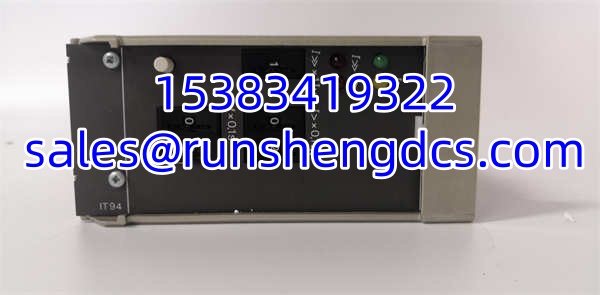

Description
Key Technical Specifications
| Parameter | Specification |
|---|---|
| Manufacturer Part Number | IT94-3 HESG440310R2 HESG112699B |
| Manufacturer | ABB |
| Product Series | ABB Industrial Control System |
| Product Type | Negative Derivative Feedback Controller Module |
| Control Method | Negative derivative feedback control |
| Signal Processing | Digital signal processing (DSP) technology |
| Primary Function | Stabilize control loop output, suppress system lag and instability, reduce noise and interference |
| Compatible Systems | ABB distributed control systems, industrial automation control platforms |
| Application Industries | Power generation, chemical processing, water treatment, pharmaceutical manufacturing |
| Product Status | Legacy / Discontinued — spare/replacement only |
| Condition | Surplus / Refurbished |
Product Introduction
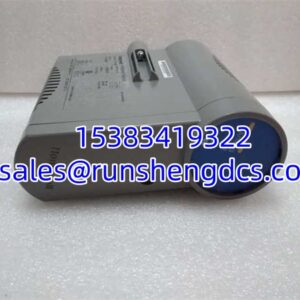
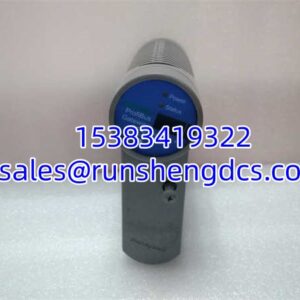
When an ABB distributed control system needs to tame a sluggish or oscillating control loop, the IT94-3 HESG440310R2 HESG112699B is the module that brings stability. This isn’t a generic I/O card — it’s a purpose-built negative derivative feedback controller designed specifically for ABB’s industrial automation architecture, serving as a specialized signal processing module that keeps process variables locked on target.
The IT94-3 module implements negative derivative feedback control, a sophisticated control strategy where the output error signal is inverted and fed back into the controller input. In plain terms: the module continuously compares the actual output signal against the ideal setpoint, calculates the error, and feeds that error signal back into the controller in a way that counteracts instability. This approach is particularly effective at damping out oscillations, reducing overshoot, and eliminating the hunting behavior that plagues poorly tuned control loops.
What sets the IT94-3 apart from standard PID controllers is its focus on derivative feedback. While a conventional PID controller applies proportional, integral, and derivative actions to the error signal, the negative derivative feedback approach specifically targets the rate of change of the output — making it exceptionally good at suppressing rapid fluctuations and stabilizing systems that are prone to lag-induced instability. The module’s digital signal processing architecture allows it to execute these calculations at high speed with high precision, ensuring that the control response is both fast and accurate.
The IT94-3 is designed for integration into ABB’s distributed control system ecosystem, mounting directly into the system backplane and communicating with the main controller and other I/O modules through the system bus. It interfaces with field devices through the system’s terminal blocks, receiving process variable signals and outputting corrected control signals to final control elements like control valves, dampers, and variable frequency drives.
Why it matters: in process control applications — whether it’s maintaining steam drum level in a boiler, controlling pH in a water treatment plant, or regulating pressure in a chemical reactor — an unstable control loop doesn’t just mean poor product quality. It means equipment stress, premature valve and actuator wear, safety risks, and potentially costly process upsets. The IT94-3 module’s negative derivative feedback capability provides an extra layer of stability that standard PID control alone may not achieve, especially in processes with significant lag or dead time. Having a tested spare on the shelf means you can replace a failing module during a planned outage rather than operating with degraded control performance until a replacement can be sourced for a discontinued product.
QA/QC Transparency SOP
Every HESG440310R2 HESG112699B goes through a five-step verification process:
- Intake & Origin Verification: We cross-check the ABB part number labels (, HESG440310R2, HESG112699B) against ABB’s known production records for the industrial control system series. We verify the serial number and revision code to confirm authenticity — counterfeit ABB control modules are a known problem in the surplus market.
- Visual & Mechanical Inspection: We inspect the PCB for burnt components, cracked solder joints, or corrosion. We verify that the backplane connector pins are straight and undamaged. We check all onboard connectors and terminal blocks for corrosion or physical damage. We verify that the module’s mechanical mounting features are intact.
- Power-Up & Self-Test: We install the module in a test ABB control system backplane and apply power. We verify that the module powers up correctly and completes its internal self-test sequence without errors. We verify that all status LEDs indicate normal operation.
- Communication & Functional Verification: We verify system bus communication by confirming the module can communicate with the main controller and other I/O modules in the test rack. We simulate process variable signals and verify that the module’s negative derivative feedback control algorithm processes them correctly, producing stable, damped output signals. We verify that the module responds correctly to setpoint changes and disturbance inputs.
- Final QC & Anti-Static Packaging: After passing all tests, the module is bagged in ESD-safe packaging with a printed test report. No unit ships without a signed-off QC sheet documenting power-up test, self-test results, communication verification, functional testing, and visual inspection.
Field Engineer Gotchas
- Negative Derivative Feedback Is Not a Substitute for Proper PID Tuning: The module’s negative derivative feedback capability is a powerful tool, but it works best when the underlying PID loop is already reasonably well tuned. If your proportional gain is way too high or your integral time is way too short, the negative derivative feedback can only do so much. Always start with a properly tuned base PID loop, then use the ‘s derivative feedback to fine-tune stability.
- Backplane Compatibility Must Be Verified: The module is designed for specific ABB control system backplanes. Not all ABB backplanes are compatible with all module types. Before ordering, verify that your existing system’s backplane slot type and system bus protocol are compatible with the module. A mismatch will result in the module not being recognized by the controller.
- Signal Grounding Is Critical: The module processes analog signals with high precision. Poor signal grounding can introduce noise that the module’s anti-interference circuitry may not fully reject, leading to erratic control behavior. Always verify that signal grounds are properly implemented — single-point grounding for analog signals, separate ground buses for analog and digital circuits.
- Derivative Action Amplifies Noise: While the ‘s negative derivative feedback is designed to stabilize control loops, derivative action inherently amplifies high-frequency noise. If your process variable signal is noisy, consider adding signal filtering (either in the field transmitter or in the controller’s input conditioning) before the signal reaches the module. Otherwise, the derivative action may amplify the noise rather than suppressing instability.
- Not Hot-Swappable Without Procedure: While some ABB control systems support limited hot-swap capability, GE’s official guidance is to follow your plant’s specific procedures. Removing an active control module while the system is operating can cause a bump in the control output, potentially upsetting the process. Always follow proper lockout/tagout procedures and coordinate with operations before removing or replacing the module.
- Firmware/Configuration Backup: Before removing a failed module, document its configuration settings if accessible through the system’s engineering workstation. The replacement module may need to be configured with the same parameters (derivative gain, filter time constant, etc.) to match the existing control strategy.
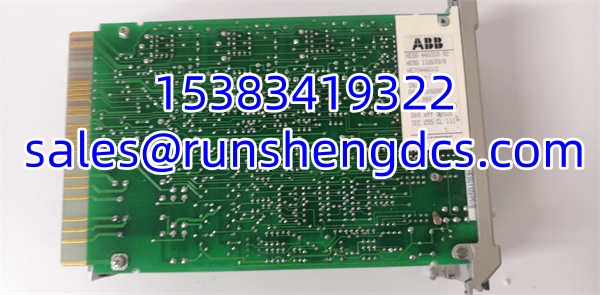
ABB IT94-3 HESG440310R2 HESG112699B
Application Scenarios
- Power generation boiler control: Stabilizing drum level control loops in utility and industrial boilers, where the three-element control strategy (drum level, feedwater flow, steam flow) can be prone to oscillation due to shrink-and-swell effects. The module’s negative derivative feedback helps damp out these oscillations, keeping drum level steady and preventing boiler trips on high or low level.
- Chemical process reactor control: Maintaining stable temperature and pressure in chemical reactors, where exothermic reactions can cause rapid temperature excursions. The module’s fast derivative response helps counteract temperature swings before they become dangerous, protecting both product quality and equipment integrity.
- Water treatment pH control: Stabilizing pH control loops in municipal and industrial water treatment plants, where the highly nonlinear pH curve makes control inherently difficult. The negative derivative feedback helps prevent the hunting behavior common in pH control, reducing chemical consumption and ensuring consistent effluent quality.
- Pharmaceutical process control: Maintaining precise temperature, pressure, and flow control in pharmaceutical manufacturing processes where product quality depends on tight process variable control. The module’s high-precision signal processing and strong anti-interference performance ensure that control loops remain stable even in electrically noisy manufacturing environments.
- Spare parts for aging ABB control system installations: Many ABB distributed control system installations are 15–25 years old. Control modules like the can fail due to component aging, capacitor drying, connector wear, or PCB trace corrosion. Since the product is legacy/discontinued, having a tested spare on the shelf is essential for minimizing unplanned outage time.
FAQ
Q: What does “negative derivative feedback” mean in practical terms?
A: In a control loop, derivative action responds to the rate of change of the process variable. Negative derivative feedback takes the derivative of the output signal, inverts it, and feeds it back into the controller input. This has the effect of opposing rapid changes in the output — if the output is rising too fast, the negative derivative feedback pushes it back down, and vice versa. The result is a more damped, stable response with less overshoot and oscillation.
A: The HESG440310R2 HESG112699B is a legacy ABB control module designed for older ABB distributed control system platforms. It is not directly compatible with the newer AC 800M series, which uses a different module architecture and backplane protocol. Verify your specific system’s series and backplane compatibility before ordering.
A: The is not a standalone PID controller — it’s a specialized module that implements negative derivative feedback as part of a broader control system. It works in conjunction with the main controller and other I/O modules in the ABB distributed control system. It enhances the stability of control loops but does not replace the primary PID control function.
A: The most common failure modes for legacy ABB control modules like the include capacitor aging (electrolytic capacitors drying out over time), backplane connector pin corrosion or wear from repeated insertion/removal, and PCB trace corrosion in humid environments. Power supply component failure is also a known issue on older modules.
Q: Is this product still available new from ABB?
A: No, the is a legacy/discontinued product. It is only available through surplus suppliers and aftermarket channels. For new installations, ABB has newer control system platforms (AC 800M, System 800xA) that should be used instead. The is suitable for repair, reuse, and replacement of existing ABB control system installations only.
A: Configuration of the module’s control parameters (derivative gain, filter time constant, etc.) is done through the ABB control system’s engineering workstation using the system’s configuration software. Only qualified control engineers familiar with the ABB system and the specific process should modify these parameters, as incorrect settings can destabilize the control loop.