
Description
Key Technical Specifications
| Parameter | Detail |
|---|---|
| Part Number | GJR5253100R0278 |
| Product Name | 07KT98 (H2 revision) |
| Manufacturer | ABB |
| Product Family | Advant Controller 31 (AC31) |
| Module Type | Basic module / PLC CPU with Ethernet |
| Power Supply | 24 V DC |
| Digital Inputs | 24× 24 V DC (group-isolated) |
| Digital Outputs | 16× 24 V DC transistor outputs (group-isolated) |
| Analog Inputs | 8× configurable: 0–10 V, 0–5 V, ±10 V, ±5 V, 0–20 mA, 4–20 mA, Pt100 (2/3-wire), differential; some channels usable as DI |
| Analog Outputs | 4× configurable: 0–10 V, ±10 V, 0–20 mA, 4–20 mA |
| Communication | 1× Ethernet TCP/IP; 2× serial (COM1/COM2) usable as Modbus, programming, or free-programmable interfaces |
| System Bus | CS31 system bus for AC31 I/O expansion |
| Memory | ~1 MB user program + 1 MB user data; RETAIN and Flash EPROM areas |
| Storage Medium | SmartMedia Card for OS, user program, and data |
| High-Speed Counter | Integrated, up to 50 kHz |
| Real-Time Clock | Integrated hardware RTC |
| Operating Temperature | 0 … +55 °C (typical AC31 spec; confirm against nameplate) |
| Storage Temperature | −25 … +75 °C |
| Protection Rating | IP20 |
| Approx. Weight | ~1.62 kg |
Product Introduction
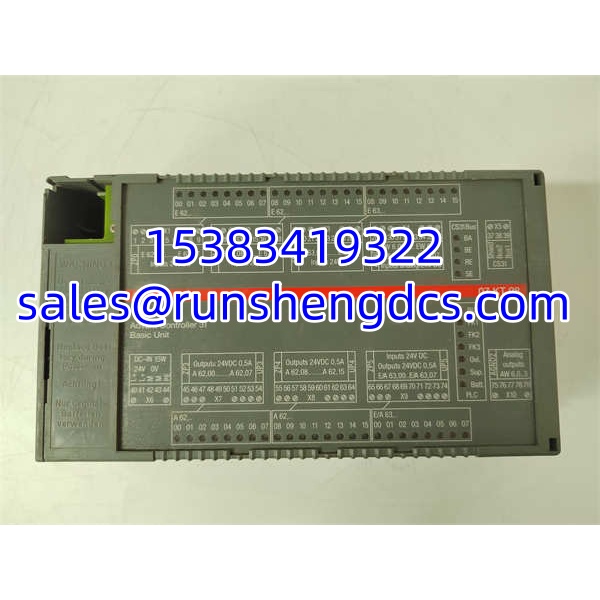
The ABB 07KT98 H2 (GJR5253100R0278) is a high-performance basic module — effectively the CPU — for the ABB Advant Controller 31 (AC31) PLC platform. It is also referenced in the field as 07KT98 WT98, where WT98 indicates the Ethernet-enabled variant of the 07KT98 family.
This module consolidates control, communication, and I/O in a single unit. It executes the user control program, manages local digital and analog I/O, communicates over Ethernet TCP/IP and serial Modbus, and coordinates remote I/O or field devices via the CS31 system bus. The integrated SmartMedia Card holds the operating system, user program, and data, while the hardware real-time clock supports time-stamped events and batch records.
With 24 digital inputs, 16 digital outputs, 8 analog inputs, and 4 analog outputs built in, the 07KT98 can handle small-to-medium standalone applications without additional I/O modules. For larger systems, it acts as the master controller for expanded AC31 racks and CS31 remote stations. The 50 kHz high-speed counter supports encoder, pulse counting, and speed measurement tasks.
QA/QC Transparency SOP
- Intake & Part-Number Verification — Confirm full marking: 07KT98, hardware revision H2, and order number GJR5253100R0278. Inspect the housing, terminal blocks, Ethernet port, serial ports, CS31 connector, and SmartMedia Card slot for physical damage.
- Power-Up & POST — Apply 24 V DC. Verify RUN/ERR LEDs, boot sequence, and absence of fault codes. Confirm the module reaches a stable RUN state.
- Communication Check — Verify Ethernet link and IP accessibility. Test serial COM1/COM2 for Modbus or programming connectivity. Confirm CS31 bus communication if remote I/O is available.
- I/O Functional Test — Stimulate each DI channel and verify status. Toggle each DO and confirm switching. Apply known AI signals (voltage/current/Pt100) and verify readings. Drive AO channels and measure output.
- Memory & RTC Validation — Verify SmartMedia Card recognition, program load/upload capability, and RETAIN data retention. Check that the RTC maintains time after a power cycle.
- Final QC & Packaging — Record firmware version and test results. Factory-reset unless a specific project is requested. Pack in ESD-safe, anti-static packaging with photo documentation and test report.
Field Engineer Gotchas
- H2 revision matters. The H2 hardware revision may differ in firmware compatibility, connector layout, or internal components from H3/H4/H5 units. Always match the revision or confirm cross-compatibility with ABB documentation before substitution.
- WT98 = Ethernet variant. GJR5253100R0278 corresponds to the Ethernet-capable 07KT98 (WT98). Non-Ethernet 07KT98 variants will not provide the same network interface.
- Not an AC500 or AC800M module. The 07KT98 belongs to the /Advant Controller 31 family. It cannot be swapped into AC500, AC800M, or AC800PEC racks.
- SmartMedia Card is critical. The OS and user program reside on the SmartMedia Card. A missing, corrupted, or incompatible card will prevent the CPU from running. Keep a verified backup card on site.
- CS31 bus addressing. Remote I/O on the bus requires correct station addresses and termination. Misaddressed stations cause intermittent I/O faults that look like CPU problems.
- Analog channel configuration. AI channels are configurable for voltage, current, or Pt100. Incorrect channel configuration produces stable but wrong readings — always verify per-channel scaling.
- Legacy platform. is end-of-life. Official firmware updates, manuals, and technical support may be limited. Archive the original project file, parameter set, and SmartMedia Card image before any maintenance.
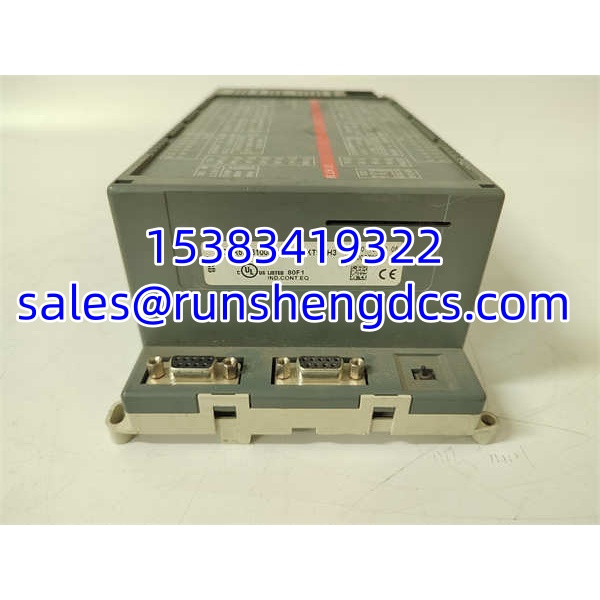
ABB 07KT98 H2 GJR5253100R0278
Application Scenarios
- Standalone machine controller. A packaging or material-handling machine uses the 07KT98 as the sole PLC, leveraging its built-in 24 DI / 16 DO for sensors and actuators, and 8 AI / 4 AO for pressure, temperature, and speed control.
- Legacy plant maintenance. An installed system suffers a CPU failure. The GJR5253100R0278 H2 is sourced as a like-for-like replacement, and the existing SmartMedia Card project is loaded without re-engineering.
- Process skid with Modbus devices. The serial ports communicate with Modbus instruments (flow meters, analyzers, drives), while Ethernet provides HMI/SCADA connectivity. remote I/O handles field devices outside the main cabinet.
- Utility or infrastructure retrofit. An older water, HVAC, or energy-management system retains its control logic but gains Ethernet connectivity through the 07KT98 WT98, enabling remote monitoring without replacing the entire control architecture.
FAQ
Q: What is the difference between 07KT98 and WT98?
A: is commonly used to identify the Ethernet-enabled variant of the 07KT98 basic module. GJR5253100R0278 corresponds to this Ethernet-capable version.
A: Possibly, but the project, communication configuration, and IP addressing must be verified. Ethernet-enabled and non-Ethernet variants may differ in firmware behavior and slot/parameter requirements.
Q: Does it support Modbus?
A: Yes. The two serial ports (COM1/COM2) can operate as Modbus interfaces, and Ethernet TCP/IP is also available on this variant.
Q: What memory does it use?
A: It uses a SmartMedia Card for the operating system, user program, and data, with approximately 1 MB user program and 1 MB user data capacity.
Q: Is this module still available new from ABB?
A: is a legacy platform. Most units are now sourced as new surplus, refurbished, or tested used stock.
Q: Can I expand I/O beyond the built-in channels?
A: Yes. Additional I/O modules can be added locally or via the system bus for remote I/O expansion.
Q: How do I back up the program?
A: Use the programming tool to upload the project from the CPU/SmartMedia Card. Also keep a physical backup of the SmartMedia Card and document the firmware version, IP address, and serial port settings.